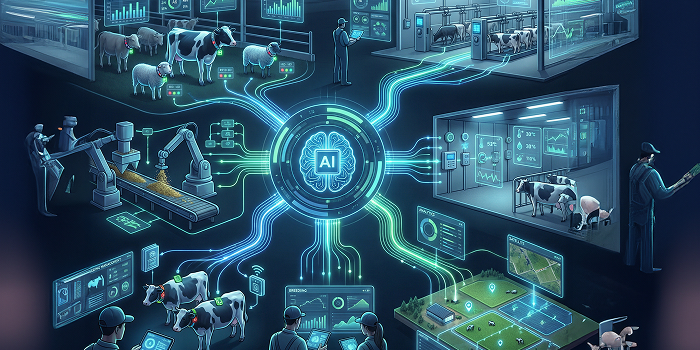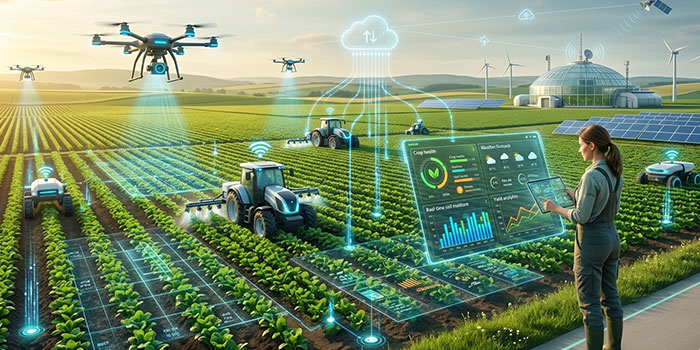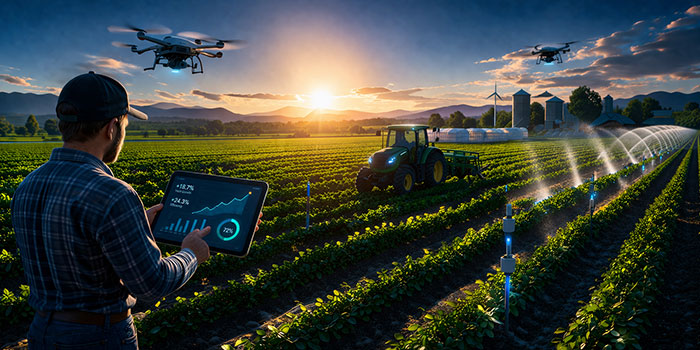
Aquaculture management software is a digital system used to manage farm production data and activities. Depending on its capabilities, it can support feeding, stocking, biomass, mortality, water quality, inventory, costs, harvesting, traceability, and reporting.
Benefits of Aquaculture Management Software? A Chetu Guide for Fish Farms
Vipin Panwar – Director of Operations | October 15, 2026
Key Takeaways:
- Aquaculture management software connects production data, bringing feeding, stocking, biomass, mortality, water quality, inventory, costs, harvesting, and traceability records into a centralized fish farm management system.
- Its use comes from linking those records: Feed data checked against biomass and weight gain gives you FCR, and health records checked against water readings help you investigate changes in production.
- The right product depends on the farm: A small farm may only need production tracking, costs and reports. A multi-site farm, hatchery or exporter will probably need sensor integrations, batch traceability and custom workflows.
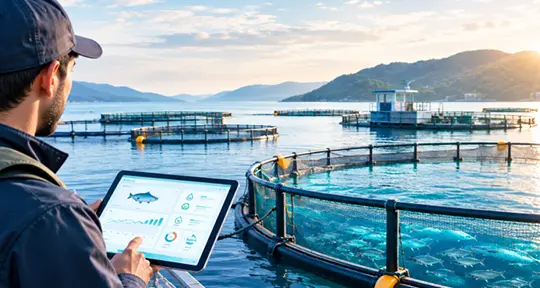
Aquaculture already makes up over fifty percent of the world for production of aquatic animals and the proportion is expected to increase. The OECD-FAO Agricultural Outlook 2026–2035 projects aquaculture to reach 56% of global fisheries and aquaculture production by 2035, up from 53% in the base period.
In fish farms this growth expands information for feeding stocking biomass mortality water conditions inventory harvesting. When information is spread through spreadsheets, manual logs, sensors, and different systems, understanding connection between day-to-day operations and production results become complex.
Custom aquaculture software platform puts them in one place so every department works from the same numbers. can also connect data across departments, providing farm managers with a more detailed understanding of business and production performance.
What Is Aquaculture Management Software?
It is a centralised digital platform that manages all farm data, including fish farming, feeding, stocking, biomass, mortality, water quality, inventory, and traceability. All data is logged in one system. It can replace spreadsheets, paper logs, and disconnected sensor feeds with a single source of truth.
The key is that there is not one derivative of aquaculture software, with the same set of features applied to all products. Requirements may vary between a pond based fish farm, a recirculating aquaculture system, a hatchery, and a multi-site commercial operation.
Aquaculture Software vs. Fish Farming Software vs. Fish Farm Management System
The terms below overlap, but their typical scope can differ.
| Term | Typical scope | Examples of what it may manage |
|---|---|---|
| Aquaculture software | Broadest category for aquatic farming operations | Fish, shrimp, shellfish, stocking, feeding, water quality, production, inventory |
| Fish farming software | Software focused specifically on fish production | Fish populations, feeding, growth, mortality, biomass, harvests |
| Fish farm management system | A centralized system used to manage day-to-day farm operations and data | Production records, feed, inventory, costs, workforce activity, reporting, traceability |
| Aquaculture management platform | A broader connected environment that can bring operational systems and data sources together | Farm management, analytics, sensors, integrations, dashboards, reporting |
No single software provider has a standard nomenclature, so the feature set is more relevant than the label. When deciding, which fish farm software to procure, farm operators should examine what can it do to track, integrate, report. and automate.
The production data that makes the software useful
Many of the operational measurements are found consistently across all aspects of an aquaculture farm, as they help managers monitor how well a production cycle is proceeding.
- Biomass: The is an estimate of the number of fish or other aquatic animal in a production unit. It is used in forecasting how much feed is necessary for a certain amount of growth.
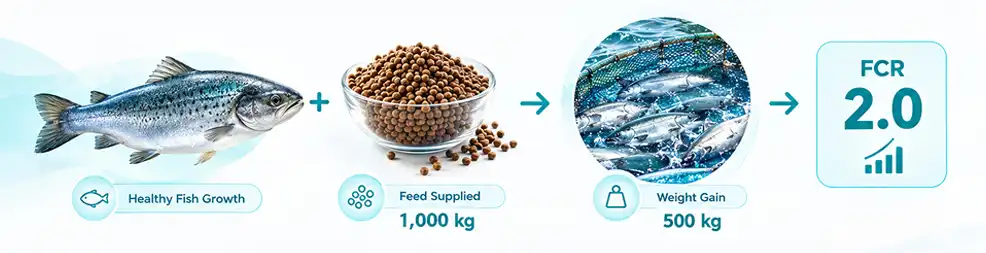
- Feed conversion ratio (FCR): It compares the amount of feed supplied with the weight gained by the fish:
FCR=Feed supplied ÷ Weight gain
As an example, if the input of a production unit is 1,000 kg Of feed and output through growth is 500 kg the FCR will be equal to 2. 0. FCR is lower means that more feed conversion efficiency; however, the factors affecting FCR are species type, feed sources, environmental conditions and calculating method of measure. FAO highlights feed management and FCR as indicators to monitor in aquaculture.
![he production data that makes the software useful]()
- COGS, or cost of goods sold, is defined as direct costs related to the production of goods sold. Farm management personnel at an example fish farm are able to record the production and costs incurred for individual batches or production cycles, which the system links so that management can directly observe which batch has cost them most of their money.
They matter because software is more useful when separate records can be connected. When the data are related to biomass, gain and cost of production, feed intake is more important.
What Can Aquaculture Farm Management Technology Help You Manage?
Its everyday practicality relies on the farm's ongoing operational issues.
The farm teams need to know about fresh feed deliveries to the farm, which fish are being harvested from a production unit, if the mortality has increased and the value of a production cycle. When that data is stored on different spreadsheets, or hand written records, it complicates comparisons.
An aquaculture management platform to manage aquaculture could gather all these records and allow an easier consultation.
Feed and
production costs
Fish health and
mortality
Traceability from
stocking to harvests
1. Feed and production costs
Feed is a common input requiring farmers to keep close watch on. The amount of feed bought, stored, issued, and consumed needs to be logged for a more detailed production history.
Management software for a fish farm can link feed input to each pond tank cage, batch, or production cycle. If they are paired with biomass and growth data, managers can calculate feed conversion ratio (FCR) and analyze trends in feed efficiency.
Tools provided by the software will not necessarily lead to a reduction in feed costs. The software is designed to offer the manager more uniform data to use in judging the value of food management and production.
2. Fish health and mortality
Mortality is another important production record. Sudden mortality may be cause for investigation, in particular if there are coinciding changes in environmental conditions or other management systems.
Fish farm software allows the mortality to be recorded by date, production unit species batch or some other code. If the system is able to input water-quality data then this can be used to compare with the health history rather than having to go through each record independently.
The application does not diagnose disease. It offers a systematic record, which may support farm personnel to recognise a change and to investigate it with suitable aquaculture or veterinary assistance.
3. Traceability from stocking to harvest
Traceability is a means of tracking for farms that need to keep a record of the animal's origin, their rearing environment, production events, and destination.
FAO highlights traceability as an aspect of aquaculture value chain management, and explains the use of critical tracking events and key data elements to trace products along the chain.
An integrated aquaculture farm management system can record for stocking transfer treatments, feeding, mortality, harvesting, and other production related events. Establishing a digital production history can be used for internal record keeping and applicable regulatory and customer requirements.
Specific records needed vary based on species, the market destination, certification, and rules in force.
What Features Should Fish Farm Software Include?
Not every fish farm has the same feature checklist. The most appropriate fish farm management system will be different for each farm and will depend on the way they raise, monitor, move, and harvest the stock.
For farms with more demanding needs, these features can even be integrated together to make the core of a bespoke package.
- Feed inventory and consumption tracking: The system can track feed purchases, feed types, inventory levels, quantities issued, feeding schedules, and consumption. Linking this data with biomass can enable FCR calculations, and assist in comparison analysis of feed utilization across production units.
- Stock, batch, and population tracking: Fish can be transferred from facility to facility during a production cycle. A management system will keep a record of stocking, transfers, sampling, grading, mortalities, and harvests.
For farms that use tags or another identifying method, the system can read ID tags and relate records to individual animals or groups. - Water-quality and sensor integration: Water-quality needs differ based on species and culture environment. Some farm organizations may choose to track temperature, dissolved oxygen, pH, salinity, or other measurements; custom aquaculture software platform can add IoT enabled sensors and data sources to log measurements to the appropriate production unit.
- Dashboards, permissions, and reporting: A farm manager takes only different information from a field worker. Role based dashboards are able to show financial, inventory, feed, and production information to authorized users and provide operational staff with access to records needed for their job.
Reporting can also bring together data from multiple ponds, tanks, cages, batches, or sites, by given how the facility is organized.
How Does Aquaculture System Improve Feed Management and FCR?
FCR is one of the clearest examples of why connected farm data matters.
If a farm records feed quantities but does not consistently record biomass and weight gain, it has limited information for evaluating feed conversion. When those records are connected, managers can calculate FCR for a defined production period and compare results across production units or cycles.
- Using FCR to valuate feed efficiency
FCR is calculated by dividing feed supplied by the corresponding weight gain.
A result of 1. 5 indicates that 1. 5 units of feed were given to produce 1 unit of weight during the period of measurement. Yet this figure shouldn't be taken as a goal for all because the 'correct' FCR is depended on all the time factors involved, including type of farmed species feed systems, environment, and management.
FAO also points out that the feed conversion rate is influenced by other factors, like quality of the feed, feeding practices, quality of water, and naturally available food.
Because of this, an aquaculture management platform should use FCR as a metric to analyze, not just a number to optimize at all cost.
- Using software to support feeding decisions
Feed details can be captured in software to manage feeding schedules, record amounts fed, link feedings to biomass inputs and compare planned against actual consumption.
For instance, if one pond is consuming more feed than predicted, the manager can inspect its biomass records, growth data, environmental data, and feeding history.
That does not imply the software is able to automatically recognize the origin. It gives the farm team a connected set of records from which the cause can be investigated.
Which Aquaculture Operations Can Benefit From Management Software?
The software requirements change with the way a farm operates. A useful starting point is to match the platform to the farm's operational complexity.
| Operation | Common management needs | Useful software capabilities |
|---|---|---|
| Small or independent fish farms | Feed, stock, mortality, costs, harvests | Basic production records, inventory, mobile access, reporting |
| Multi-site farms | Consolidating information across locations | Centralized dashboards, standardized records, permissions, analytics |
| Hatcheries | Broodstock, spawning, batches, transfers, survival | Batch tracking, breeding records, population analytics, production history |
| Sensor-enabled farms | Continuous environmental monitoring | IoT and sensor integrations, alerts, historical data |
| Export-focused operations | Production history and traceability | Batch records, movement history, documentation, audit trails |
| Integrated aquaculture businesses | Farm operations connected with other business systems | APIs, ERP/accounting integrations, centralized reporting |
The key question is not simply whether a farm is large or small. It is how much operational information the farm needs to coordinate and how many systems are involved.
A small operation with straightforward workflows may be well served by an existing product. But a smaller farm with specialized equipment or reporting requirements could still have a reason to consider custom development.
Should You Choose Custom Aquaculture Software or an Off-the-Shelf Platform?
An existing product is a sensible choice when its features already cover your workflows. Custom development makes sense when you need workflows, integrations or reports that existing products can't provide without major compromises.
| Requirement | Off-the-shelf platform | Custom aquaculture software |
|---|---|---|
| Basic production tracking | Usually suitable if supported | Can be tailored to specific workflows |
| Feed and inventory management | Depends on available modules | Can follow existing farm processes |
| Sensor integration | Limited to supported hardware or APIs | Can be developed around required interfaces |
| Multi-site management | Depends on platform architecture | Can be designed around the farm's structure |
| Specialized reports | Usually limited to available reports | Reports can be built around defined requirements |
| Integration with existing systems | Depends on available connectors/APIs | Integrations can be developed for required systems |
| Initial implementation | Typically faster | Requires planning and development |
| Cost predictability | Licensing is generally easier to estimate | Depends on scope, integrations, and complexity (no license needed with Chetu) |
If an existing product covers your workflows and integrations, custom development adds complexity you don't need. If your processes or hardware fall outside what a product supports, custom software gives you more control.
How Much Does Aquaculture Management Software Cost?
There is no single price. Scope ranges from a basic production log to a multi-site platform connected to sensors, mobile apps, analytics and other business systems.
Development or licensing costs can vary based on:
- Number of production sites and users
- Feed, inventory, and production modules
- Batch or individual fish tracking
- Mobile application requirements
- Sensor and IoT integrations
- Analytics and reporting
- Third-party system integrations
- User roles and access controls
- Cloud deployment and infrastructure
- Maintenance and ongoing support
Licensing is usually more practical when your workflows already match the product. Custom development covers design, build, integration, testing, deployment and maintenance. It takes more planning up front and gives you control over workflows, data structures, integrations and later changes. The fair comparison is the total cost of meeting your requirements, not a license fee set against a development estimate.
Why Choose Chetu for Aquaculture Management Software Development?
Chetu develops custom software around specific operational requirements, including production management, mobile applications, dashboards, system integrations, IoT connectivity, analytics, and reporting.
Chetu can also integrate the platform with ERP and accounting systems, so production, cost, and inventory data stays consistent across the business.
For an aquaculture operation, that can mean developing a centralized aquaculture management platform that connects farm records with the systems and equipment already used by the business.
Potential development areas include:
- Fish farm management systems for production and inventory
- Feed tracking and FCR reporting
- Stock, batch, biomass, and mortality management
- Water-quality and sensor integrations
- Mobile applications for farm teams
- Role-based dashboards and access controls
- APIs and integration with existing business systems
- Production analytics and reporting
- Traceability and digital record management
The appropriate architecture depends on the farm's species, production method, existing technology, number of sites, users, and reporting requirements.
Frequently Asked Questions
Aquaculture software is a broader category that can support different types of aquatic farming. Fish farm management software is generally focused on fish production. The terms overlap, so the actual features, integrations, and supported production methods are more important than the product name.
It can help farm teams track feed, inventory, production, mortality, and other operating data in a centralized system. Connecting feed consumption with biomass and weight gain also makes FCR easier to calculate and monitor. The software supports better record keeping and analysis; it does not guarantee a specific cost reduction.
Custom software can be developed to integrate with compatible sensors, APIs, databases, and other systems. The approach depends on the hardware, available interfaces, communication protocols, and the data the farm needs to collect.
Custom aquaculture software can be a better fit for large operations with complex workflows, multiple sites, specialized equipment, or unique integration needs. An off-the-shelf platform works well when its existing features already meet those requirements.
There is no standard price. Cost depends on the required modules, number of users and sites, integrations, mobile functionality, sensor connectivity, reporting, security, deployment, and ongoing support. A reliable estimate requires defining those requirements first.
Disclaimer:
This content has been made available for information purposes only. Views and opinions expressed in this content are those of the individual author only and do not necessarily represent the opinions and views of Chetu. Chetu, and its representatives, make no representation or warranty of any kind, express or implied, regarding the accuracy, adequacy, validity, reliability, availability, or completeness of any information of this content. Under no circumstances shall Chetu, or its representatives, have any liability to you or any loss or damage of any kind incurred as a result of the use of this content or reliance on any information provided in this content. Your use of this website and your reliance on any information on this content is solely at your own risk.
About Chetu:
Founded in 2000, Chetu empowers businesses with AI and digital transformation solutions, supporting startups, SMBs, and Fortune 5000 companies. We deliver end-to-end software solutions backed by global digital intelligence and industry expertise. Our customized software delivery model and one-stop-shop approach span the full technology spectrum. Headquartered in Sunrise, Florida, Chetu operates 13 locations across the U.S., Europe, and Asia.
See more at: Chetu Blogs
Share


Limited Time Offer for a Free E-Book

Suggested
Reading
Read our blogs on automation strategies, technology and business solutions.