Thank you!
Your blog has been successfully shared.


Let's Talk !  954 342 5676
  +44 137 243 2466
Anshu Raj - Director of Operations | June 26, 2026
L'Oréal isn't just the world's largest beauty company it's one of the most disciplined technology investors in consumer retail. Across 35+ brands including Maybelline, Kiehl's, and Lancôme, L'Oréal have consistently moved early on digital. In 2014, when most beauty brands were still debating mobile strategy, it launched Makeup Genius; an AR try-on app that prefigured everything that followed. A decade later, it has done it again.
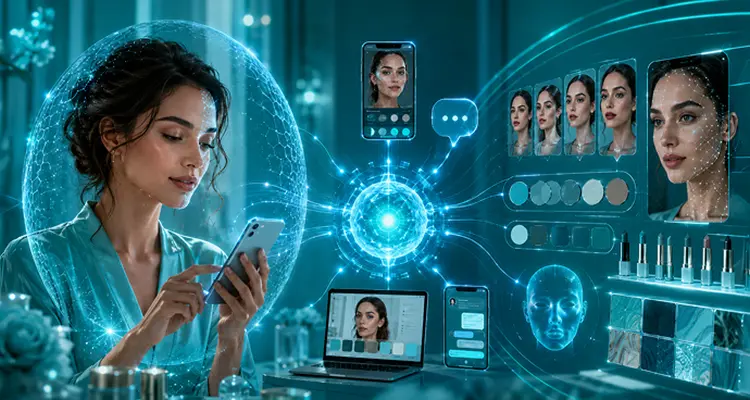
Beauty Genius is L'Oréal Paris's AI beauty assistant, and it is specifically described as the first beauty assistant built on Agentic AI. Protected by more than ten patents and deployed in partnership with Meta on WhatsApp, it represents what enterprise-grade AI customer experience solutions look like in production: not a chatbot bolted onto a product page, but a layered diagnostic, conversational, and memory-driven system that guides consumers from confusion to conversion.
Let's decode that architecture, extract the lessons that transfer to other brands, and outline what it takes to build a comparable system.
The problem Beauty Genius was built to solve is both specific and commercially significant. Seventy percent of consumers report feeling overwhelmed by the volume of beauty choices available to them. Confronted with hundreds of foundation shades, competing serum claims, and contradictory social media advice, most shoppers do one of two things: walk away empty-handed or purchase the wrong product and return it.
That return cycle points to a deeper structural problem in e-commerce: beauty is an inherently tactile and personal category, and without the ability to experience a product before committing, online conversion has consistently trailed in-store performance. Some of the most purchase-relevant consumer questions — around hair thinning, inflammatory acne, and post-procedure skin recovery — are too intimate for a public forum and too sensitive for a store associate exchange.
The competitive pressure made this urgent. Beauty's price-driven growth era is ending — much of the 7% annual growth from 2022–2024 came from price hikes, not real demand. Even top players are split: L'Oréal grew 4% in 2025 while Estée Lauder declined 8% as per L'Oréal finance and EL reports. The independent brand segment has also struggled, with revenue weakening at a 3.9% CAGR since 2020. The real threat is hyper-experimental consumers who try new brands constantly but don't stay loyal. The strategic response required a shift from "beauty for all" to "beauty for each" — AI personalization in retail that turns trial into retention.
AI Skin Analysis
Technology
Generative AI
for Retail
Agentic AI
Solutions
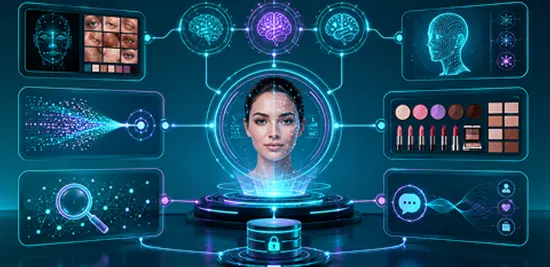
Beauty Genius is best understood as a 360-degree beauty retail AI solution: it diagnoses, recommends, educates, and simulates outcomes. The technical architecture has three distinct layers, each solving a different job.
Layer 1 — AI skin analysis technology handles the first-party signal problem. Using a high-quality selfie, the system analyzes more than ten skin parameters — tone, texture, hydration, visible concerns — against a skin atlas built from 150,000 dermatologist annotations. It's a clinical-grade classification system that personalizes everything downstream.
Layer 2 — Generative AI for retail converts that diagnostic signal into conversation. Drawing on a proprietary knowledge base spanning hair care, hair color, makeup, and skin care — including clinical studies, formulation data, and ingredient interactions — the system generates tailored guidance through natural dialogue. L'Oréal built a proprietary chain of reasoning with semantic filters and intent detection to keep responses accurate, on-brand, and commercially relevant.
Layer 3 — Agentic AI solutions introduce persistence. For users with accounts, Beauty Genius remembers conversation history across sessions, tracks preferences, and provides proactive guidance toward beauty goals over time. It is a goal-driven assistant that compounds value the more a consumer engages with it.
Beneath all three layers sits a commerce integration architecture: over 750 L'Oréal Paris products, a virtual try-on AI system trained on more than 6,000 inclusive images and tested across 10,000 products in 50 countries, and direct hand-off pathways to purchase and customer service. The system launched on web, then expanded to WhatsApp via a Meta partnership — without rebuilding the core engine. The underlying tech stack spans generative AI, augmented reality, computer vision in retail, color science, and multiple LLMs running in concert. It is not a single model. It is an orchestrated system.
Beauty Genius has generated over 1.1 million conversations in the US alone. L'Oréal credits it with measurable increases in sales conversion rates and average basket value. The broader AR try-on tooling has also reduced return rates by letting consumers validate shade and texture fit before purchasing.
The brand recognition followed: L'Oréal was named Fortune's Most Innovative Company in Europe, collected multiple 2025 CES innovation awards, and earned recognition at Cannes Lions. The WhatsApp rollout signals that the core AI customer engagement platform has proven durable enough to scale across channels without significant re-engineering.
L'Oréal's revenues grew from €25.8 billion in 2016 to €43.5 billion in 2024 — approximately 68.5% growth — with 5.1% growth in 2024 outperforming the global beauty market. Beauty Genius should be read as directional evidence, not a guaranteed formula. What it demonstrates is that well-architected AI in the beauty industry can defend and extend market share in a category where personalization is the battleground.
Several principles transfer directly to any beauty or retail brand considering a similar investment.
Personalization has become a baseline expectation, not a differentiator. The question is no longer whether to personalize, but how fast.
AI unlocks commercially valuable conversations no other channel can. The private, judgment-free nature of an AI beauty assistant makes it uniquely effective for sensitive topics — skin conditions, hair loss, post-treatment routines.
A layered architecture outperforms single-model chatbots. Diagnostics, generation, and agentic memory each require different model types, training data, and success metrics. Collapsing all three into one prompt is the most common and costly shortcut.
Proprietary data is the real moat. L'Oréal's advantage isn't access to any particular foundation model — every brand has that. The advantage is decades of clinical annotations, formulation knowledge, and inclusive image data no competitor can replicate quickly.
Multi-channel deployment compounds reach. Core AI personalization in retail designed for portability pays dividends at scale — without a rebuild every time a new channel becomes relevant.
Commerce outcomes, not engagement metrics, are the right KPIs. Conversion rate lift, basket size, and return rate reduction justify investment. Conversation volume is vanity.
Inclusivity in training data is both an ethical requirement and a commercial one. A diagnostic system that performs poorly on darker skin tones actively fails the consumers most underserved by legacy beauty retail.
The technical requirements for an AI beauty assistant development project are well-defined: a multi-LLM architecture for diagnostics, conversation, and agentic reasoning; a computer vision pipeline for selfie-based skin analysis; color science calibration for accurate AR beauty tech try-on across diverse skin tones; inclusive training datasets; and a semantic search and intent detection layer. Persistent memory architecture tied to user accounts is required for the agentic layer to function meaningfully.
Compliance cannot be retrofitted. GDPR, CCPA, and India's PDPB all require consent flows, data minimization, and regional storage controls designed in from day one.
Organizational readiness matters as much as the tech. Executive buy-in for a multi-quarter retail AI implementation is non-negotiable. Cross-functional input from product teams, domain experts, legal, and marketing is essential. The product catalog must also be AI-ready — complete attributes, ingredient tagging, and shade metadata are prerequisites, not afterthoughts.
The phased rollout is straightforward: one high-value diagnostic use case first, one channel first, then generative capabilities, agentic memory, and multi-channel expansion. Each phase generates the signal that de-risks the next.
The gap for most mid-market and enterprise beauty brands isn't ambition — it's engineering capacity. L'Oréal built Beauty Genius with a large in-house AI organization. Most brands don't have that bench and shouldn't try to build from scratch before proving the model.
Chetu's retail AI solutions serve as the execution bridge for that gap. With 26+ years of experience, 2,800+ developers, and 7,000+ clients, Chetu's custom AI development practice maps to every technical layer this initiative requires: custom AI and ML model development; computer vision and AR integration for selfie analysis and virtual try-on; generative AI for retail including LLM orchestration and chain-of-reasoning design; agentic AI solutions with persistent memory; data engineering for inclusive and compliant training datasets; systems integration across product catalogs, e-commerce, CRM, and POS; and privacy-by-design architecture for biometric data.
The delivery model is built around Chetu's HyperWeave AI Framework — pilot-first, quick wins before scaling. Chetu's AI consulting and roadmapping practice ensures every phase is scoped to your existing stack, compliance obligations, and commercial timeline.
If you're exploring how to build an AI beauty assistant for your brand, Chetu offers a free consultation to scope the build. The architecture is proven. The business case is documented. The question is how fast your brand moves.
Disclaimer:
This content has been made available for information purposes only. Views and opinions expressed in this content are those of the individual author only and do not necessarily represent the opinions and views of Chetu. Chetu, and its representatives, make no representation or warranty of any kind, express or implied, regarding the accuracy, adequacy, validity, reliability, availability, or completeness of any information of this content. Under no circumstances shall Chetu, or its representatives, have any liability to you or any loss or damage of any kind incurred as a result of the use of this content or reliance on any information provided in this content. Your use of this website and your reliance on any information on this content is solely at your own risk.
About Chetu:
Founded in 2000, Chetu empowers businesses with AI and digital transformation solutions, supporting startups, SMBs, and Fortune 5000 companies. We deliver end-to-end software solutions backed by global digital intelligence and industry expertise. Our customized software delivery model and one-stop-shop approach span the full technology spectrum. Headquartered in Sunrise, Florida, Chetu operates 13 locations across the U.S., Europe, and Asia.
See more at: Chetu Blogs
Share


Limited Time Offer for a Free E-Book
Privacy Policy | Legal Policy | Careers | Sitemap | Referral | Contact Us
Copyright © 2000- 2026 Chetu Inc. All Rights Reserved.