Thank you!
Your blog has been successfully shared.


Let's Talk !  954 342 5676
  +44 137 243 2466
Deepak Borole – Director of Operations | February 9, 2026
Buying tickets shouldn’t feel like a gamble. But if you’ve ever refreshed a page endlessly, only to see tickets vanish in seconds and reappear at triple the price, you know the frustration.
That’s the problem NFT ticketing is quietly fixing. Not with hype. Not with buzzwords. But with structure. Control. And transparency that didn’t exist before.
NFT ticketing uses blockchain-backed tokens to change how tickets are issued, resold, verified, and remembered. And while the idea still sounds futuristic to some, the mechanics are already solving very real problems for event organizers and fans alike.
Non-fungible tokens, or NFTs, are fundamentally misunderstood. The world’s first exposure to them was through the simple and surface-level concept of a profile picture. Many did not understand why others would spend a substantial amount of money to own an image that could be a screenshot or a bitcoin. So people saw this as a fad.
And honestly? That reaction made sense. In time, fads fade away. As a result, according to a study by Investment Monitor, the NFT market crashed by a staggering 97%. So what’s the point of NFTs? Here’s the thing. The value was never just the image.
The real strength lies in how NFTs are created, or minted, using blockchain technology. That process makes them programmable, traceable, and enforceable. And that’s exactly what the ticketing industry has been missing.
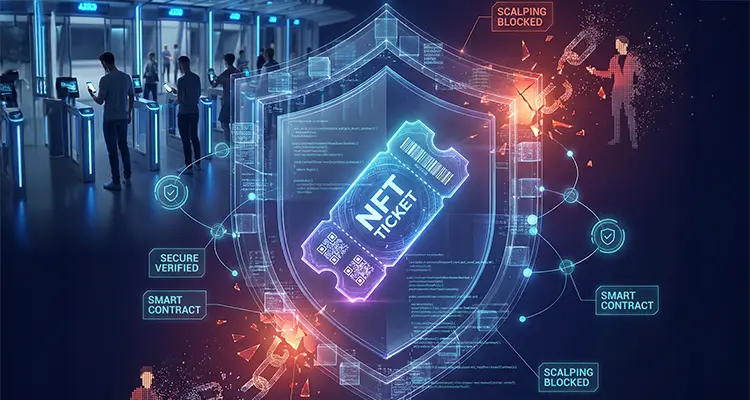
Scalping, weak resale controls, and declining customer trust are ongoing challenges for event organizers. NFTs, when treated as programmable contracts, offer a way to regain control. They help reduce price gouging, monitor distribution across primary and secondary markets, and ensure fans actually get access.
The current event ticketing market can be exhausting. Some buyers use AI-controlled bots to monopolize ticket sales, snapping up inventory faster than humans ever could. Regular fans are pushed into resale platforms, paying inflated prices just to attend. That’s scalping. And it thrives on a lack of visibility.
There’s been no reliable way to track how tickets move after the first sale. No consistent method to enforce resale rules. And no shared source of truth across platforms. Blockchain changes that.
By storing transactions in connected blocks, the system creates an immutable timeline of ownership and exchanges. Every transfer is recorded. Every rule is enforced automatically.
NFT ticketing gives event organizers a way to secure legitimate purchases, limit resale abuse, and create meaningful digital experiences around attendance. With support from expert-level developers, tickets become smarter, not just digital.
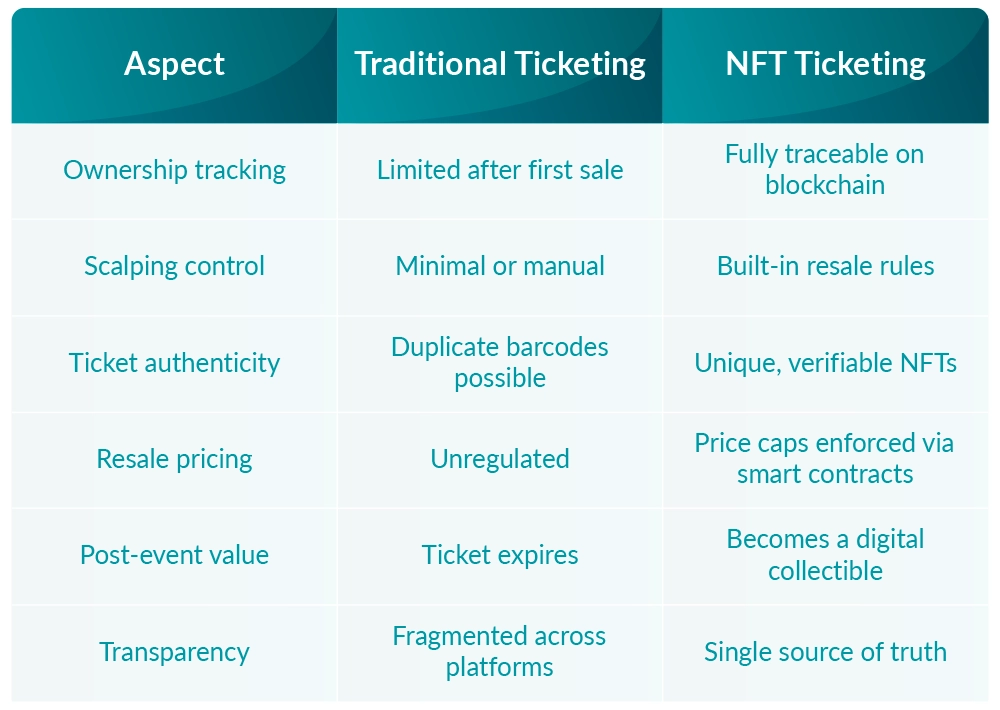
The difference between traditional ticketing systems and NFT-based models becomes clearer when compared side by side.
NFT ticketing is pushing the live event industry toward a more balanced system. One where organizers, artists, and fans all benefit. Here’s how.
At the core of NFT ticketing is programmability. Rules are embedded directly into the ticket using blockchain support.
Limit how many tickets a wallet can hold
Restrict or completely disable resale
Cap resale prices to prevent price gouging
Automatically route resale revenue to organizers or performers
There is no need for manual enforcement and no room for loopholes.
Because NFT tickets live on the blockchain, their entire lifecycle is visible.
Ownership is traceable from creation to redemption
Counterfeit tickets and duplicated barcodes are eliminated
Verification at entry becomes reliable and immediate
Each ticket is unique, and that uniqueness builds trust.
This is where the experience extends beyond the event itself. NFT tickets do not disappear after the show ends. They remain as digital assets that fans can keep, trade, or build on. Using CAD tools, organizers can design custom artwork, lifelong passes, or limited-edition memorabilia tied to attendance.
Key moments from events can even be minted later, giving fans something meaningful to hold onto. When fans feel connected, they come back.
It’s understandable why adoption has been gradual. NFTs arrived loudly. And the first wave didn’t explain the long-term value very well. But beneath the noise, the functionality has matured.
With blockchain-based records of purchases and resales, ticketing becomes fairer. Fans get a real chance to buy. Organizers gain insight into both primary and secondary markets. And trust starts to rebuild.
Yes, NFT and blockchain development can feel complex. But with the right development partner, that complexity becomes manageable. Scalable systems can be designed to integrate securely with existing ticketing workflows while opening new revenue and engagement models.
That’s where experienced teams like Chetu step in, helping event organizers design, build, and maintain NFT ticketing platforms that are practical, compliant, and ready for real-world use.
NFT ticketing isn’t about chasing trends. It’s about fixing what’s been broken for years.
When tickets become programmable, traceable, and collectible, the entire experience shifts. Less chaos. More control. Better outcomes for everyone involved. And maybe, finally, buying tickets feels fair again.
Disclaimer:
This content has been made available for information purposes only. Views and opinions expressed in this content are those of the individual author only and do not necessarily represent the opinions and views of Chetu. Chetu, and its representatives, make no representation or warranty of any kind, express or implied, regarding the accuracy, adequacy, validity, reliability, availability, or completeness of any information of this content. Under no circumstances shall Chetu, or its representatives, have any liability to you or any loss or damage of any kind incurred as a result of the use of this content or reliance on any information provided in this content. Your use of this website and your reliance on any information on this content is solely at your own risk.
About Chetu:
Founded in 2000, Chetu empowers businesses with AI and digital transformation solutions, supporting startups, SMBs, and Fortune 5000 companies. We deliver end-to-end software solutions backed by global digital intelligence and industry expertise. Our customized software delivery model and one-stop-shop approach span the full technology spectrum. Headquartered in Sunrise, Florida, Chetu operates 13 locations across the U.S., Europe, and Asia.
See more at: Chetu Blogs
Share


Limited Time Offer for a Free E-Book
Privacy Policy | Legal Policy | Careers | Sitemap | Referral | Contact Us
Copyright © 2000- 2026 Chetu Inc. All Rights Reserved.