How Big Data in Construction Supports Smarter Project Decisions
Rick Heicksen - Director of Sales | October 27, 2026
- Big data in construction brings BIM, IoT sensors, ERP, project management, and financial data into one view. Teams can then analyze costs, schedules, equipment, and risks with more confidence.
- Analytics, AI and machine learning help teams go beyond reviewing what happened. They can forecast delays, cost pressure and maintenance needs, and act on them earlier.
- Data silos, poor data quality, legacy systems and low user adoption hold back analytics. A phased, goal-driven strategy built on integration and governance helps construction firms scale digital transformation

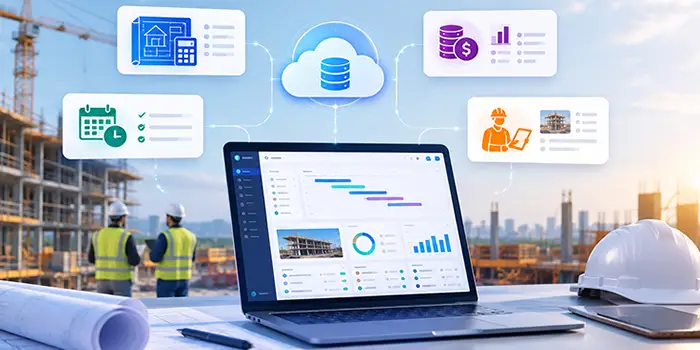
Construction projects generate large amounts of seperated data across planning, design, procurement, equipment, field activity, costs, schedules, and building operations. Big Data in Construction connects these sources so teams could better analyze performance, spot risks, and guide project decisions.
Big data refers to information in your business that is collected and stored; then analyzed to find useful patterns. Through big data analytics in construction, organizations can combine information from IoT sensors, connected equipment, BIM environments, project platforms, ERP, CRM, and financial systems. IoT sensors are connected devices that capture real-world conditions and automatically share data with digital systems. As the use of AI in construction, cloud computing, and construction IoT expand, construction data analytics is moving beyond reporting toward forecasting, automation, and more connected decision-making.
What Is Big Data in Construction?
Big Data in construction is the large and diverse datasets generated across bids, active and completed projects, sales, vendors, operations, and market activity. Among sources are connected equipment, drones, accounting tools, schedules, and field activity project management systems, BIM models, and IoT sensors.
Big data analytics reveal patterns across costs, timetables, resources, equipment, quality, and risk by combining these datasets in construction processes. While BIM and big data connect model-based information with broader project data, construction IoT continuously captures operational data from IoT (Internet of Things), which connects equipment, sensors, and jobsites Constructive artificial intelligence and predictive analytics in construction then enable identification of trends and possible future conditions.
Together, these capabilities make data analytics in construction a core element of construction digital transformation.
5 Vs of Construction Big Data
Understanding Big Data in Construction starts with five crucial characteristics that explain why traditional data management methods may be inadequate.
1. Volume From BIM models, drawings, sensors, equipment telematics, financial systems, pictures, schedules, and field reports, projects produce enormous datasets. To effectively retain and examine this data, scalable systems are required.
2. Velocity Sensors, mobile applications, connected equipment, and project platforms can update information continuously. Quick data processing of pertinent information enables teams to track shifting project environments. and respond sooner.
3. Variety Construction data comprises organized information like schedules and budgets together with unstructured material like photographs, documents, emails, site reports, and inspection notes. Construction data analytics helps combine these formats for broader analysis.
4. Veracity Analytics might suffer from inadequate records, duplicates, variable naming, and obsolete material. Reliability of data is enhanced by integration, administration, standardization, and validation.
5. Value The aim is to convert information into useful ideas. Data analytics in construction can help teams evaluate project timelines, resource use, costs, risks, and trends, so information supports practical decisions.
Where Does Construction Big Data Come From?
Construction data is generated from evaluating all stages of the project starting from design, procurement, financial management, maintenance, handover, and operations, as well as your entire firm's history.
BIM platforms produce data on components, revisions, and coordination. Connecting BIM and big data adds operational context to model information, while revit modeling services can become useful in structuring design data for downstream workflows.
Construction IoT sensors capture equipment usage, location, temperature, environmental constraints, and other operational variables. Project platforms add timeframes, RFIs, submissions, reviews, and field reports. A connected construction project management software development approach can help consolidate these datasets.
Financial systems contribute to job costs, invoices, payroll, procurement, inventory, and budgets. Construction accounting software development and construction ERP software development can bridge the gap between financial data and project operations.
How Big Data Analytics Works in Construction
Big data analytics in construction typically begin by integrating data from BIM, ERP, construction management software, and IoT devices through APIs, cloud services, or custom pipelines.
Data is then cleaned, regulated, mapped, and validated before analysis. Once ready, it can be passed through dashboards, statistical models, BI platforms, machine learning, or predictive analytics in construction.
- Descriptive analytics explains what has happened.
- Diagnostic analytics helps understand why it happened.
- Predictive analytics identifies patterns associated with possible future outcomes.
- Prescriptive analytics assesses available data and suggests potential actions.
These analytical layers can be integrated into construction management software to improve transparency across schedules, costs, resources, quality, and performance.
Applications of Big Data in Construction
The applications of big data in construction span planning, budgeting, bidding, project execution, equipment, quality, risk analysis, and financial operations.
1. Project Planning and Scheduling
Historical project data, task dependencies, resource availability, and ongoing conditions can help teams compare planned versus actual progress, analyze schedule patterns, and improve project planning in real-time.
2. Cost Estimation and Budget Management
Records of costs, labor, materials, project characteristics, and prior estimates can improve budgeting and forecasting. Integrating analytics with construction estimating software helps teams organize relevant data around estimating workflows.
3. Bid and Preconstruction Analysis
Teams can look at past performance, resource needs, estimate data, and past bid outcomes. Better preconstruction analysis can be achieved by means of a centralization of these documents and workflow data by construction bid management software.
4. Equipment and Asset Management
Connected equipment and telematics create information on usage, location, operating settings, and maintenance history. This data helps with condition-based and preventative maintenance planning in construction equipment.
5. Risk Management
Identifying risk patterns can be aided by schedule, cost, inspection, field, and previous project data. Predictive analytics in construction can draw attention to conditions that project managers may need to review more thoroughly.
6. Quality Management
Inspection records, punch lists, photos, BIM data, and defect record histories can help to draw attention to recurring quality problems. AI in construction and smart image processing can also help analyze visual site data for given applications.
7. Financial and Resource Management
Adding information on projects, accounting, ERP, labor, purchasing, inventory, and job costing helps to clarify financial and operational visibility. Reliable data and useful presentation of big data in construction will help to maximize its advantages.
How AI and Machine Learning Enhance Construction Big Data

Big data offers the information base; AI in construction and machine learning provide tools for evaluating vast, typical datasets at volume.
Machine learning can find trends in costs, equipment performance, resources, project records, and timetable history. Construction predictive analytics can highlight circumstances related to potential delays, cost pressure, maintenance requirements, or resource limitations using past and present data.
Natural language processing can aid in processing RFIs, reports, contracts, specifications, and other text-heavy papers, whereas computer vision can analyze jobsite material.
These systems ought to help, not substitute, expert opinion. Their efficiency comes from regular, pertinent, and well-managed data.
Big Data, BIM, and Digital Twins: How They Work Together
Big data, BIM, and digital twins serve various roles in integrated construction environments. BIM provides structured digital information about infrastructure including design, materials, and architecture.
BIM and big data become more crucial when models connect with schedules, costs, field updates, machine information, and IoT data. Digital twins extend this relationship by creating digital representations that can be updated with information from physical assets and operating conditions. For simpler understanding, a digital twin is a virtual representation of a real building, asset, or system that reflects its current condition using connected data.
Big data technologies manage these information funnels, while AI and analytics evaluate patterns across them. Together, BIM, digital twins, construction IoT, and smart analytics help a connected information lifecycle from design through operations.
Challenges of Implementing Big Data in Construction
The current limitations of operating big data in construction at scale depend on more than deploying an analytics platform.
Disconnected Systems and Data Silos
Estimating, accounting, budgeting, scheduling, BIM, and document systems are often mutually exclusive. APIs, middleware, and custom integrations can support creating a connected data environment.
Inconsistent Data Quality
Duplicate or inconsistently removed information affects analytical reliability. Governance, validation of rules, and standard terminology are essential.
Legacy Technology
Older applications may lack modern APIs or integration options. Construction of digital transformation may require modernization, migration, or customization before advanced analytics can scale.
Data Security and Access Control
Construction data may hold sensitive projects and other client related information. Analytics environments should include appropriate authorization, encryption, and governance controls for secure accessibility.
Interoperability
Analytics platforms, machinery, ERP, and BIMs often use different data structures. A clear connected, environment is a must to ensure how information moves between systems securely.
User Adoption
Analytics creates value only when teams can use it. Dashboards, reports, and alerts should align with the workflows of project managers, engineers, architects, and field operatives.
Building a Data-Driven Construction Strategy
Starting with corporate objectives rather than technology choice defines a data strategy. Companies should first identify the decisions and procedures they want to refine before mapping prominent sources across document systems, estimating tools, ERP, BIM, and construction management software.
Next, teams should examine data quality, responsibility, naming regularity, API availability, and authoritative records. Then, a scalable system may connect machine learning services and processes.
Targeted applications are more realistic than general technology implementation. Organizations could begin by improving project reporting, tying financial and operational data, looking at equipment performance, or enhancing estimating procedures.
More complex data analytics in construction, predictive models, and artificial intelligence may be progressively introduced as the foundation is secured.
Future of Big Data in Construction
The future of Big Data in Construction will increasingly depend on connected systems, real-time information monitoring, and AI-assisted analysis with prediction.
As construction IoT matures, mobile devices, equipment, sensors, and building systems will create efficient operational datasets. Cloud platforms can unite these channels with BIM, ERP, and projects.
AI in construction will also become increasingly embedded in estimating, scheduling, project management, maintenance software, and risk of workflows. Predictive analytics can support teams in advancing from retrospective reporting toward forward-looking analysis.
BIM and big data will stay significant as enterprises connect design models with field and operational data, while digital twins broaden that data lifecycle into facility operations.
Ultimately, digital transformation in construction will rely less on collecting information and more on connecting, governing, analyzing, and applying it to attain optimized efficiency.
How Chetu Can Help With Construction Data and AI Solutions
For companies trying to modernize legacy systems, link with project data, and put AI-enabled processes into action, Chetu offers construction software development services.
Project management, BIM, ERP, accounting, estimating, equipment, field, and enterprise systems may all be combined into single platforms for reporting and analysis by development teams. Chetu may also help with cloud systems, IoT-connected apps, custom data integrations, artificial intelligence and machine learning tools, and business intelligence dashboards.
Specialized capabilities include construction project management software development, construction equipment maintenance software, construction accounting software development, construction bid management software, construction erp software development, construction estimating software development, and digital document workflows such as submittal exchange software.
Organizations may create a better basis for data-driven project execution and continuous digital transformation by integrating operational data with analytics and construction management tools.
Disclaimer:
This content has been made available for information purposes only. Views and opinions expressed in this content are those of the individual author only and do not necessarily represent the opinions and views of Chetu. Chetu, and its representatives, make no representation or warranty of any kind, express or implied, regarding the accuracy, adequacy, validity, reliability, availability, or completeness of any information of this content. Under no circumstances shall Chetu, or its representatives, have any liability to you or any loss or damage of any kind incurred as a result of the use of this content or reliance on any information provided in this content. Your use of this website and your reliance on any information on this content is solely at your own risk.
About Chetu:
Founded in 2000, Chetu empowers businesses with AI and digital transformation solutions, supporting startups, SMBs, and Fortune 5000 companies. We deliver end-to-end software solutions backed by global digital intelligence and industry expertise. Our customized software delivery model and one-stop-shop approach span the full technology spectrum. Headquartered in Sunrise, Florida, Chetu operates 13 locations across the U.S., Europe, and Asia.
See more at: Chetu Blogs
Share


Limited Time Offer for a Free E-Book

Suggested
Reading
Read our blogs on automation strategies, technology and business solutions.