Thank you!
Your blog has been successfully shared.


Let's Talk !  954 342 5676
  +44 137 243 2466
Ranjeet Kumar - Director of Operations | July 01, 2026
Every construction project throws off an enormous amount of data — schedules, drawings, RFIs, change orders, field reports, and more. Yet most organizations still run into the same problems. Communication breaks down between teams, design conflicts surface too late, and planning stays reactive instead of getting ahead of issues. As projects grow bigger and more complex, contractors are leaning harder on digital tools just to hold onto visibility and coordination.
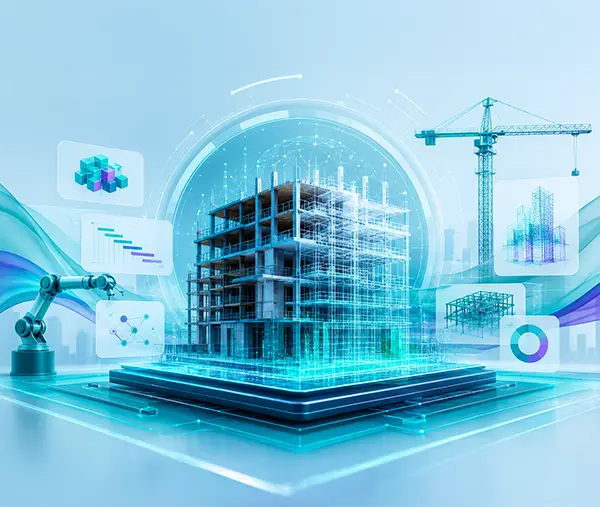
Turner Construction is worth looking at here — not because it launched some headline-grabbing AI product, but because it spent years building the digital foundation that AI actually depends on. Through BIM, VDC, and 3D modeling, Turner changed how its teams plan and deliver projects, and AI in construction project delivery is simply the next layer sitting on top of that work.
Turner has put real time into digital construction workflows, following one simple principle: a problem caught in a model is a lot cheaper and easier to fix than the same problem discovered in the field.
Turner's long-running investment in BIM is a solid example of how a large contractor builds that kind of digital foundation well before bringing in more advanced AI capabilities on top of it.
BIM gives project teams one shared environment where architectural, structural, and MEP information — built out as parametric, data-rich models carrying real material and quantity data, not just geometry — gets coordinated in a single place. VDC in construction workflows builds on that by letting teams simulate sequencing, logistics, and coordination before construction even begins. Turner has also leaned heavily on model-based construction planning to keep visibility and predictability intact once execution actually starts.
These systems weren't originally built with AI in mind — they were built to solve coordination headaches. But that's exactly what makes them valuable now: those coordinated models, often exchanged through open standards like IFC and synced across tools like Navisworks, are the structured data that AI-driven analytics, forecasting, and automation need in order to work at all.
Most construction organizations run into the same core challenges, no matter the size of the project.
Issues that could've been caught in a model turn into expensive field changes instead.
Schedules, budgets, and field information often live in separate systems that don't talk to each other.
Teams end up working from different versions of the same information, which creates real coordination risk.
Problems get addressed after they've already cost something, instead of before.
The more complex a project gets, the worse these issues compound. That pressure is a big part of what's driving digital transformation in the construction industry, and it's why demand for AI-powered construction management solutions keeps climbing.
Turner's long-term investment in BIM and VDC demonstrates how construction project coordination using BIM can help improve visibility, strengthen communication, and identify issues earlier in the project lifecycle, before they turn into expensive field problems.
This is the part where a lot of construction AI initiatives either take off or stall.
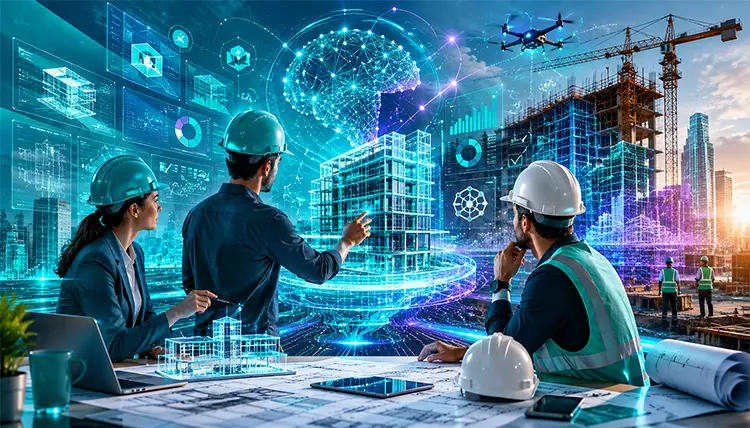
Construction AI in BIM and VDC doesn't replace either discipline — it depends on both of them.
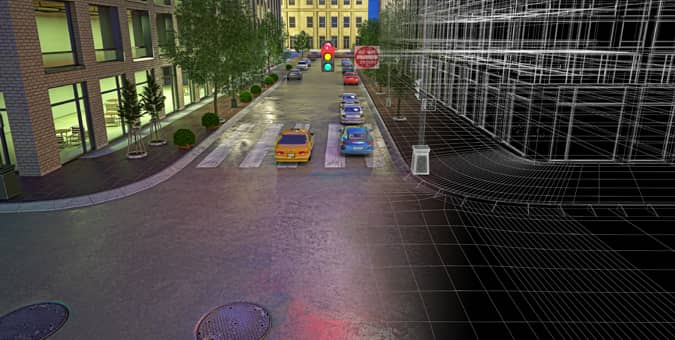
A data-rich BIM model gives architects, engineers, contractors, and owners a shared source of truth. VDC adds virtual planning and simulation on top, letting teams test decisions before work ever starts in the field. Meanwhile, 3D modeling in construction planning makes all of this far easier to understand and communicate, since most people read a model faster than they read a stack of 2D drawings.
Once that foundation is in place, AI can start adding value that's actually measurable.
Clash detection using BIM and AI checks structural geometry against MEP routing inside a coordinated model — catching conflicts faster and more consistently than someone manually reviewing the same model by hand, and surfacing them through conflict visualization and issue-resolution workflows instead of a stack of field complaints.
AI can dig through structured project data used by modern Construction Project Management Software to flag potential schedule delays, budget risk, and coordination gaps well before they turn into costly problems on site.
Construction automation and workflow optimization cut down on repetitive coordination tasks and keep information moving more cleanly between stakeholders.
Construction digital twin technology lets teams check a building's real-world performance against its digital model throughout the asset's lifecycle, opening the door to ongoing optimization long after handover.
Outcomes vary project to project, but organizations that combine BIM, VDC, and AI-enabled workflows tend to see real, measurable improvements in planning, coordination, and execution.
Easier coordination across teams and trades
Design conflicts caught earlier, before they reach the field
Less rework and fewer avoidable costs
Schedules that are actually predictable
Stronger visibility across the project
Better collaboration between stakeholders
Put together, this is what construction efficiency using AI and BIM really looks like — fewer surprises, more informed decisions, and more confidence carried through the life of the project.
It's worth remembering that none of this happens because the AI is "smart." It happens because the data feeding it is clean, current, and trustworthy — and that's the product of disciplined modeling practice, not a software feature.
Organizations looking to adopt construction AI are better off building the right foundation first, rather than buying tools and hoping the data catches up.
Phase 1: Assess BIM Maturity
Take an honest look at how consistent and trusted your BIM practices actually are across projects. If field teams don’t trust the model, AI won’t have much to work with either.
Phase 2: Standardize VDC and Modeling Processes
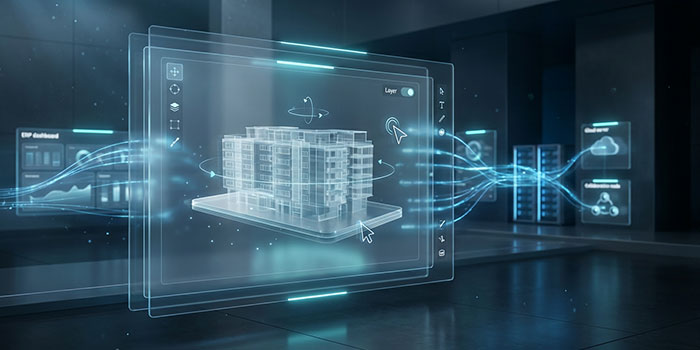
Build repeatable workflows for coordination, model versioning, component reuse, and planning across BIM and Construction ERP Software environments. Consistency here is what eventually makes AI outputs reliable rather than noisy.
Phase 3: Introduce AI-Powered Capabilities
Start small, with targeted use cases — predictive analytics, clash detection, workflow automation, or a single digital twin pilot — rather than rolling everything out at once.
Phase 4: Measure and Scale
Track the metrics that actually matter: rework reduced, forecast accuracy, coordination efficiency, and issues caught before they ever reach the field.
Smart construction technology adoption depends just as much on people and process as it does on the software itself.
Construction AI initiatives are only as good as the systems holding them up. That's why Chetu delivers Construction Software Development services that strengthen the BIM, VDC, analytics, and project management foundations that AI depends on.
Our expertise spans everything from 2D drafting and BIM modeling environments through design automation, clash detection, quantity takeoff, and digital twin solutions.
Whether you're expanding existing BIM capabilities or building a digital construction strategy from scratch, the goal stays the same: a connected data environment that lets construction AI in BIM and VDC workflows deliver results you can actually measure.
Disclaimer:
This content has been made available for information purposes only. Views and opinions expressed in this content are those of the individual author only and do not necessarily represent the opinions and views of Chetu. Chetu, and its representatives, make no representation or warranty of any kind, express or implied, regarding the accuracy, adequacy, validity, reliability, availability, or completeness of any information of this content. Under no circumstances shall Chetu, or its representatives, have any liability to you or any loss or damage of any kind incurred as a result of the use of this content or reliance on any information provided in this content. Your use of this website and your reliance on any information on this content is solely at your own risk.
About Chetu:
Founded in 2000, Chetu empowers businesses with AI and digital transformation solutions, supporting startups, SMBs, and Fortune 5000 companies. We deliver end-to-end software solutions backed by global digital intelligence and industry expertise. Our customized software delivery model and one-stop-shop approach span the full technology spectrum. Headquartered in Sunrise, Florida, Chetu operates 13 locations across the U.S., Europe, and Asia.
See more at: Chetu Blogs
Share


Limited Time Offer for a Free E-Book
Privacy Policy | Legal Policy | Careers | Sitemap | Referral | Contact Us
Copyright © 2000- 2026 Chetu Inc. All Rights Reserved.