Thank you!
Your blog has been successfully shared.


Let's Talk !  954 342 5676
  +44 137 243 2466
Anshu Raj - Director of Operations | April 07, 2026
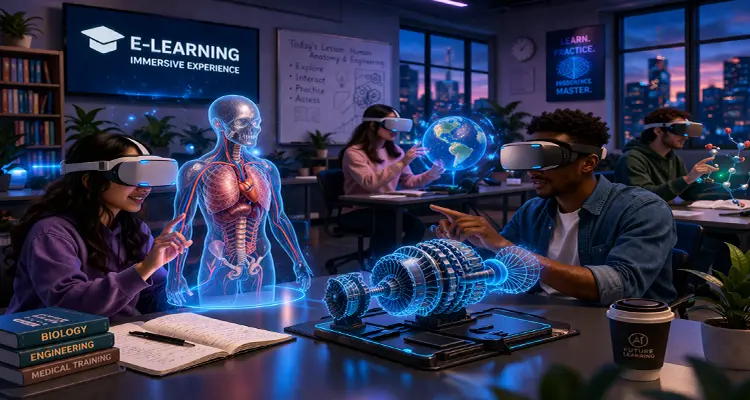
The fast-emerging immersive learning technology is transforming the way organizations impart learning and training. E-learning is becoming a highly interactive, engaging, and results-oriented experience with the growth of Extended Reality (XR) training solutions, i.e., augmented reality (AR) and virtual reality (VR).
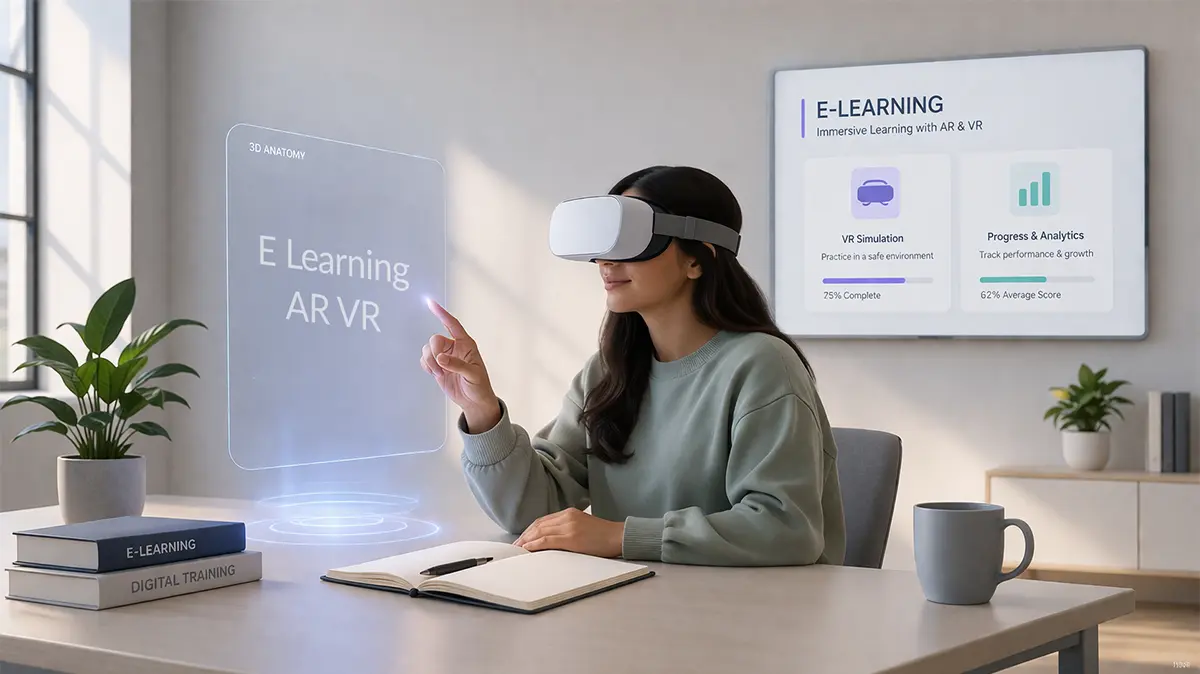
AR/VR corporate training is emerging as an important tool in modern business with the aim of advancing workforce development and upskilling, knowledge retention, and scalable training space. AR and VR represent part of the larger digital transformation in education and training, facilitating organizations to stop delivering content in the form of a flat plane of learning and develop new forms of dynamic, experiential learning environments. Such technologies do not only enhance engagement but also assist organizations in developing measurable learning outcomes with the help of data and analytics.
Most of the conventional forms of e-learning utilize fixed modules, videos, and presentations that may hinder interaction and diminish knowledge acquisition. Organizations can convert passive learning to active engagement by adopting interactive e-learning solutions that are driven by AR and VR.
Immersive technologies facilitate the interaction of the subject matter by immersing learners into interactive environments. Users do not have to just read or watch; they can explore, interact, and practice in real time.
Key benefits include the following:
Increased student interaction and retention
Practical learning in secure, virtual settings.
Instantaneous feedback and performance monitoring.
Better learning analytics and training ROI.
Through such features, organizations are able to make sure that training should be not only interesting but also effective and business-oriented.
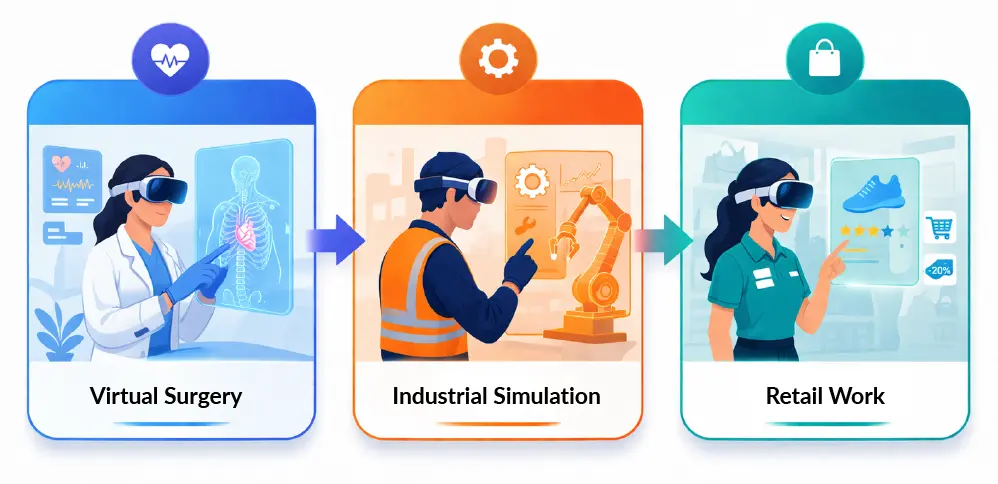
Augmented reality (AR) and virtual reality (VR) move learning experiences into real life through simulated experiences, allowing the users to engage with digital elements overlaid on the actual world or entirely simulated worlds. This method is particularly important in the sector when practical experience is highly significant.
For example:
Doctors are able to conduct virtual surgery
Learning of effective equipment handling can be applied among manufacturing workers.
The retail workers are able to simulate the customer interactions.
This type of learning based on simulation enables the learners to acquire experience in the real world at zero risk and cost, unlike the other training methods. It also helps organizations to provide uniform training experiences to globally spread teams.
One of the most impactful applications of AR and VR is simulation-based learning, which allows employees to practice complex tasks in a controlled, risk-free environment.
This method is particularly beneficial for enterprise training programs, as it supports:
Reduced operational and training costs
Improved critical thinking and decision-making skills
Faster onboarding and skill development
Organizations leveraging Extended Reality (XR) training solutions can create high-fidelity simulations that closely mimic real-world scenarios. These simulations improve both learner confidence and performance, ensuring that employees are better prepared for real-life challenges.
Gamification is one of the processes that improve the effectiveness of AR/VR-based training. Organizations can greatly boost the motivation of learners by including incentives, tests, and monitoring of progress.
Gamification, when used in conjunction with immersive environments, makes the training process a very compelling experience.
Key advantages include the following:
Increased turnout and graduation.
Better memory capacity.
Higher satisfaction in learners.
Such interactive e-learning solutions make training more enjoyable and provoke continuing education and result in the final achievement.
To fully leverage immersive learning, organizations must ensure seamless enterprise LMS integration (SCORM & xAPI compliant). These standards enable AR and VR content to work effectively within existing learning management systems.
Key benefits include the following:
Compatibility with various LMS platforms
Accurate tracking of learner progress and performance
Advanced reporting and learning analytics
By aligning immersive content with SCORM and xAPI standards, organizations can gain deeper insights into learner behavior and measure training effectiveness more accurately. This ensures that investments in AR/VR training deliver measurable value.
Developing high-quality AR/VR content requires the right combination of tools and technologies. Modern platforms enable organizations to create scalable and interactive training experiences.
Some widely used tools include:
Unity and Unreal Engine for 3D content development
ARKit and ARCore for mobile-based AR applications
WebXR for browser-based immersive experiences
These tools support the development of advanced XR training solutions that align with organizational goals and enhance learning outcomes. When combined with strong instructional design, they enable the creation of impactful training programs that drive engagement and performance.
With the ongoing adoption of digital transformation in education and training within organizations, AR and VR are becoming an indispensable part of the contemporary e-learning practices. The technologies help businesses to provide interactive, scaled, and data-driven training that grows in response to the modern requirements of the workforce.
Interacting with the help of the technology of immersive learning, interactive e-learning solutions, and advanced analytics, organizations will be able to stimulate the development of new skills, enhance engagement, and increase the results of training. Since onboarding to advanced skill-building, both AR and VR are not simply improving e-learning but are defining it.
With the growth in the adoption of AR/VR, organizations that invest in AR/VR are today in a better position to shape the future of learning and development.
Disclaimer:
This content has been made available for information purposes only. Views and opinions expressed in this content are those of the individual author only and do not necessarily represent the opinions and views of Chetu. Chetu, and its representatives, make no representation or warranty of any kind, express or implied, regarding the accuracy, adequacy, validity, reliability, availability, or completeness of any information of this content. Under no circumstances shall Chetu, or its representatives, have any liability to you or any loss or damage of any kind incurred as a result of the use of this content or reliance on any information provided in this content. Your use of this website and your reliance on any information on this content is solely at your own risk.
About Chetu:
Founded in 2000, Chetu empowers businesses with AI and digital transformation solutions, supporting startups, SMBs, and Fortune 5000 companies. We deliver end-to-end software solutions backed by global digital intelligence and industry expertise. Our customized software delivery model and one-stop-shop approach span the full technology spectrum. Headquartered in Sunrise, Florida, Chetu operates 13 locations across the U.S., Europe, and Asia.
See more at: Chetu Blogs
Share


Limited Time Offer for a Free E-Book
Privacy Policy | Legal Policy | Careers | Sitemap | Referral | Contact Us
Copyright © 2000- 2026 Chetu Inc. All Rights Reserved.