Thank you!
Your blog has been successfully shared.


Let's Talk !  954 342 5676
  +44 137 243 2466
Anshu Raj - Director of Operations | April 08, 2026
The fast development of e-learning platforms, digital education tools, and remote learning technology has changed the manner in which institutions offer education. The current online learning solutions are now in place to serve global classes and enable flexible classes and interactive courses. Nonetheless, personalization, engagement, and accessibility are some of the problems that many platforms cannot overcome, along with measurable learning outcomes.
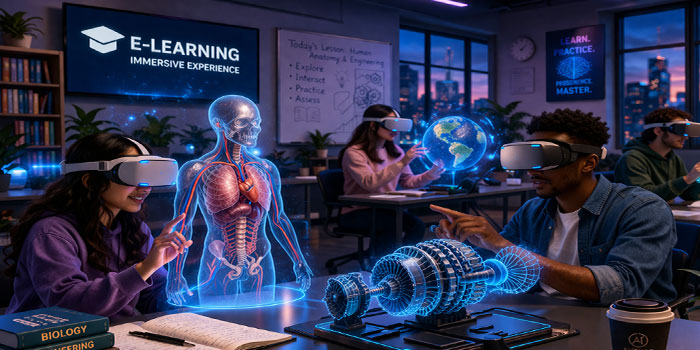
It is at this point that bidirectional brain-machine interfaces (BMIs) are starting to transform the future of AI-based learning. BMIs allow computers to receive and send neural impulses to the brain and vice versa, which means that a computer can understand your brain and at the same time give feedback. This technology, when incorporated in learning management systems (LMS), interactive learning software, and virtual classrooms, develops smart systems that reconfigure to the cognitive state of every learner in real time.
To technology leaders and EdTech executives, this is a strategic opening to develop the new generation of adaptive e-learning ecosystems that can bring quantifiable changes in learning outcomes.
One of the most important contributors to the success of the modern online learning solutions is personalization. Conventional learning management (LMS) systems have a tendency of adapting the content according to the user behavior, like quiz or course score. Nevertheless, bidirectional brain-machine interfaces take individualized online education to another level because they offer instant feedback about the cognitive processes of students.
The BMIs are a type of communication that transpires between the brain and digital systems, enabling adaptive e-learning platforms to customize content in real-time based on the level of engagement, understanding, or mental effort of the learner.
On interactive learning software enhanced by BMI, platforms are able to recognize:
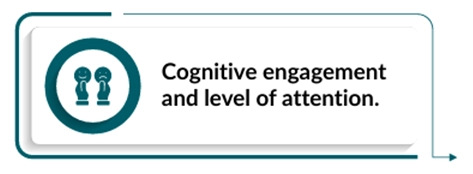
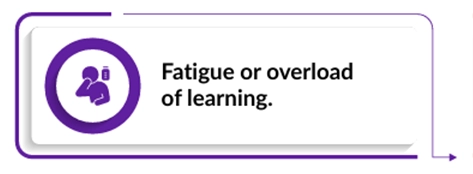
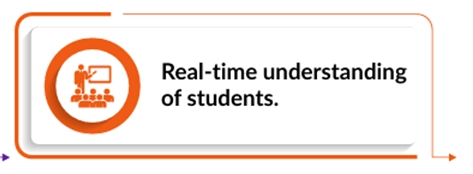
This advanced level of personalization enables institutions to adapt learning processes to each individual student, either one that is struggling with an idea or one that is performing above the expectations. This leads to an increase in engagement and a better academic performance.
The retention rates also increase using these platforms, as they provide a very relevant learning experience. To other stakeholders like schools and districts, this can give quantifiable outcomes that show the worthiness of highly advanced AI-powered education systems.
In the case of EdTech providers, creating institution-specific EdTech solutions to serve the unique requirements of a specific institution makes your company a pioneer in the future of learning, allowing the provision of scalable, inclusive, and data-driven learning settings.
Since industries are changing at a very high rate, institutions have to equip students with skills at a higher rate. The conventional e-learning systems tend to have rigid course designs that are not necessarily aligned to the pace at which the students learn.
BMIs can be integrated into digital learning tools, which can significantly reduce the learning curve.
Using the neural feedback, AI-driven educational systems can identify when students:
Fully understand a concept
Should have more reinforcement
Feel mental exhaustion.
This allows the adaptive e-learning systems to provide content at the right time and in the most convenient form
By implementing online learning solutions that use BMI, educational institutions can realize the following:
Greater rates of completion.
Better measures of student performance.
More in tune with workforce needs.
To executives and CIOs at EdTechnology, implementations of BMI technology can be applied in virtual classrooms and training systems to differentiate their applications in the competitive market. BMIs offer a data-driven and scalable method of accelerating student success in either language acquisition or STEM education.
Even though the technology of remote learning has developed, the barriers that are encountered by many learners remain in the form of attention disorders, cognitive fatigue, or learning disabilities. Conventional digital education technologies tend to be unable to offer personalized support for these issues.
BMIs bring a potent means of dealing with these obstacles in the form of real-time neural responses.
Interactive learning software based on BMI will have the capability to monitor signals associated with:
Attention difficulties.
Cognitive overload.
Learning in a stressful or frustrated situation.
Based on this information, adaptive e-learning platforms will be able to provide interventions that are specific to the individual profile of the learner. In case systems can vary the lesson pace, offer some interactive visuals, or give some varied explanations to enhance understanding.
This is a good value proposition to the education executives. BMI-based solutions assist organizations to achieve the goals of inclusivity and increase access to students who would not have thrived in a traditional setting.
In the case of EdTech companies, the need to support the needs of various learners by providing education platforms using AI-based systems can aid in meeting the growing demand to enable equal learning opportunities, as well as improving relations with school administrations and policymakers.
Accessibility is now the number one priority as schools and colleges grow bigger virtual classrooms and online learning software. Although the digital platforms enhance access due to geographical factors, there are still barriers to participation for many physically challenged students.
BMIs present new solutions that enhance an inclusive education.
The BMI-based learning management systems (LMS) provide the students with the capability to engage with digital material in completely new modalities. For example, learners may:
Control platforms using neural cues.
Use hands-free device controls.
Access improved interactions with instructors through communication tools.
Such abilities enable students with disabilities to become more active in the learning experience.
Simultaneously, BMIs assist institutions to comply with the law on accessibility as well as to place their online learning solutions on a path of being progressive and inclusive.
This technology also assists the future-proofing of digital infrastructure for the leaders of technology and the CIOs. Educational institutions can easily move into the next generation of learning technologies through the adoption of innovations such as BMIs into interactive learning software, instilling their long-term policies of digital transformation.
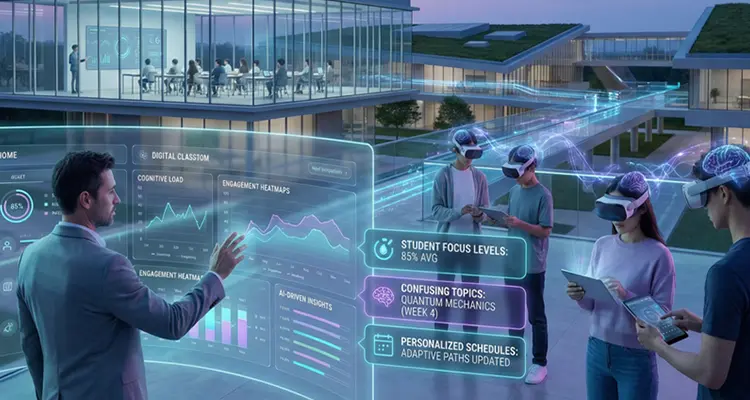
The educational leaders live in a data-driven age as they use analytics to enhance the teaching approaches and to gauge the success. Conventional learning management systems normally monitor indicators like course completion rates, time devoted to lessons, or test scores.
Nonetheless, AI-based education systems based on BMI allow more comprehensive insights into cognitive engagement.
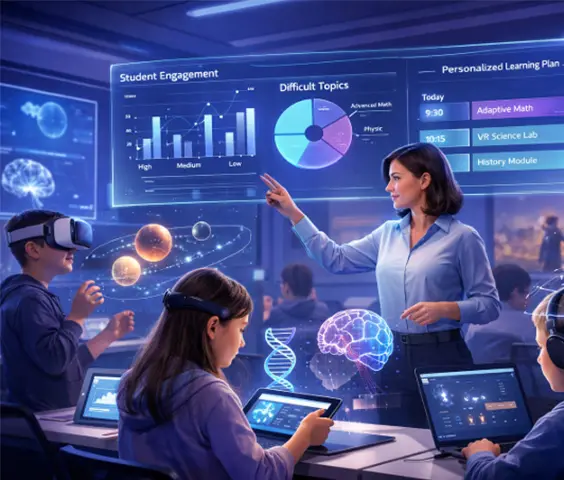
The insights that educators can gain with BMI data include:
These are student engagement levels in certain lessons.
Concepts that confuse or are fatiguing to understand.
The best learning time of various students.
Such insights can help teachers to adjust course designs, enhance interactive learning programs, and streamline curriculum designs with the help of neurological feedback.
In the case of EdTech companies, the provision of online learning solutions that are based on body mass index makes them critical stakeholders in data-driven learning. These insights can help institutions to better refine teaching strategies, improve their methods of evaluation, and show measurable student outcomes improvements.
Also, bidirectional brain-machine interfaces stand as one of the most promising directions of AI-based learning. BMIs can completely change the nature of knowledge delivery and learning by integrating neurotechnology with e-learning platforms, adaptive e-learning systems, and digital education tools.
In the case of the EdTech industry, there are a number of strategic advantages associated with the concept of implementing BMI capabilities in the virtual classroom and remotely. Learning technology:
Very customized learning experiences.
Increased knowledge and skills faster.
Additional accessibility to a variety of learners.
Insightful data to teachers and colleges.
Fighting differentiation in a saturated market.
To the educational executives and technology leaders, the implementation of BMI-enabled solutions is not a question of staying afloat with the innovation; it is more of providing scalable and measurable learning outcomes.
Companies that start investing in BMI technology at present will have a strategic advantage since the sphere of education is still developing.
Creating bespoke EdTech solutions will make your company a leader in the future of learning, as they are designed to meet the specific needs of an institution. Technology providers can also create platforms that can provide effective educational efficacies as well as enable institutions to prepare to enter the new era of digital education by taking advantage of the latest technological advances such as the bidirectional brain-machine interface.
Disclaimer:
This content has been made available for information purposes only. Views and opinions expressed in this content are those of the individual author only and do not necessarily represent the opinions and views of Chetu. Chetu, and its representatives, make no representation or warranty of any kind, express or implied, regarding the accuracy, adequacy, validity, reliability, availability, or completeness of any information of this content. Under no circumstances shall Chetu, or its representatives, have any liability to you or any loss or damage of any kind incurred as a result of the use of this content or reliance on any information provided in this content. Your use of this website and your reliance on any information on this content is solely at your own risk.
About Chetu:
Founded in 2000, Chetu empowers businesses with AI and digital transformation solutions, supporting startups, SMBs, and Fortune 5000 companies. We deliver end-to-end software solutions backed by global digital intelligence and industry expertise. Our customized software delivery model and one-stop-shop approach span the full technology spectrum. Headquartered in Sunrise, Florida, Chetu operates 13 locations across the U.S., Europe, and Asia.
See more at: Chetu Blogs
Share


Limited Time Offer for a Free E-Book
Privacy Policy | Legal Policy | Careers | Sitemap | Referral | Contact Us
Copyright © 2000- 2026 Chetu Inc. All Rights Reserved.