Thank you!
Your blog has been successfully shared.


Let's Talk !  954 342 5676
  +44 137 243 2466
Anshu Raj - Director of Operations | April 09, 2026
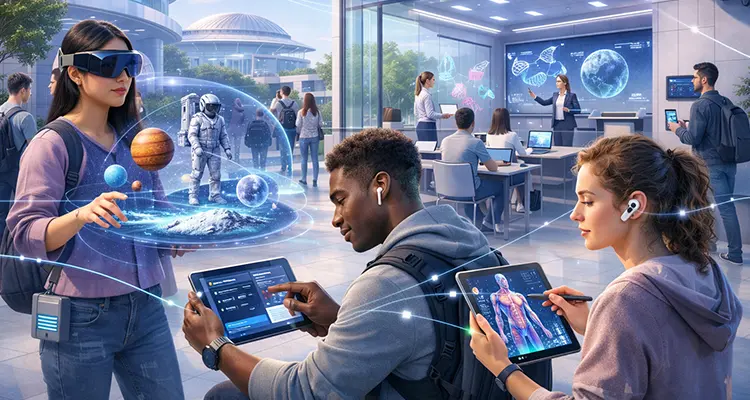
The education industry landscape is changing extremely fast with the emergence of smart campus technology and a general need to experience the digital-first approach. The students of today are more technologically inclined than ever, requiring them to be connected effortlessly, to be personalized, and to receive novel tools that reflect the digital environment in which they operate on their day-to-day activities.
Institutions are reacting with the adoption of new EdTech products, the use of AI in education, the utilization of connected devices in the classroom, and data-driven approaches to education. Such innovations are not merely improving the academic delivery, but they are also redefining the ways the campuses operate, collaborate, and guarantee the success of the students.
Contemporary students have been brought up in a technologically oriented environment. They like smartphones, smart homes, and being able to get everything in real time, personalization, and intuitive interfaces. Therefore, schools have to adopt modern technology to adjust to such expectations by implementing a smart campus.
Smart campuses are a combination of digital solutions to infrastructure, academics, and administration and allow students to engage their campuses in more significant manners. It can be the ability to study the material of courses with the help of mobile applications or the use of the digital wayfinding program to find the necessary path to the university building: technology is the heart of the student experience.
Using connected devices in classrooms is one of the components of this change. Systems with smartboards and IoT devices and collaborative platforms enable students and instructors to make lectures more dynamic.
These devices facilitate:
Institutions are making classes more interesting and effective by closing the divide between physical and digital classrooms
Artificial intelligence is playing a critical role in shaping the future of education. With AI in education, institutions can analyze student behavior, performance, and engagement patterns to create personalized learning paths.
AI-powered systems can:
Recommend tailored study materials
Identify knowledge gaps
Provide real-time feedback
This level of customization ensures that each student receives the support they need, improving outcomes and retention rates.
Closely related to AI is adaptive learning technology, which adjusts content delivery based on a student’s progress and comprehension level. Unlike traditional one-size-fits-all approaches, adaptive systems continuously evolve to match individual learning speeds.
This approach helps:
Reduce learning disparities
Improve student confidence
Enhance overall academic performance
VR/AR in Education
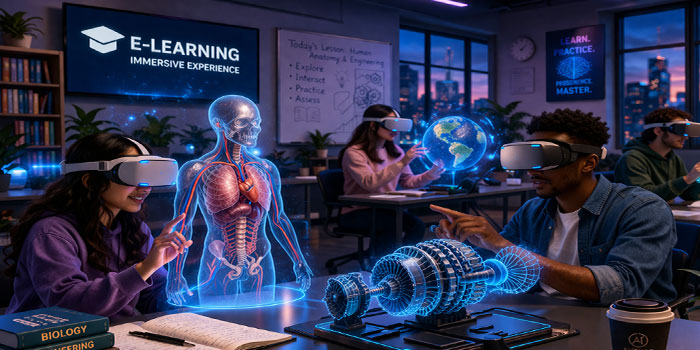
Immersive technologies such as VR/AR in education are transforming how complex subjects are taught. Instead of relying solely on textbooks, students can now explore virtual environments, conduct simulations, and visualize abstract concepts.
For example:
Medical students can practice surgeries in virtual labs
Engineering students can interact with 3D models
History students can experience historical events in immersive settings
These experiences make learning more engaging, interactive, and memorable.
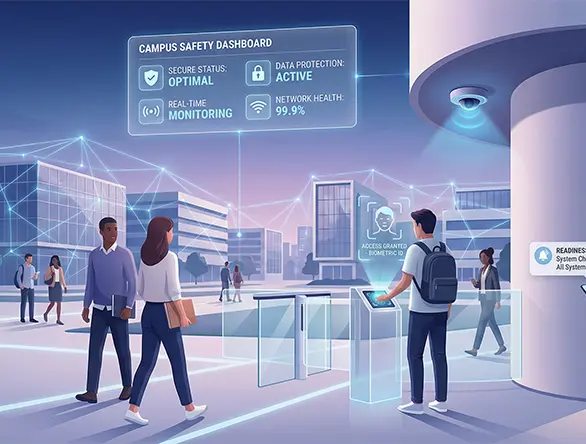
Safety and security are becoming more and more vital as campuses get more interlinked. The technology of campus safety utilizes smarts to track, identify, and act on possible threats immediately.
Technologies include:
AI-powered smart surveillance systems.
Biometric (or smart card) access control systems.
Emergency notification systems.
The tools assist institutions to have a safe environment among students, faculty, and staff members.
The emergence of data-based education has allowed institutions to make well-informed choices based on current information. Nonetheless, it also entails data privacy as well as data protection challenges.
Smart campuses deploy a high level of cybersecurity to:
Secure confidential student data.
Make sure that data regulations have been met.
Avoid unauthorized access.
Through data intelligence together with robust security systems, institutions will be able to develop a secure and efficient online ecosystem.
Among the greatest advantages of the modernization of education with the help of smart campuses, it is possible to mention the possibility to foster equity. Institutions can offer everyone equal chances to succeed by making digital tools and resources available to everyone.
Cloud-based platforms, distance learning, and mobile access will assist the students:
Learn from anywhere
Access resources anytime
Enroll in online class rooms.
EdTech solutions are enabling more inclusive learning environments that cater to diverse needs. Features such as multilingual content, accessibility tools, and flexible learning schedules make education more accessible to a broader audience.
With the institutions persisting in investing in smart campus technology, it will pivot towards developing whole ecosystems. These ecosystems will bring academic systems, administrative, and student services together on a single platform.
The next-generation developments can involve:
Completely robotic campus functions.
Student Success: Advanced predictive analytics.
Increased interconnection of AI and immersive technologies.
Implementation of smart campus technology is no longer a choice but a necessity to any institutions that want to remain competitive in the continuously changing educational environment. Campuses are changing the way knowledge is provided and consumed by using AI in education, adaptive learning technology, VR/AR in education, and data-driven education.
These innovations are defining the future of modernizing education due to their ability to improve the learning process, as well as to provide safety and equity. With the ever-changing technology, smart campuses will be central in equipping the students with the experiences and knowledge that will enable them to succeed in a digitally driven world.
Disclaimer:
This content has been made available for information purposes only. Views and opinions expressed in this content are those of the individual author only and do not necessarily represent the opinions and views of Chetu. Chetu, and its representatives, make no representation or warranty of any kind, express or implied, regarding the accuracy, adequacy, validity, reliability, availability, or completeness of any information of this content. Under no circumstances shall Chetu, or its representatives, have any liability to you or any loss or damage of any kind incurred as a result of the use of this content or reliance on any information provided in this content. Your use of this website and your reliance on any information on this content is solely at your own risk.
About Chetu:
Founded in 2000, Chetu empowers businesses with AI and digital transformation solutions, supporting startups, SMBs, and Fortune 5000 companies. We deliver end-to-end software solutions backed by global digital intelligence and industry expertise. Our customized software delivery model and one-stop-shop approach span the full technology spectrum. Headquartered in Sunrise, Florida, Chetu operates 13 locations across the U.S., Europe, and Asia.
See more at: Chetu Blogs
Share


Limited Time Offer for a Free E-Book
Privacy Policy | Legal Policy | Careers | Sitemap | Referral | Contact Us
Copyright © 2000- 2026 Chetu Inc. All Rights Reserved.