Thank you!
Your blog has been successfully shared.
Let's Talk !  954 342 5676
 +44 137 243 2466
Chris Braddy - Director of Operations | September 02, 2026
Executives are worried, and the data backs them up. 49% of Learning & Development professionals say executives are concerned employees lack the skills needed to execute business strategy, and the pressure is only building.
The World Economic Forum projects that by 2030, 59% of the global workforce will need upskilling. Organizations invested approximately $1,500 per employee in workplace training in 2024. Despite this investment, one in four employees says workplace training does not meaningfully prepare them for their role.
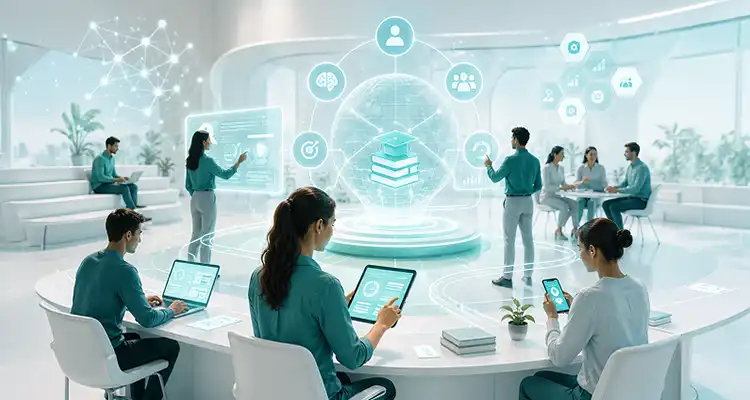
Skills are changing faster than traditional training programs can keep up. Organizations need a continuous approach that identifies knowledge gaps, adapts learning to employee needs, and connects training with workforce performance. A modern LMS supports this through personalized learning, learning analytics, and ongoing development.
An LMS is a software program that consolidates the delivery, monitoring, and management of organizational learning. An LMS for employee training consolidates course content, assessments, progress tracking and reporting under a single system, instead of relying on different spreadsheets, face-to-face sessions, or fragmented e-learning tools.
Cloud-based learning platforms are typically used; employees can log into training on any device, but IT still has to manage, so it’s not a win. Transition to online corporate training has enabled LMSs to become much more scalable than traditional classroom-based training and much easier to keep up to date with evolving business requirements.
As companies gain more insight into the advantages of LMS systems and how they can streamline their training processes, the number of organizations integrating this solution is growing. Whereas training is often seen as a series of disjointed events, with an LMS, L&D teams can:
The LMS has evolved from a simple content delivery mechanism into a more comprehensive platform for managing workforce capability, and it is a software that is increasingly being utilized. The LMS has grown from a simple content delivery tool into a strategic system for managing workforce capability, and it's a software that's evolved.
An organization must have insight into what it is to fix before it can fix it. A knowledge gap occurs when the employee does not know what he/she needs to know to successfully carry out the role. A skills gap is related but concerns the gap between what skills an employee currently possesses and what skills the job now requires.
These gaps don't appear randomly. Some of the reasons include using old onboarding resources, speeding up the changes of tools or processes, speeding up promotions without any training, and the change in the industry due to automation and AI. When they are not dealt with, they manifest as missed deadlines, poor quality, and increased errors.
One of the reasons that this is challenging to manage manually is the pace of change. 32% of the skills needed for the typical job have changed in 2024 compared to 2021 – and the trend is accelerating. AI and digital transformation are accelerating skills of evolution, making it a business imperative, not a one-and-done project.
That's why skill gap analysis and knowledge gap analysis are crucial features of an LMS. Rather than having a manager deciding based on emotions, as to what training needs to be delivered to which employees, an organization can use an assessment to draw a clear picture based on evidence of where the gaps are and how critical each gap is.
Performance assessment and learning analytics are useful only if they can make an impact, which means they must identify a gap that you can act on. A good LMS has built-in methods for measuring learning, not just whether an employee had taken a course, but whether he or she absorbed it and can apply it.
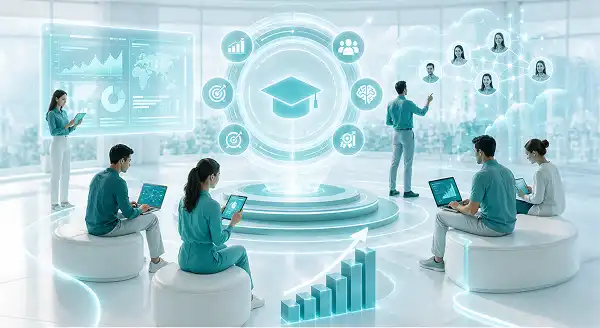
Learning Analytics transforms the raw assessment data into actionable data. Dashboards and reports show L&D teams which employees are progressing, which courses need improvement, and where training delivers the greatest value. AI can strengthen this analysis by comparing assessment results, role requirements, and performance patterns to help identify skills gaps among existing employees and new hires.
Organizations are increasingly turning to analytics for skills and personalization, and are asking questions such as:
Without this layer of performance assessment and analytics, training is essentially a guess. With it, L&D becomes a data-driven function that can defend its budget and prove its impact.
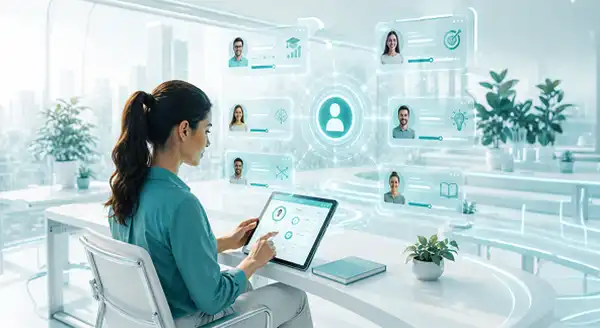
Not every employee learns the way, at the same rate, or needs the same content and treating them that way is one of the primary reasons trainings do not land. Personalized learning addresses this by customizing the learning process to the person.
This is achieved in modern LMS platforms by using adaptive learning paths that tailor content and pacing to learners based on their assessment outcomes, and self-paced learning, which allows the employee to complete the content at their own speed rather than following a defined classroom path. All of these elements make a standard course catalog into a customized employee upskilling course.
With personalized career development taking the top spot for addressing organization skills gaps, it's not hard to see why: when employees understand how learning activities relate to their individual roles and development, they are much more likely to attend them than those taking generic, one size fits all courses. Individual skill gaps can also help guide learning paths that are easier to tie to promotion and progression, leading to increased retention and motivation.
Training that only works at a desk doesn't work for a hybrid workforce. Mobile learning, or mLearning, extends training to smartphones and tablets, letting employees' complete modules during a commute, between meetings, or on the shop floor wherever the workday happens.
This matters more with remote and hybrid work now standard across most industries. A rigid, desktop-only LMS creates friction for distributed teams; a mobile-first one removes it. Flexible learning formats for short modules, microlearning, and offline-accessible content make it realistic for busy employees to fit training into fragmented schedules instead of requiring long blocks of dedicated time.
Mobile and AI-enabled learning continue to reshape workplace training, enabling employees to learn within their daily workflow rather than stepping outside of it. For organizations investing in online corporate training, mobile accessibility isn't nice to have anymore.
Some of the most effective learning doesn't happen in a formal course at all. It happens through peer interaction. Social learning features inside an LMS bring that dynamic into the platform through peer learning, mentoring, collaboration tools, and discussion forums.
These features matter because they capture tacit, organizational knowledge that structured content often misses. A discussion forum where employees can ask questions and share real-world context turns individual learning into collective knowledge sharing, and mentoring features can pair less experienced employees with subject-matter experts inside the same system used for formal training.
Informal learning and peer collaboration are increasingly recognized as effective methods for developing workplace skills, especially in AI-driven environments where best practices are still being established in real time. For organizations trying to improve employee engagement through training, social features are often the difference between a course employees complete because they have to and one they engage with because they want to.
Implementing an LMS well is more than just picking up a platform. Organizations that are the most successful practice the following:
This is a change towards ongoing, data-driven training that is already reflected in figures. Nearly 9 in 10 HR managers deliver formal training at least quarterly, and 83% of employees felt they were receiving enough training in 2025 rather than in one-off training events, indicating a move towards learning programs that are continuous rather than one-off. Those who view their LMS as a system and not as a project are the ones who are reaping these benefits.
The problem of addressing the workforce skills gap does not resolve itself, and traditional, one-off training initiatives are unable to meet the rapid pace of changing job requirements. To bridge that gap, a well-designed LMS can provide the tools necessary for organizations. Leveraging learning analytics and performance assessment tools to determine areas of weakness, utilizing personalized learning to fill those gaps effectively, and mobile and social learning to help keep employees engaged on the journey.
These features combine to make training more than just a compliance checkbox – they are a real force to push employees up the learning curve and boost business results. A course library is not enough for organizations looking to build a future-ready workforce. They require a learning management system that is connected, has analytics, and will evolve in pace with the skills needed to perform a task. If you need to address the gap between your existing training method and the outcome, it may be time to consider an LMS that is designed for today's methods of employee learning.
Disclaimer:
This content has been made available for information purposes only. Views and opinions expressed in this content are those of the individual author only and do not necessarily represent the opinions and views of Chetu. Chetu, and its representatives, make no representation or warranty of any kind, express or implied, regarding the accuracy, adequacy, validity, reliability, availability, or completeness of any information of this content. Under no circumstances shall Chetu, or its representatives, have any liability to you or any loss or damage of any kind incurred as a result of the use of this content or reliance on any information provided in this content. Your use of this website and your reliance on any information on this content is solely at your own risk.
About Chetu:
Founded in 2000, Chetu empowers businesses with AI and digital transformation solutions, supporting startups, SMBs, and Fortune 5000 companies. We deliver end-to-end software solutions backed by global digital intelligence and industry expertise. Our customized software delivery model and one-stop-shop approach span the full technology spectrum. Headquartered in Sunrise, Florida, Chetu operates 13 locations across the U.S., Europe, and Asia.
See more at: Chetu Blogs
Share


Limited Time Offer for a Free E-Book
Read our blogs on automation strategies, technology and business solutions.
Privacy Policy | Legal Policy | Careers | Sitemap | Referral | Contact Us
Copyright © 2000- 2026 Chetu Inc. All Rights Reserved.