


We build from the ground up around your workflows.
Fast deployment with minimal setup.
Hybrid rollout with a rapid MVP delivery


Let's Talk !  954 342 5676
  +44 137 243 2466
By: John Bailey
GET A PHARMACY MANAGEMENT CONSULTATIONWhen it comes to supplying pharmacies with point-of-sale (POS) systems there are a few key considerations regarding the capabilities and features your systems include.
Here are a few of the most important functionalities to include in an optimized POS system to provide your clients with better internal accountability, assistance with HIPAA and legislative compliance, and overall improved pharmacy management.
To avoid data silos, linking different information technology systems enables direct communication between systems and the exchange of usable data. This allows for the streamlining of pharmacy processes such as creating prices, ordering products, and coordinating prescription histories.
A POS system should be interoperable with other software and systems that a pharmacy utilizes to streamline important work and exchange information through Electronic Data Interchange (EDI). Systems that can communicate with an interoperable POS system and improve the pharmacist-patient care process include:
Electronic Health Records (EHR) and Electronic Medical Records (EMR).
Customer Relationship Management (CRM) systems.
External Practice Management System (PMS) modules.
Additionally, providing POS systems that can utilize add-on services can enable pharmacies to accomplish business improving tasks such as listing their products in search engine results to reach new audiences.
Electronic signature capture has many practical and mandatory applications in a pharmacy. A POS system that integrates electronic signature capture allows customers to sign for multiple prescriptions simultaneously. This saves patients and pharmacists time while reducing the likelihood of medication mix-ups.
Reducing a pharmacy's legal liability by making it easy to comply with applicable state and federal laws, signature capture can be used for:
Third-party audits.
HIPAA Notice of Privacy Policy (NOPP).
Pharmacist Counseling.
Pseudoephedrine (PSE) log sheets.
OBRA ‘90 counseling requirements.
What's more, electronic signature capture allows pharmacies to streamline workflows by updating and automating accounting processes. Further integration with popular accounting programs, including QuickBooks, Sage, SAP, Oracle, and Microsoft Dynamic GP, can automate accounts payable/receivable programs that are integrated with vendor databases and short-term credit management modules.
Through the aggregation of data from POS systems to pharmacy information systems (PIS), inventory management integrations aid in enabling mandatory drug compliance. For example, US pharmacies are required to comply with a host of regulations regarding the proper inventorying of drugs which is detailed in various laws enforced by the FDA, DEA, and EPA:
The Drug Supply Chain Security Act (DSCSA): As this law requires that drugs be traced as they move through the supply chain, for every prescription drug it receives, a pharmacy must store transaction information history and drug inventory statements for a minimum of two years.
The Controlled Substance Act (CSA): This law requires pharmacies to maintain complete and accurate inventory records accounting for all controlled substances in their custody. The records must include every controlled substance purchased, received, stored, distributed, dispensed, or disposed of by pharmacies.
The Resource Conservation Recovery Act (RCRA): Pharmacies are required to identify each item of hazardous waste generated, calculate the total weight of all hazardous waste that falls under the regulations of the RCRA, and notify the EPA or the applicable state agency of their production of hazardous waste.
Differing patient assistance and pricing programs, such as the 340B drug pricing program, require that pharmacies maintain and integrate multiple inventories into their workflow. With EDI-enabled interfaces, a POS system’s inventory management can be linked directly to suppliers to automatically download and access their most up-to-date catalogs.
As patient populations and service needs change in the area that a pharmacy is located in, a customized and scalable inventory management integrated POS system can also account for necessary inventory adjustments that impact bottom-line costs and profit margins.
Since pharmacies must also adhere to many different standards of compliance, multifaceted payment processing support with assured security is an absolute requirement. Below are the most important payment processing capabilities for a POS system to possess.
The ability to accept different payment methods such as debit cards, credit cards, EMV chip cards, and mobile payments is imperative in an age where many people don't carry cash. An integrated payment processing system greatly improves the security and safety of pharmacy customer’s account data while allowing for a broader range of payment options.
It also saves time for pharmacy staff who will no longer need to manually input information to the POS system to complete transactions or reconcile accounting at the end of the day.
When processing payments, benefit program administrators require that an IISA is in place—as per IRS guidance—to process transactions that are paid via Flexible Spending Accounts (FSA), Health and Savings Accounts (HSA), and Health Reimbursement Accounts (HRA).
Through access to these networks, pharmacy POS systems can delineate which products being purchased are covered and provide a remaining total for the products that must be paid for out-of-pocket. Further, the ability to verify item eligibility when paying with FSA, HSA, and HRA requires certification through The Special Interest Group for IIAS Standards (SIGIS).
Every business that accepts credit card payments is required to comply with the Payment Card Industry Data Security Standard (PCI DSS). This allows POS systems to securely store a customer's sensitive payment data and retrieve it when needed.
A PCI compliant POS system can use that stored data to manage accounts receivable data and create statements for each customer, streamlining monthly billing. And all of this can be completed while avoiding data breaches and fines associated with non-compliance.
Demands in the pharmacy industry are constantly evolving. With the escalation of multiple pandemics in recent years—including ones that are viral and opioid-related—every system used by pharmacists requires that they follow strict compliance guidelines to better protect their patients (and their practice).
To stay at the forefront of these demands, technology can be utilized to provide solutions to the pharmacy industry’s most pressing needs. Managing pharmacy workflows in the most efficient manner possible, maintaining the highest degrees of data security, complying with local and federal laws, and ensuring optimal patient care can all be accomplished by when POS systems include all the right functionalities.
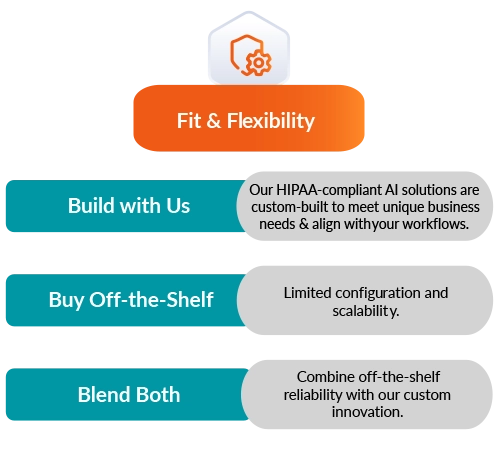
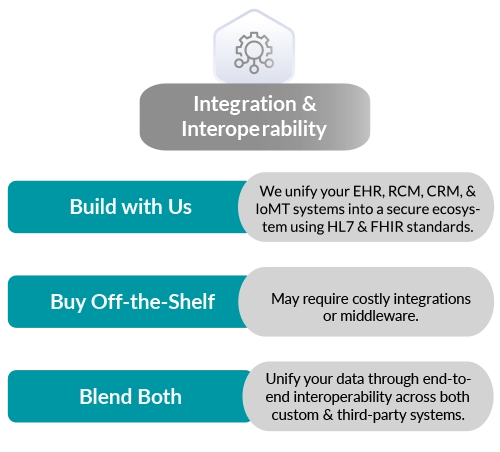
Speed, control, and scalability aren’t one-size-fits-all. Whether you're launching a new healthcare solution or upgrading legacy systems, this quick-hit comparison helps you weigh the trade-offs—custom builds, off-the-shelf ease, or a hybrid that delivers fast and flexibly.
Build with Us
Buy Off-the-Shelf
Blend Both
Speed to Value
We build from the ground up around your workflows.
Fast deployment with minimal setup.
Hybrid rollout with a rapid MVP delivery
Fit & Flexibility
Our HIPAA-compliant Al solutions are custom-built to meet unique business needs & align with your workflows.
Limited configuration and scalability.
Combine off-the-shelf reliability with our custom innovation.
Integration & Interoperability
We unify your EHR, RCM, CRM, & JoMT systems into a secure ecosys-tem using HL7 & FHIR standards.
May require costly integra-tions or middleware.
Unify your data through end-to-end interoperability across both custom & third party systems.
Ownership & Scalability
You own the code, the IP, and the roadmap - built for long-term growth.
Vendor-controlled roadmap and licensing.
Shared scalability with flexible expansion options.


Disclaimer:
This content has been made available for information purposes only. Views and opinions expressed in this content are those of the individual author only and do not necessarily represent the opinions and views of Chetu. Chetu, and its representatives, make no representation or warranty of any kind, express or implied, regarding the accuracy, adequacy, validity, reliability, availability, or completeness of any information of this content. Under no circumstances shall Chetu, or its representatives, have any liability to you or any loss or damage of any kind incurred as a result of the use of this content or reliance on any information provided in this content. Your use of this website and your reliance on any information on this content is solely at your own risk.
About Chetu:
Founded in 2000, Chetu empowers businesses with AI and digital transformation solutions, supporting startups, SMBs, and Fortune 5000 companies. We deliver end-to-end software solutions backed by global digital intelligence and industry expertise. Our customized software delivery model and one-stop-shop approach span the full technology spectrum. Headquartered in Sunrise, Florida, Chetu operates 13 locations across the U.S., Europe, and Asia.
See more at: Chetu Blogs


Limited Time Offer for a Free E-Book
Privacy Policy | Legal Policy | Careers | Sitemap | Referral | Contact Us
Copyright © 2000- 2026 Chetu Inc. All Rights Reserved.