Thank you!
Your blog has been successfully shared.


Let's Talk !  954 342 5676
  +44 137 243 2466
Director of Sales - Nick Swanson | February 19, 2026
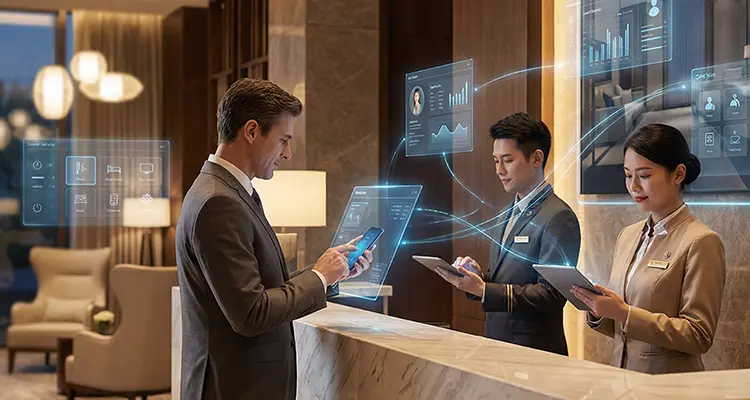
In 2026, hospitality managers and hotel owners face increasing pressure to deliver exceptional guest experiences while maintaining lean, efficient operations. Rising guest expectations, staffing challenges, and the growing number of digital touchpoints have made disconnected hotel systems a significant barrier to success.
Property Management System (PMS) integration has evolved from a back-office convenience into a strategic necessity. A modern, well-integrated PMS enables hotels to centralize operations, automate workflows, and turn operational data into meaningful guest interactions. For properties focused on growth, two-way PMS integration provides the foundation for scalability without compromising service quality.
By effectively integrating PMS through seamless data flow between various applications in and out of the PMS, hoteliers now have the potential to consolidate and simplify all applications including those used for food and beverage (F&B), Human Resources, Sales, Marketing, guest‑facing systems, POS, front office, accounting, housekeeping, maintenance, and amenities.
Two-way PMS integration ensures that data is synchronized in real time rather than pushed one direction. For example, when a reservation is modified, the update instantly reflects across channel managers, housekeeping schedules, billing systems, and access controls. This real-time consistency reduces operational friction, minimizes errors, and ensures that teams across departments are aligned.
When managing numerous moving parts, it is important to have a bird's eye view on all operations. PMS integration helps provide a 360 degree solution to minimize administration errors and time consumptions, plus eliminate duplication of data entry processes between departments. Hoteliers should be able to interact with data from all sectors on a single PMS platform to rectify interoperability dissonance.
The more proficient a hotel can run the less it costs in overhead, saving hotels immense amounts on their bottom line. Also, it decreases the time it takes employees to complete operational tasks, giving them more time to tend to patrons, increasing guest experience.
Guest expectations are changing thanks to the rise of mobile devices and the demand for services at their fingertips. Hotel systems have the ability to include applications for in-room dining menus and ordering, guest requests, hotel services, account information and updates, check-out, flight information, and local guides. Guests expect these amenities to be accessible via the in-room TV or their mobile devices.
It also means convenience for the guest through charging amenities to the room or using a single access card aka a closed loop mag-stripe card, throughout the property for both amenity access and charges. Integrating applications with a PMS is beneficial to hoteliers to be able to spot trends and tailor the hospitality experience to their guests. This also helps with gathering information for loyalty programs to entice patrons to come back.
The truth is, the hospitality industry and the technology that propels it are constantly evolving. Adopting a fully integrated PMS is imperative to keep up with ergonomic practices and consumer demands. It is exciting to see the fast pace at which advances in technology are shaping the future of PMS. We can look forward to further innovations in the hospitality field.
Two‑way PMS integration is especially critical for hotels focused on scalability and growth. As properties expand to multiple locations, consistent service standards and centralized control become harder to maintain without integrated systems.
With two‑way integration:
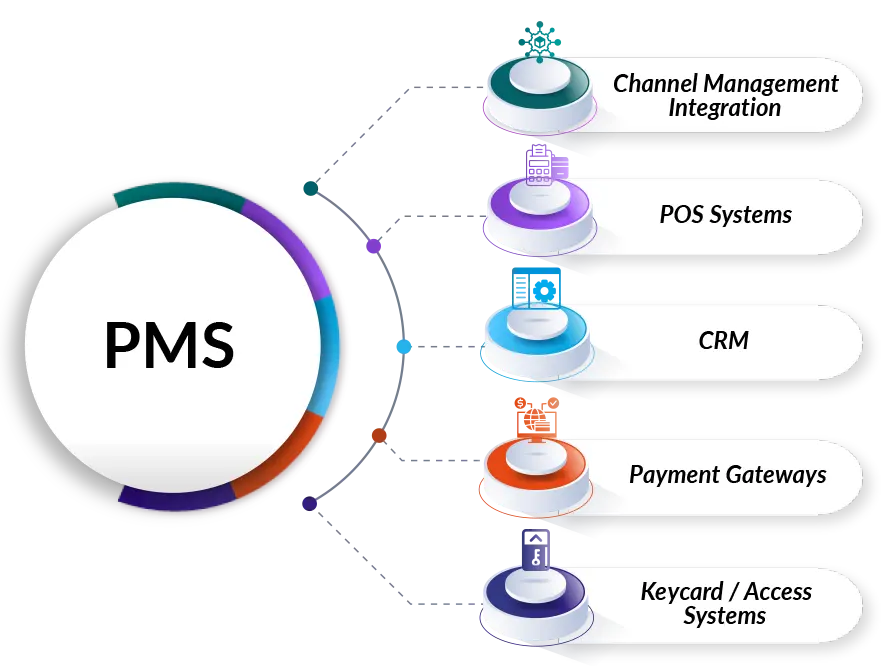
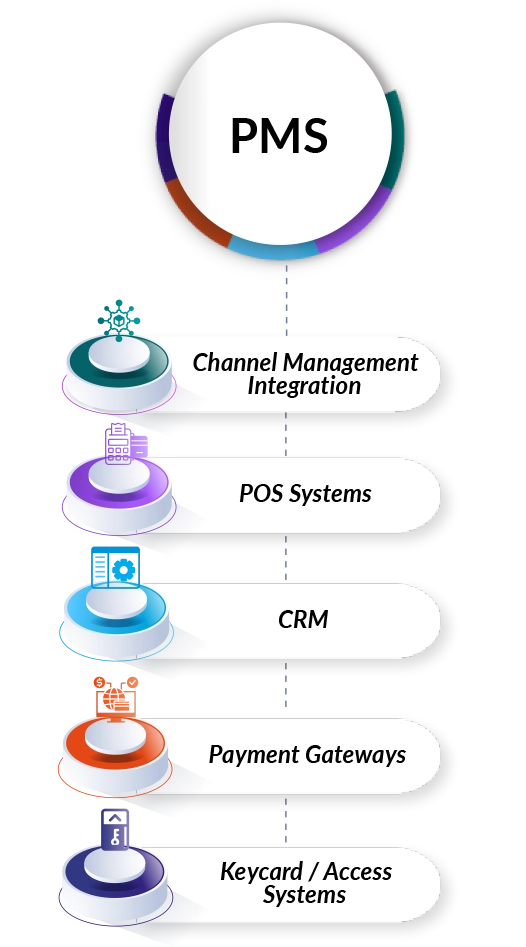
Channel management integration ensures real‑time inventory and rate updates across OTAs and booking platforms.
POS systems automatically sync charges and guest folios.
CRM platforms capture guest interactions and preferences for personalized marketing.
Payment gateways provide secure, unified billing experiences.
Keycard and access systems respond instantly to room status changes.
This interconnected ecosystem allows hotels to scale operations without proportionally increasing operational complexity or staffing requirements.
By effectively integrating PMS through seamless data flow between various applications, hoteliers can consolidate and simplify operations across F&B, HR, Sales, Marketing, guest‑facing platforms, POS, front office, accounting, housekeeping, maintenance, and amenities. This interlinking eliminates technology silos and creates a cohesive operational framework that supports both day‑to‑day efficiency and long‑term strategic growth.
Two-way PMS integrations allow data to flow back and forth between the PMS and connected systems such as channel management platforms, point of sale systems, CRM tools, payment gateways, and keycard or access systems. For example, when a guest updates a reservation through an online channel, the PMS reflects the change immediately, and any updates made at the front desk automatically sync back to external systems. This real-time exchange improves accuracy, prevents overbookings, and enhances operational reliability.
The convergence of Property Management Systems (PMS) and Event Management Systems (EMS) combines guest experience management with hotel operational efficiency. This integration allows hotels to manage accommodations, events, dining, and ancillary services within a single ecosystem. For guests, it results in more personalized and seamless experiences. For hotel operators, it improves forecasting, resource allocation, and revenue opportunities through tailored guest services.
In today’s digitally connected hospitality landscape, PMS integration is no longer optional, it is essential. Hotels that invest in two-way PMS integration gain operational clarity, improved guest satisfaction, and a scalable foundation for future growth.
Talk to Our PMS Experts to explore a personalized PMS integration solution aligned with your business goals.
Disclaimer:
This content has been made available for information purposes only. Views and opinions expressed in this content are those of the individual author only and do not necessarily represent the opinions and views of Chetu. Chetu, and its representatives, make no representation or warranty of any kind, express or implied, regarding the accuracy, adequacy, validity, reliability, availability, or completeness of any information of this content. Under no circumstances shall Chetu, or its representatives, have any liability to you or any loss or damage of any kind incurred as a result of the use of this content or reliance on any information provided in this content. Your use of this website and your reliance on any information on this content is solely at your own risk.
About Chetu:
Founded in 2000, Chetu empowers businesses with AI and digital transformation solutions, supporting startups, SMBs, and Fortune 5000 companies. We deliver end-to-end software solutions backed by global digital intelligence and industry expertise. Our customized software delivery model and one-stop-shop approach span the full technology spectrum. Headquartered in Sunrise, Florida, Chetu operates 13 locations across the U.S., Europe, and Asia.
See more at: Chetu Blogs
Share


Limited Time Offer for a Free E-Book
Privacy Policy | Legal Policy | Careers | Sitemap | Referral | Contact Us
Copyright © 2000- 2026 Chetu Inc. All Rights Reserved.