Thank you!
Your blog has been successfully shared.


Let's Talk !  954 342 5676
  +44 137 243 2466
Jaideep Sharma - Director of Operations | July 01, 2026
Increasingly, banks are being pressured to make lending decisions at a faster pace and with greater accuracy. Furthermore, financial institutions are having to manage rapidly increasing numbers of financial documents for which they are making lending decisions.
AI-powered credit intelligence platforms allow financial institutions to automate the processes associated with reviewing financial documents, improve risk management, and providing actionable insights to credit analysts. Financial institutions that implement the right strategy around AI will be able to build scalable lending operations that result in increased efficiency while still producing adequate quality in their lending decisions.
Financial institutions have always relied on accurate financial analysis in retail lending; however, as lenders as they must now review records and supply documents for much larger amounts of financial documents within tighter approval timelines, using traditional credit assessment methods has become much more difficult than it used to be to successfully meet these objective.
The findings of the 2025 Enterprise AI Report from OpenAI established that there is an exponential rise in enterprise AI adoption; therefore each year appears to have witnessed an eightfold increase in the volume of messages sent by enterprises to AI. This rapid uptake mirrors a much broader shift in companies toward integrating AI into their routine operational processes across many industry sectors.
In the context of financial services, AI-powered insights derived from credit analytics are reshaping the way financial services companies process financial information and evaluate the risk and provide insights associated with lending activities. By leveraging intelligent document processing, retrieval-augmented generation (RAG) and human oversight, lenders can perform credit analytics more efficiently while ensuring the quality of their lending decisions remains high.
The case study of Pulse Ratings Inc. — a firm that specializes in retail credit rating and consulting — demonstrates how an agentic AI (an AI that is regularly updated with real-time input from a human being) can provide a more modern approach to credit analytics and still maintain the application of expert judgment when making credit decisions.
Modern lending generates enormous volumes of structured and unstructured financial data. Credit analysts routinely review:
Balance sheets
Income statements
Cash flow reports
Retailer disclosures
Creditor filings
Annual financial reports
As organizations grow, both the volume and complexity of supporting financial documentation increase, making manual analysis increasingly time-consuming and difficult to scale.
Traditional credit analysis remains highly labor-intensive. Analysts spend hours collecting, reviewing, validating, and compiling financial information before reaching lending decisions.
This often results in:
Longer turnaround times
Inconsistent reporting standards
Higher operational costs
Analyst fatigue and burnout
As lending volumes continue to rise, these inefficiencies become major barriers to growth.
Retail lenders need to keep an eye out for changes in economic conditions, supply chain disruptions, inflation, and changes in consumer spending patterns.
Without timely credit risk intelligence, financial institutions could miss potential warning signs and ultimately lead to higher default rates, late responses to defaults, and increase overall portfolio risk.
Moving To Advanced Automation AI is expanding beyond automating repetitive tasks; today’s AI systems are able to comprehend and interpret contextual relationships across many thousands of different types of financial-documents based information, this means that there is now much more data available to make well-informed, fact-based credit decisions.
While the role of the credit analyst is to make the ultimate credit decision based on expert judgment, AI has evolved from a tool for simply automating routine tasks to becoming an intelligent assistant, enabling an increase in productivity so that credit analysts can focus on the most strategic aspects of their work, ultimately leading to better business performance and outcomes.
AI-powered co-pilots help financial analysts:
Surface critical insights faster
Identify emerging risk indicators
Standardize credit assessments
Reduce document review time
These capabilities improve both efficiency and consistency across lending operations.
Organizations adopting AI-powered credit analysis can achieve:
Faster credit decisions
Improved risk visibility
Better customer experiences
Greater decision consistency
Lower operational costs
These advantages are driving broader adoption of AI across lending and credit underwriting functions.
Pulse Ratings Inc. provides credit ratings and financial consulting services focused on evaluating retailers' financial health.
As document volumes continued to grow, analysts faced increasing pressure to review larger amounts of financial data quickly while maintaining the same level of accuracy, consistency, and regulatory compliance.
The company wanted a solution that would:
Automate financial document extraction
Accelerate report generation
Standardize assessments
Preserve expert oversight
To overcome these challenges, Pulse Ratings implemented an agentic AI framework powered by Retrieval-Augmented Generation (RAG).
The initiative focused on three primary objectives:
Automate financial data extraction and summarization
Generate draft credit analysis reports
Enable Analyst-in-the-Loop validation
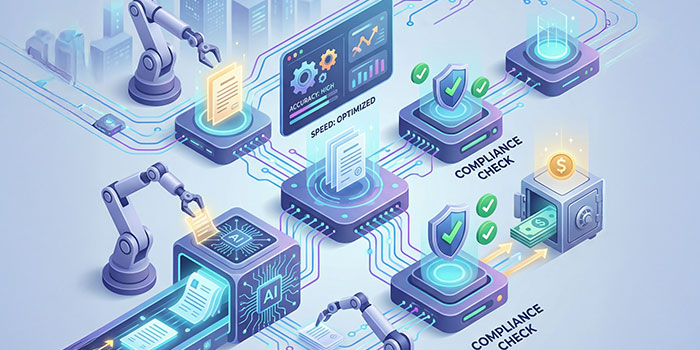
The resulting platform streamlined the entire credit analysis workflow—from document ingestion through analyst-reviewed reporting.
The solution was designed to:
Automate financial document processing
Improve reporting efficiency
Support scalable growth
Maintain compliance and governance
FastAPI manages document uploads, authentication, analyst interactions, and session management.
OCR, document extraction, text normalization, and content chunking prepare financial data for analysis.
OpenAI embeddings, semantic retrieval, and large language models generate context-aware financial insights.
AWS S3, MongoDB, and Chroma DB manage secure document storage, metadata, and vector retrieval.
Analysts access dashboards, validation of workflows, and administrative tools for reviewing AI-generated outputs.
Financial documents are securely uploaded and tagged with metadata for accurate retrieval.
Azure Form Recognizer will extract all text, tables, and layouts from any financial documents and convert them into structured data.
Embedding models convert document content into vectors stored within Chroma DB, enabling context-aware retrieval.
The platform will automatically produce financial health assessments, risk indicators, trend analysis, and draft credit reports which will allow for quicker, better informed lending decisions by lenders.
Human oversight remains essential for:
Regulatory compliance
Risk accountability
Decision validation
Governance requirements
Analysts continue to:
Verify AI-generated findings
Add contextual intelligence
Refine recommendations
Validate final reports
The most effective AI implementations:
Enhance analyst productivity
Improve decision accuracy
Support informed credit decisions
Combine AI speed with human expertise
Automation reduces analysis time and accelerates reporting cycles.
Organizations lower manual processing costs while improving productivity.
AI-powered workflows standardize assessments and reduce reporting variability.
Financial institutions gain earlier visibility into emerging risk indicators.
Analysts spend more time evaluating risk and less time compiling data.
Assess current workflow bottlenecks.
Centralize financial document management.
Implement OCR and intelligent document processing.
Deploy RAG-powered retrieval systems.
Establish Analyst-in-the-Loop validation workflows.
Create governance and compliance frameworks.
Future platforms will support autonomous workflows, multi-step reasoning, and AI-powered financial assistants.
Organizations will expand AI capabilities beyond PDFs to analyze spreadsheets, earnings reports, and alternative financial datasets.
Emerging solutions will provide:
Early warning systems
Portfolio monitoring
Risk forecasting
Continuous financial health assessments
The Pulse Ratings implementation reflects a broader shift taking place across financial services. Organizations are increasingly investing in AI platforms that combine intelligent retrieval with expert validation to improve decision quality and operational efficiency.
Industry research supports this momentum, with 71% of early generative AI adopters already implementing RAG architectures, while 73% of insurance executives identify AI as their top investment priority. Together, these trends demonstrate why AI-powered credit intelligence is becoming a strategic investment across lending and financial risk management.
Scaling manual credit analysis has become increasingly difficult in today's lending environment. Rising document volumes, growing regulatory expectations, and more complex financial data require smarter approaches to credit evaluation.
Using the Pulse Ratings framework has illustrated combining RAG, document processing, and AITL validation processes can drive operational efficiencies while preserving an expert’s judgment needed for responsible lending.
Furthermore, if financial services companies are successfully implementing intelligent automation in conjunction with human expertise, they will also reap the benefits of better risk management, improved speed in their lending decisions, enhanced operational efficiencies, and remain competitive in an increasingly data-driven marketplace in the financial industry.
We help financial institutions develop custom AI-powered credit intelligence solutions that streamline financial document processing, automate credit analysis, and improve risk management outcomes.
From intelligent document processing and RAG-powered knowledge retrieval to secure cloud-native architectures and Analyst-in-the-Loop validation frameworks, our team can help you modernize lending operations with confidence.
Disclaimer:
This content has been made available for information purposes only. Views and opinions expressed in this content are those of the individual author only and do not necessarily represent the opinions and views of Chetu. Chetu, and its representatives, make no representation or warranty of any kind, express or implied, regarding the accuracy, adequacy, validity, reliability, availability, or completeness of any information of this content. Under no circumstances shall Chetu, or its representatives, have any liability to you or any loss or damage of any kind incurred as a result of the use of this content or reliance on any information provided in this content. Your use of this website and your reliance on any information on this content is solely at your own risk.
About Chetu:
Founded in 2000, Chetu empowers businesses with AI and digital transformation solutions, supporting startups, SMBs, and Fortune 5000 companies. We deliver end-to-end software solutions backed by global digital intelligence and industry expertise. Our customized software delivery model and one-stop-shop approach span the full technology spectrum. Headquartered in Sunrise, Florida, Chetu operates 13 locations across the U.S., Europe, and Asia.
See more at: Chetu Blogs
Share


Limited Time Offer for a Free E-Book
Privacy Policy | Legal Policy | Careers | Sitemap | Referral | Contact Us
Copyright © 2000- 2026 Chetu Inc. All Rights Reserved.