Thank you!
Your blog has been successfully shared.


Let's Talk !  954 342 5676
  +44 137 243 2466
Rohith Raghuprakash - Director of Operations | April 07, 2026
The debt collection industry is under more pressure than it has been in years. Consumer delinquencies are climbing, Federal Reserve Bank of New York data puts total household debt delinquency at 4.5% as of Q3 2025, while regulatory scrutiny is tightening, and contact rates from traditional phone outreach are falling. Against that backdrop, the question most collection operations are wrestling with is no longer whether to modernize, but how fast to move.
This article breaks down what separates AI-powered collections from traditional approaches across the metrics that matter most: speed, personalization, accuracy, cost, compliance, and scalability. Whether you're evaluating new AI debt collections software or building a business case internally, understanding the practical differences is the right place to start.
For most of its history, debt collection has been a fundamentally manual operation. Agents work through lists of delinquent accounts, make calls, leave voicemails, send letters, and try again. The cadence is driven largely by volume and gut feel, who seems most reachable, which accounts are closest to charge-off, which balances are large enough to prioritize.
That model worked reasonably well when portfolios were smaller, and consumers still answered unknown numbers. But those conditions have changed, traditional methods now struggle against a landscape where:
Average recovery rates sit between 20–30% for delinquent accounts
Agent utilization rates for outbound calling hover around 40–45%
Fully-loaded collection fees can run 20–50% of recovered amounts
Younger consumers increasingly ignore phone calls from numbers they don't recognize
Regulation F, FDCPA, and TCPA create compliance obligations that are difficult to enforce consistently at scale
The result is a model that is expensive, hard to scale, and increasingly misaligned with how modern consumers want to engage.
AI adoption in debt collection has accelerated sharply over the last few years. According to ACA International's 2024 report, 57% of agencies are already using AI in some capacity, up from roughly 25% in 2020. Investment in AI and machine learning among collection firms rose from 11% of companies in 2023 to 18% in 2024, and nearly half of firms that had no AI plans a year ago are now actively evaluating options.
The driver isn't novelty. It's economics. Traditional operations scale linearly, more accounts means more agents, more supervisors, more compliance overhead. AI introduces what analysts describe as operating leverage: the ability to absorb significantly higher volumes without proportionate cost increases. That's a structural advantage in an industry where delinquency volumes are rising and margins are thinning.
The message from those numbers is fairly straightforward: this shift is no longer on the horizon. It's already underway.
The AI in collections is not one technology, but a combination of multiple technologies. Fundamentally, machine learning algorithms use historical payment data, credit profile, and behavioral indicators to rate every account on the basis of probability of repayment. That scoring layer is what separates AI-driven prioritization from gut-feel queue management: collectors work accounts in the order the data says will produce results.
Natural Language Processing is next to that scoring engine, which drives the conversational component of collections, AI-based agents that can make outreach calls or execute negotiating payments, as well as transcribes and analyzes live agent conversations in real time.
Robotic Process Automation handles the repetitive work that consumes agent hours without requiring human judgment, such as data entry, payment posting, and follow-up scheduling. It all is linked through API integrations to the existing systems, CRMs, payment processors, and core banking platforms, maintaining the information in every touch point up-to-date.
The table below summarizes the key differences at a glance. The sections that follow examine each dimension in more detail.
| Category | Traditional Collections | AI-Powered Collections |
|---|---|---|
| Efficiency & Speed | Manual outreach; agents handle one account at a time | Simultaneous processing of thousands of accounts; 24/7 automated engagement |
| Personalization & Customer Experience | Generic scripts, and the same letter goes to every account | Dynamic messaging tailored to debtor behavior, channel preference, and payment history |
| Accuracy & Decision-Making | Human error in data entry; inconsistent decisions | ML-driven scoring; 95% reduction in data entry errors via RPA |
| Cost & ROI | High fixed costs (labor, training, supervision) | 40–60% cost reduction vs. traditional models |
| Compliance | Dependent on agent memory; manual audit trails | FDCPA/TCPA/Reg F rules hard-coded; automated audit logs |
| Scalability | Scales linearly, more volume requires more headcount | Scales instantly to any volume with no added agents |
| Recovery Rate | 20–30% average on delinquent accounts | 25%+ improvement through predictive scoring (Kaplan Group, 2025) |
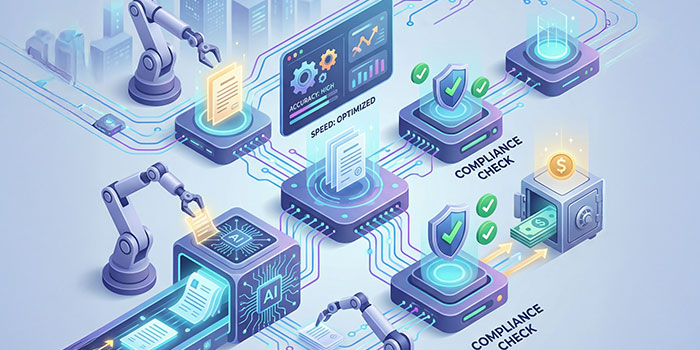
In a properly setup AI debt collections environment, most of the routine tasks are automated, whether it is payment reminders or compliance logging. The automation helps the collectors to work on other tasks and here’s how this works in practice:
If these systems don’t connect properly, even advanced AI solutions may fall short.
Modern collections automation is a coordinated stack of purpose-built tools, each eliminating a specific category of manual effort:
Beyond specific features, well-configured collections automation shifts the operating model in ways that compound over time. Early-intervention triggers flag accounts showing financial stress signals, enabling proactive outreach that prevents charge-offs. Dynamic offer management adjusts settlement terms in real time based on predicted debtor capacity, lifting settlement rates by as much as 32% in documented deployments. And because AI continuously tests message timing, and offer structure in the background, strategy improves automatically.
The financial case for AI in debt collections isn't theoretical, it shows up across four areas that directly affect your bottom line.
Data-Driven Decisioning: AI models score every account by repayment likelihood using payment history, behavioral signals, and macroeconomic data, so your team works on accounts in the order that actually produces results.
Reduced Human Effort: Routine tasks, such as outreach, reminders, balance confirmations, and dispute acknowledgments, run automatically. This feature unburdens the agent to help in negotiations and tasks that actually require their attention.
Better Recovery Rates: AI-powered collections consistently show 20–30% improvement in recovery rates over traditional methods. Personalized payment plans lifted promise-to-pay completion by 35% in Kaplan Group's 2025 analysis, and digital self-service channels recovered 28% more than equivalent outbound calling pools.
Operational Cost Reduction: Operational costs drop 40–60% when routine interactions shift to automated systems, with cost per dollar collected falling from $0.22 to $0.12 in documented deployments.
It is well established fact, that poorly integrated system quickly shows up in compliance exposure and recovery performance. This is why choosing the best AI debt collections solutions should be done after a proper evaluation of capabilities, and some of which should not be ignored are:
Compliance enforcement built into workflow logic, FDCPA, TCPA, and Regulation F rules applied automatically, not dependent on agent recall or manual configuration
Real API integrations with your CRM, dialer, and payment processor, bidirectional, real-time
ML-driven account scoring with explainable outputs, you need to understand why an account was prioritized, both for internal buy-in and regulatory defensibility
Omnichannel capability, voice, SMS, email, and self-service portals, with intelligent channel selection driven by debtor behavior
Self-service payment portals with AI-generated plan options, accessible around the clock
Dashboards tracking the KPIs like recovery rate, cost per dollar collected, and promise-to-pay completion
Security certifications, SOC 2, PCI-DSS, and ISO 27001 are baseline requirements for any platform handling consumer financial data
Choosing between off the shelf platform and developing custom software depends on your workflows and the role of collections performance in your industry.
While off-the-shelf solutions get you to value faster; custom development makes sense when your asset types or existing systems require something a configurable product can't accommodate. Either way, you need the best implementation partner because integrating AI in debt collections touches compliance architecture, model tuning, and change management, none of which are plug-and-play.
There's a clear and growing distinction between AI debt collection and the traditional methods we've been using and the difference shows up in recovery rates, compliance risks, and how well operations can expand. In fact, Data from the industry consistently indicates that AI not only improves the current processes but also shifts the financial dynamics of collections over time.
However, that doesn't mean every organization has to start from scratch immediately. The best strategy for you will depend on factors like the size of your portfolio and your compliance landscape, as well as where you can make the most impactful changes. But with delinquency volumes rising, margins tightening, and regulators paying closer attention than ever, the window for treating AI adoption as a future consideration is narrowing.
If you'd like to discuss what that looks like for your organization, our AI debt collection software team is ready to help.
Disclaimer:
This content has been made available for information purposes only. Views and opinions expressed in this content are those of the individual author only and do not necessarily represent the opinions and views of Chetu. Chetu, and its representatives, make no representation or warranty of any kind, express or implied, regarding the accuracy, adequacy, validity, reliability, availability, or completeness of any information of this content. Under no circumstances shall Chetu, or its representatives, have any liability to you or any loss or damage of any kind incurred as a result of the use of this content or reliance on any information provided in this content. Your use of this website and your reliance on any information on this content is solely at your own risk.
About Chetu:
Founded in 2000, Chetu empowers businesses with AI and digital transformation solutions, supporting startups, SMBs, and Fortune 5000 companies. We deliver end-to-end software solutions backed by global digital intelligence and industry expertise. Our customized software delivery model and one-stop-shop approach span the full technology spectrum. Headquartered in Sunrise, Florida, Chetu operates 13 locations across the U.S., Europe, and Asia.
See more at: Chetu Blogs
Share


Limited Time Offer for a Free E-Book
Privacy Policy | Legal Policy | Careers | Sitemap | Referral | Contact Us
Copyright © 2000- 2026 Chetu Inc. All Rights Reserved.