Thank you!
Your blog has been successfully shared.


Let's Talk !  954 342 5676
  +44 137 243 2466
Ranjeet Kumar - Director of Operations | May 26, 2026
According to the World Health Organization (WHO), about 466 million people worldwide are deaf or hard of hearing. On top of this, the National Center for Learning Disabilities estimates that 1 in 5 people in the U.S. struggle with learning or attention span challenges, whether it be ADHD, dyslexia, autism, or some other neurodivergent differences. This statistical data is expected to increase in the coming years, and with society spending more time on live digital media than ever, companies have been shifting their efforts to accommodate everyone, including those with special needs.
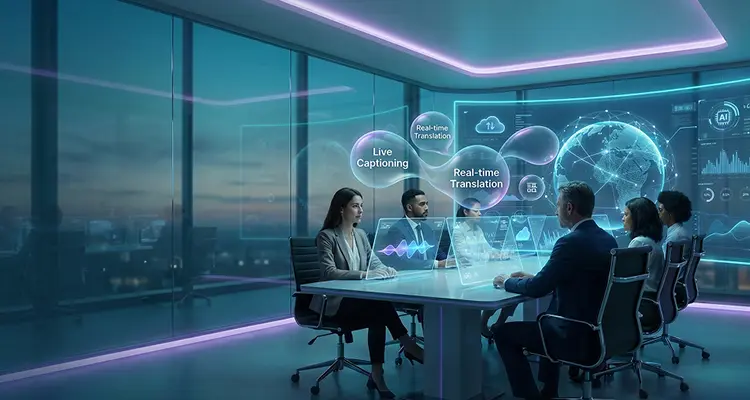
Enter real-time captioning, a complex solution that uses technologies like Artificial Intelligence (AI) capable of Natural Language Processing (NLP), Automatic Speech Recognition (ASR), and more to provide the accessibility desired and required of any live media, digital or traditional.
The process of converting spoken audio into live text instantly is called real-time AI captioning. It is a widely employed technology when dealing with digital encounters like webinars, video conferencing, broadcasting, online educational classes, and live streaming. Furthermore, the requirement for assistive technology is constantly increasing throughout the world. That is why organizations are investing their money in digital communication and accessibility solutions.
Highly proficient software developers with deep knowledge of the technologies that deal with understanding and generating human language can create and integrate real-time captioning into different platforms and applications. Here is a quick summary of the essential components:
ASR engines can use acoustic models, language models, and dictionaries to convert audio signals into text accurately. This function is possible through Machine Learning (ML) algorithms, which recognize and transcribe the words in real time.
MT technology translates the text generated by the ASR engine into the target language. MT engines use neural networks and other machine learning algorithms to learn how to translate text from one language to another accurately. MT engines can be trained on large datasets to improve their accuracy and to handle different dialects and accents.
With NLP, the software can process and analyze the text generated by ASR engines. This tool can improve the accuracy of the captions by analyzing the context of the content.
Businesses that have taken the plunge with real-time captioning apps generally base their dependence on these features mostly on aspects such as accessibility, communication, and engagement being improved during their face-to-face communication. Working with different groups is one of the things in which real-time captioning has brought additional changes and improvements. Some examples include meetings, online seminars, and training sessions.
For video conferences, remote meetings and executive presentations, they deploy live transcription features to promote collaboration.
Apart from accessibility, live captioning AI is also a good way to increase the engagement of the audience in webinars, conferences and hybrid events.
Captions give employees a better chance of grasping content while providing support for accessibility compliance requirements in workforce training programs.
Streaming services include live captioning to aid users in accessibility, multi-language communication, and content discovery.
There are some operational benefits that businesses utilizing speech-to-text services in media and entertainment software solutions can enjoy.
Improved Accessibility
Better User Engagement
Enhanced Content Comprehension
Multilingual Reach
Searchability & Content Repurposing
Regulatory Compliance
To embed real-time captioning software into digital platforms, one must have a solid technical setup that supports live streaming. Generally speaking, the development work consists in connecting the speech recognition tool with the streaming, conferencing, and media platforms by using APIs or SDKs. This kind of integration can basically mean the following:
Real-time audio ingestion
Streaming data pipelines
Low-latency processing
Cloud-based scaling
AI transcription engines
Multilingual translation layers
Caption rendering systems
Despite major advances in AI transcription software, implementing accurate real-time captioning still presents technical challenges.
Background Noise
Accent & Dialect Recognition
Latency Management
Industry-Specific Terminology
Speaker Overlap
Global businesses increasingly require captioning systems that support multilingual communication and international audiences.
Modern AI captioning platforms can:
Translate captions into multiple languages
Support region-specific dialects
Process multilingual meetings in real time
Improve accessibility across global teams
With an increase in digital communication, companies also have to think of their content being accessible. That's why many adopt standards and regulations for accessibility in live captioning.
The ADA requires many organizations to provide accessible communication experiences for individuals with disabilities.
WCAG standards define accessibility best practices for websites, digital media, and online applications.
Federal agencies and organizations receiving government funding may need to comply with Section 508 accessibility standards.
The EAA establishes accessibility requirements for digital products and services across the European Union.
AI for live captioning won't be just simple speech recognition anymore. In fact, the best AI captioning tools available today offer features like generating meeting summaries automatically, real-time language translation, speaker identification, sentiment detection, and editable transcripts. Given the fact that AI and automation technologies continue to evolve, smart captioning tools will, in the not too distant future, be a business necessity.
Choosing the right real-time AI captioning solution depends on several business and technical considerations.
Organizations should evaluate:
Caption accuracy rates
Latency performance
Multilingual capabilities
API flexibility
Security and compliance support
Scalability requirements
Integration compatibility
Custom AI development options
Out-of-the-box tools might be fine for simple use cases, but more complex settings will call for custom-made solutions that take into account the company’s workflow and other specifics. Cooperation with a software development firm is recommended because it will make it possible to develop such systems.
Businesses' ways of communication, collaboration, and digital experience delivery are being completely changed by the rise of real-time AI captioning. Besides making things more accessible and engaging, it also allows people speaking different languages to communicate, and helps make sure things are done based on regulations. The use of AI captioning solutions is becoming a necessity for different industries.
As companies are placing more and more resources in virtual meetings, broadcasts, eLearning, and smart communication platforms, the need for real-time transcription solutions that can be scaled up or down will keep increasing.
Disclaimer:
This content has been made available for information purposes only. Views and opinions expressed in this content are those of the individual author only and do not necessarily represent the opinions and views of Chetu. Chetu, and its representatives, make no representation or warranty of any kind, express or implied, regarding the accuracy, adequacy, validity, reliability, availability, or completeness of any information of this content. Under no circumstances shall Chetu, or its representatives, have any liability to you or any loss or damage of any kind incurred as a result of the use of this content or reliance on any information provided in this content. Your use of this website and your reliance on any information on this content is solely at your own risk.
About Chetu:
Founded in 2000, Chetu empowers businesses with AI and digital transformation solutions, supporting startups, SMBs, and Fortune 5000 companies. We deliver end-to-end software solutions backed by global digital intelligence and industry expertise. Our customized software delivery model and one-stop-shop approach span the full technology spectrum. Headquartered in Sunrise, Florida, Chetu operates 13 locations across the U.S., Europe, and Asia.
See more at: Chetu Blogs
Share


Limited Time Offer for a Free E-Book
Privacy Policy | Legal Policy | Careers | Sitemap | Referral | Contact Us
Copyright © 2000- 2026 Chetu Inc. All Rights Reserved.