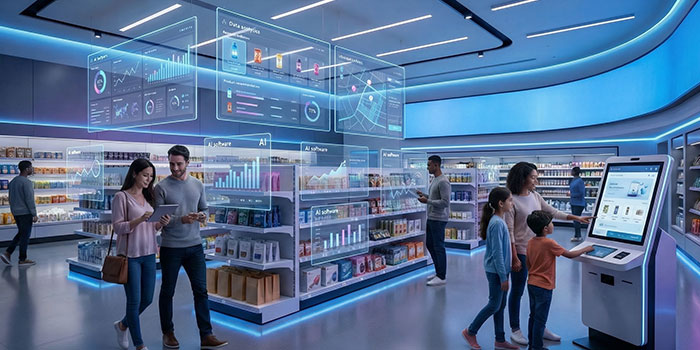
Revolutionizing Retail with Digital Sales Rooms for Growth
Roland Burrell – Director of Sales | October 13, 2026
- Collaborating with buyers in a centralized environment: Digital sales rooms consolidate content, communication and stakeholders in a tailored environment, minimizing disjointed emails and information.
- Real-time engagement insights: Sales teams have a better understanding of buyer behavior, can spot stalled deals, and follow-up accordingly.
- Faster retail sales cycles: Personalized content, shared access and the defined next steps help to facilitate multi-stakeholder purchases, reorders and vendor relationships.
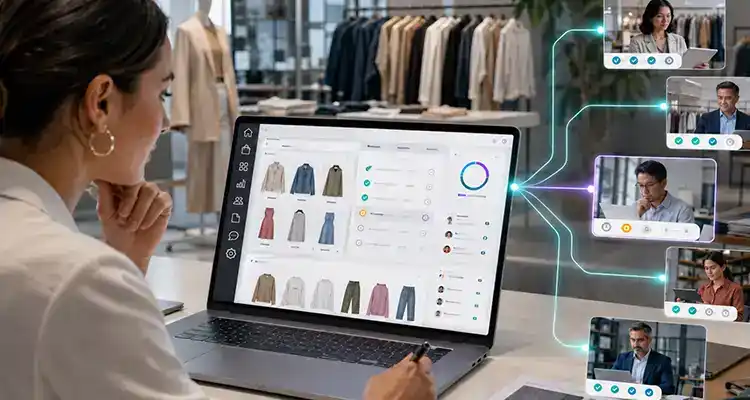
Retail buying rarely happens in one conversation. A single purchase decision on a new apparel line, a seasonal reorder, a wholesale contract renewal can pass through six or more people before a purchase order is cut: store ops, merchandising, finance, regional managers, sometimes procurement. Along the way, the deal lives in scattered email threads, PDF attachments, and disconnected calls, and the vendor rep is often the last to know when something stalls.
This is the exact friction that personalised digital showrooms were built to remove. A digital sales room gives retail vendors and their buyers one persistent, branded space to manage the entire deal from first pitch to signed contract to next reorder instead of forcing the relationship through a dozen fragmented channels.
Here's what digital sales rooms are, why retail buying breaks down without one, and how to evaluate a digital sales room solution for your team.
What Is a Digital Sales Room?
A digital sales room is a secure, personalized digital space where a sales rep and a buyer collaborate on a deal in real time. A digital sales room can be integrated with a retailer's CRM, ERP, PIM, e-commerce, and analytics systems, feeding data to a deal-specific selling platform that includes relevant customer, product, inventory, and engagement data. This integrated environment enables sales teams to provide more personalized buyer experiences, while maintaining deal activity and insights synced across business systems. It's not a shared drive or a static portal the difference matters:
- A shared folder holds files. A digital sales room platform holds a live, evolving deal: content, conversation, next steps, and engagement data, all in one link.
- A generic portal is the same for every buyer. A digital sales room is personalized per account, per stakeholder, and updated as the deal progresses.
- Email attachments are one-directional. A digital sales room is interactive buyers can comment, ask questions, and move through content on their own schedule, while reps see exactly how.
That visibility is the core value proposition, and it's where digital sales room capability starts to outperform the old model.
Why Traditional Retail Buying Creates Sales Friction
Retail deals especially multi-stakeholder or wholesale ones tend to break down in predictable ways:
Pricing sheets in one email, line sheets in another, contract terms in a third. Nothing lives in one place.
Did finance actually open the pricing terms? Did the regional manager review the new SKU catalog? Without a digital sales room, reps are guessing.
Versions of pricing or product specs drift across email chains, and buyers lose confidence in what's current.
Every new stakeholder who joins the conversation needs to be brought up to speed manually, which slows the cycle.
In retail specifically, where relationships and reliability drive renewal and reorder behavior, that erosion has a longer tail than a single lost deal.
AI- Powered Features of a Digital Sales Rooms
All the best digital sales room software features are similar. What to look for:
- AI-Powered Product & SKU Recommendations Recommends relevant products, SKUs, bundles, and complementary products/offers as per the buying needs and interactions. This enables sales representatives in retail to offer more relevant choices and deliver a better customer experience without having to sift through myriad inventories individually.
- Personalized Content Recommendations Suggest relevant case studies, product information, technical documents, and pricing documents based on each stakeholder's interest. Buyers are given information relevant to their role and where they are in the sales process.
- Buyer Engagement Intelligence Records of interactions between buyers and content shared, such as what they view, revisit, or ignore. These insights can be used by sales teams to learn more about interests and where to follow up.
- AI-Assisted Sales Follow-Ups Supports the sales team with timely follow-up messages that are relevant to the buyer and their activity. For instance, when a buyer is looking at inventory solutions, they can get information related to implementing or integrating the solution.
- AI-Generated Deal & Interaction Summaries Centralizes buyer conversations, meetings, questions, and important content interactions. This makes it easier to interpret needs, decisions, objections, and action steps for the sales team.
- Predictive Identification of Stalled Deals Recognizes that things may not be going as smoothly and that a deal might not be going the way it should, such as poor engagement, failing to get follow-ups, or lack of activity. Sales teams can get in the game and make an impact earlier and before the opportunity becomes cold.
- Conversational AI for Buyer Questions & Product Information It allows buyers to make inquiries instantly and find the specifications of a product, SKU details, information on compatibility, and other useful details. This, in turn, cuts down the time taken to get information and allows buyers to find the required information/query without having to rely on the sales representative for help.
How Digital Sales Rooms Enhance the Sales Process
The digital sales room provides a unified platform for people, content, conversations, and deal activities. This means that retail sales teams can have a better understanding of their sales processes, experience more streamlined purchases, and enjoy greater insights into their customers' intentions and level of engagement.
- Reduce Buyer Research Time: Purchasers may obtain product information, case studies, pricing information, and other important data from one centralized location instead of looking through emails and numerous links. This enables stakeholders to choose a solution that meets their needs faster and more easily.
- Enable More Informed Sales Decisions: By utilizing engagement analytics, sales forces can understand the content consumers engage with, go back to, share, or overlook. When paired with artificial intelligence, these insights can determine buyer motivations and lead sales representatives to conduct their most pertinent conversations.
- Prioritize Follow-Ups More Effectively: The ability of AI to analyze engagement patterns allows sales teams to determine which individuals are actively purchasing, as well as to discover the newest patterns, and see which opportunities are beginning to slow down. Instead of merely relying on intuition or manual effort in tracking, sales representatives can use such technologies as AI to direct their follow-up efforts to areas where they have the highest chances of making a sale.
- Reduce Back-and-Forth Communication: Digital sales rooms enable both clients and sales professionals to ask questions, offer comments, and engage in conversations regarding specific content. This minimizes time-consuming email communications while keeping significant dialogues tied with core information about the deal.
- Support Seamless Deal Handoffs: The area ensures centralized knowledge consisting of shared content, interactions of buyers, comments, and decisions made. Thus, it provides executives with the necessary context to continue in the long-term relationship without asking the buyer for any repetition of the information shared before.
- Improve Visibility Across Multiple Stakeholders: Retail transactions frequently involve executives from various departments such as operations and merchandising among others. All the parties involved have access to an online sales room, giving them the opportunity to stay informed about the progress related to the particular transaction.
Digital Sales Rooms for the Retail Industry
Retail has a few buying patterns that make digital sales rooms especially valuable and where retail-specific use cases go beyond a generic B2B sales motion:
Seasonal buying cycles.
Retail reorders are time sensitive. A digital sales room lets buyers move quickly through pre-approved catalogs and pricing without waiting on a rep to resend materials each season.
Multi-location and franchise buyers.
When a purchase decision involves a regional manager plus individual store leads, a shared room keeps everyone aligned on the same terms instead of relaying information second hand.
Wholesale and B2B retail catalogs.
SKU-level personalization inside the room lets a buyer see only the product lines relevant to their account, cutting through catalog noise.
Post-sale vendor retailer relationship management.
The same room that closed the deal can carry forward into renewals and reorders, becoming a standing relationship hub rather than a one-time sales tool.
A regional apparel buyer evaluating a new vendor typically must loop in five or six people before a purchase order is approved by store ops, merchandising, finance, sometimes a regional director. Under the old model, the vendor rep sends a line sheet by email and then waits, with no idea who's reviewed it. With a digital sales room, the rep can see that merchandising opened the line sheet twice, but finance hasn't touched the pricing terms yet so the rep follows up with finance directly instead of sending a generic "just checking in" email to the whole group. The personalized reorder catalog is already staged once the account tier is confirmed. What used to be a multi-week evaluation compresses meaningfully, not because the product changed, but because the rep isn't guessing where the deal is stuck.
Advantages of a Digital Sales Room
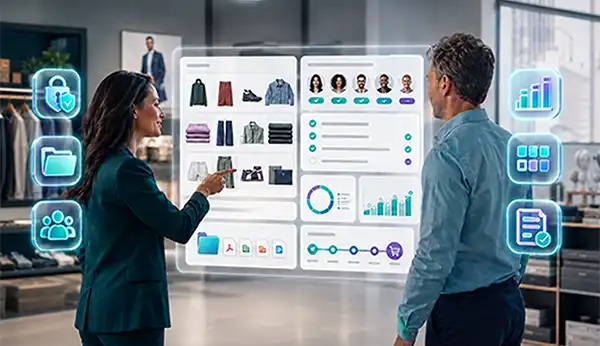
Framed by business outcome rather than feature, the advantages of a digital sales room typically include:
Faster deal velocity across multi-stakeholder purchases
Higher buyer engagement and trust, driven by a consistent, professional deal experience
Reduced sales cycle friction from eliminating repeated re-explaining
Better forecasting, grounded in real engagement data rather than rep intuition
Stronger brand presentation compared to scattered email attachments
Choosing Digital Sales Room Software
Choosing a digital sales room platform involves more than judging its collaboration and content-sharing abilities. In retail, such a platform must fit into the existing technology ecosystem, support customization, be scalable with expanding sales initiatives, and offer AI-powered intelligence without reducing the buyers' experience.
- API & Integration Support Search for REST APIs, webhooks, and connectors that have already been developed to integrate with systems like CRM, ERP, PIM, e-commerce merchants, CPQ, and analytics tools. This will enable a smooth movement of the customer, product, price, and inventory data incorporated into the sales ecosystem.
- Customization & Extensibility Check whether the platform offers customizable fields, workflows, branding, role, and permission for configuration, conditional content, and integration capabilities. A customizable DSR will be versatile enough for different business models, sales steps, product catalogs, and stakeholder needs and will not make teams follow narrow procedures.
- Scalability & Performance The system must be able to manage increasing numbers of people, accounts, products, digital sales rooms, and simultaneous clientele interactions without affecting performance. You should consider its capability of handling operations in many regions and business units, large content library, and huge volume of data.
- AI Capabilities & Data Intelligence Evaluate application-oriented AI functions like buyer intent analysis, suggestion of relevant content, suggestion of a product or SKU, consumer behavior analysis, summary generation, help with follow-up calls, and prediction of issues in closing deals. The AI should analyze real business transactions and customer interactions to enhance the sales process and not just implement typical automation technologies.
- Buyer Experience & Usability Assess page-load speed, compatibility on mobile devices, user-friendly interface, ease of finding information, and features providing user interaction. The DSR should enable various retail players to find needed info and to work together efficiently without having a need to study anything new or install different applications.
- Security & Data Governance Think about access management models, encryption, authentication, audit logging, data location, and permission administration. These controls are particularly relevant when dealing with digital sales rooms containing customer data, pricing details, contracts, product information, and sensitive business documents.
- Analytics & CRM Data Synchronization Select a platform that offers detailed engagement analytics and is capable of synchronizing relevant activity data with the CRM system. The sales team should have the ability to connect prospective buyer behaviors - for instance, content consumption, visiting frequency and the involvement of stakeholders - with the account and opportunity data.
- Workflow & Automation Support Look for configurable workflows that can automate room creation, stakeholder access, content delivery, notifications, approvals, and follow-up tasks. This reduces manual work while ensuring each buyer receives the appropriate information at the right stage of the sales cycle.
Final Thoughts
Retail sales cycles are already shaped by seasonality, multiple stakeholders, and shifting reorder patterns. Digital sales rooms don't remove that complexity, but they replace the guesswork and scattered communication that make it harder to manage. For retail teams looking to shorten cycles, build buyer trust, and turn engagement data into real sales strategy, a digital sales room is one of the more direct paths to growth.
Ready to see what a digital sales room could do for your retail pipeline? [Reach out for a demo] to get started.
Disclaimer:
This content has been made available for information purposes only. Views and opinions expressed in this content are those of the individual author only and do not necessarily represent the opinions and views of Chetu. Chetu, and its representatives, make no representation or warranty of any kind, express or implied, regarding the accuracy, adequacy, validity, reliability, availability, or completeness of any information of this content. Under no circumstances shall Chetu, or its representatives, have any liability to you or any loss or damage of any kind incurred as a result of the use of this content or reliance on any information provided in this content. Your use of this website and your reliance on any information on this content is solely at your own risk.
About Chetu:
Founded in 2000, Chetu empowers businesses with AI and digital transformation solutions, supporting startups, SMBs, and Fortune 5000 companies. We deliver end-to-end software solutions backed by global digital intelligence and industry expertise. Our customized software delivery model and one-stop-shop approach span the full technology spectrum. Headquartered in Sunrise, Florida, Chetu operates 13 locations across the U.S., Europe, and Asia.
See more at: Chetu Blogs
Share


Limited Time Offer for a Free E-Book

Suggested
Reading
Read our blogs on automation strategies, technology and business solutions.