Metaverse in Retail: Why Smart Brands Are Building Virtual Stores Now
Roland Burrell – Director of Sales | September 11, 2026
- Metaverse retail is gaining traction thanks to the use of virtual reality, augmented reality, three-dimensional environments, and artificial intelligence that enhances the shopping experience.
- Virtual shops may address issues such as a decrease in returned goods, an increase in customer interaction, and personalization in retail.
- Start with small steps and test small projects like three-dimensional product visualization, virtual fitting rooms, or interactive shops before tackling bigger metaverse plans.

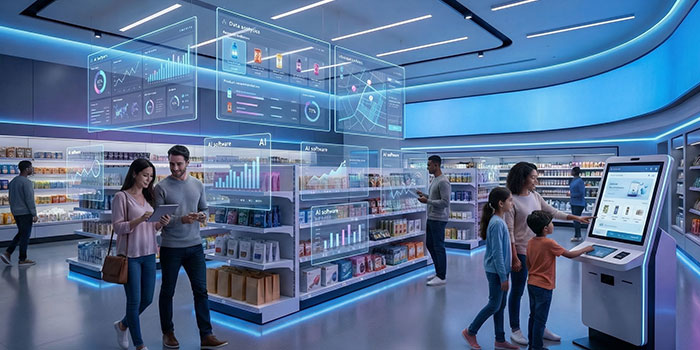
In Metaverse retail, the use of immersive technologies such as augmented reality, virtual reality, three-dimensional environments, and digital avatars completely transforms the way customers find, see, test, and purchase merchandise. In contrast to merely looking at a flat web page showing the product, consumers are provided with an opportunity to interact with the product housed in different virtual shops as well as visualize their item in their own environment or try the product out on the spot with the help of their tablet, mobile, or virtual reality headset.
This article explains what the current state of shopping in the metaverse looks like, where retailers have started experiencing gains as well as the things to take into account when developing a metaverse strategy that not only goes after a trend but also helps to solve real business issues like the gains, engagement, and loyalty of the customers has been caused by this metaverse shopping.
What Is Metaverse Shopping?
Metaverse shopping entails buying things through a continuously available, three-dimensional, digital world rather than through a two-dimensional web page. Rather than simply looking at images of items, the shopper wanders into a virtual store to take and fit various items on an avatar or place a three-dimensional picture of a sofa in their real living room.
It blends a few technologies that have matured a lot in the last few years:
- Augmented reality (AR) for overlaying digital products onto the real world through a phone or headset
- Virtual reality (VR) for fully immersive store environments
- 3D body and space scanning for accurate fit and sizing
- AI-driven personalization that adjusts what a shopper sees based on their behavior
Put together, these tools turn a purchase decision into something closer to a hands-on experience than a leap of faith.
Suppose that you are looking for a sofa. Rather than take pictures of the product and take measurements, you use AR to bring a 3D model of the sofa to your living room on your smartphone via the retailer's app. It can be walked around, measured, viewed in size and color, and experimented with various configurations prior to purchase.
For clothes, you can use your phone camera or a compatible device to make an avatar or body shape and virtually try how various sizes and styles fit your body.
VR offers a more immersive experience for virtual shops, with customers able to explore virtual stores and interact with virtual displays. But most customers will not need a VR headset to buy.
While smartphones are more prevalent, mobile AR can enable retailers to offer a host of immersive shopping experiences without the need for the customer to buy or own the technology. This way, it's easier to use, yet still allows for VR as a choice for those seeking more immersion.
Metaverse in Retail Market: The Numbers Behind the Momentum
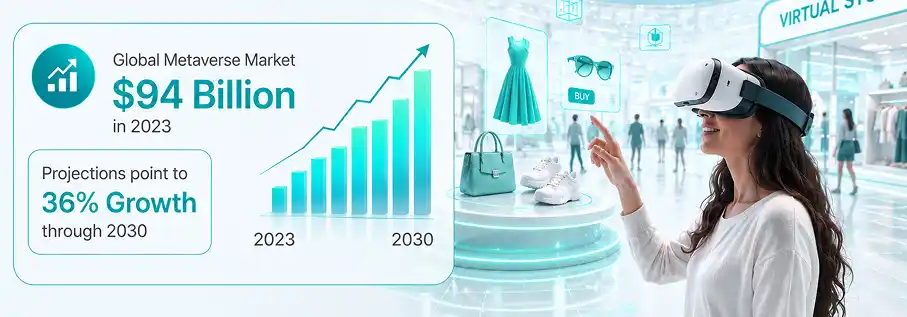
The growth here isn't speculative anymore. Statista placed the global metaverse market at roughly $94 billion in 2023, with projections pointing to 36% growth through 2030. That kind of trajectory is exactly why software teams and retail decision-makers are racing to stake out ground early rather than playing catch-up later.
The National Retail Federation reports retail sales in the U.S. in 2024 were $5.28 trillion, increasing by 3.6% over 2023. On the other hand, the total revenue of the global metaverse in e-commerce is forecasted to attain $106.13 billion by 2030, expanding at a 40% CAGR, according to Grand View Research. As the whole pie gets bigger, so does competition for consumers’ attention. This trend has prompted retailers to start exploring the use of Metaverse for e-commerce purposes below the line of novelty and on the level of quality differentiation.
Metaverse Retail Examples Worth Paying Attention To
Some of the most useful lessons come from brands already experimenting in this space:
Virtual showrooms and try-before-you-buy tools, apparel brands letting shoppers preview how a jacket or a pair of shoes will look on their body, cutting down the guesswork that usually leads to returns
Nike's digital engagement push, the brand has reported 70% higher engagement in its digital spaces compared to traditional channels, along with better conversion and a 25% drop in returns for products showcased virtually
3D home décor previews, furniture and home goods retailers letting customers drop a virtual couch or lamp into a scan of their own room before committing to a "high-ticket" purchase
Gamified brand experiences, retailers borrowing from gaming, where in-game purchases are projected to hit $74 billion by 2025, to build loyalty programs and branded worlds that keep customers coming back
These metaverse retail examples share a common thread: they replace a flat, one-size-fits-all shopping page with something interactive and personal.
Metaverse Retail Use Cases Solving Real Business Problems
It's easy to get distracted by the flashier side of virtual reality. The more compelling case for retailers is what it does for the parts of the business that quietly bleed money.
Cutting Down "Retail Hell" Return Costs
Forbes has pegged the cost of retail returns at around $642 billion a year industry-wide, a number that eats directly into margin and complicates inventory planning. A few ways virtual retail is chipping away at that:
- Virtual fitting rooms using body scanning to generate accurate measurements before checkout
- 3D product tutorials that walk shoppers through setup or sizing decisions post-purchase, reducing the "it wasn't what I expected" returns
- Room-scale previews for furniture and larger purchases, so buyers know exactly how something fits their space before it arrives
New Monetization Paths
Metaverse shops also revenue streams like in-world advertising that can't be found in normal e-commerce systems, such as drops of digital products, limited edition NFTs related to physical goods, and subscription models for content accessing. These activities do not replace primary income, but they do provide retailers with a new source of both money and consumer loyalty.
AI-Powered Personalization at Scale
Implementing AI technology in virtual shops allows merchants to form an environment that evolves with every customer. Companies can demonstrate various merchandise and store design depending on customers’ shopping practices. Also, it creates an endless channel of feedback. Thus, retailers can collect opinions from customers about a virtual store and test an idea or product even before launching it. As stated by Deloitte, traditional businesses that employ virtual prototyping can save around 30% of the time needed for product creation.
How Can Metaverse Applications Be Used in Retail to Create Unique Customer Experiences?
This is the question most retail leaders are really asking, and it comes down to a few concrete applications:
- Tailored e-commerce platforms that modify their design and display different items for customers based on who’s accessing them
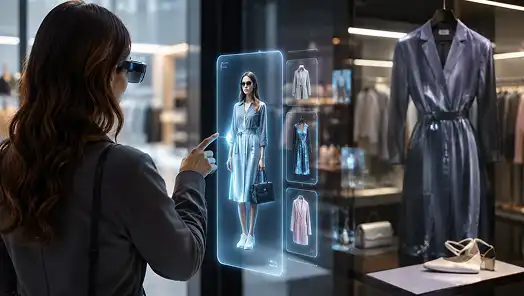
- Fitting and try-on software that employs avatars or augmented reality instead of fixed size tables
- Life-sized product presentations that give a client the opportunity to handle and modify a product in 3D
- E-stores where consumers can shop with their friends in the same virtual space regardless of their physical location
- Branded event launches, pop-ups, and previews available exclusively in the metaverse where loyal clients can find a reason to visit the event
- Every single one of these transformations turns a purchase into something that will be remembered by the customer.
Each of these turns a transaction into something a customer remembers, which is the whole point of building brand loyalty in a crowded market.
Building a Retail Metaverse Strategy: Where to Start
None of this requires a retailer to rebuild its entire digital presence overnight. A practical rollout usually looks like:
- Begin by suggesting one application, whether that be a virtual dressing room or a 3D product display is less complex than creating an entire branded universe
- Use a measurable metric, for example help to minimize product returns, increase average time spent on the website, or improve conversion for a certain product type
- Utilize available product data, since some 3D models and AR features can be made from existing photos and specifications that a retailer already possesses
- Experiment with mobile AR before switching to VR technology, since most consumers will be using mobile phones rather than headsets at least for the time being
- Look for a partner that specializes in retail rather than a more general metaverse agency as retail has specific issues with inventory and sizing as well as important aspects such as checkout that many platforms do not particularly focus on
Choosing a Metaverse Store Development Company
Not every software partner claiming to work in the realm of “metaverse" understands retail. When evaluating companies specializing in building metaverse stores, one should look for:
- A metaverse shopping platform that is integrated into existing inventory and POS systems, rather than just an independent demonstration
- Design AR/VR retail experiences for smartphones first, with support for tablets and headsets to reach customers across devices.
- Analytics that allow virtual experience to be correlated with real sales data and return rates
- History of compliance and payment processing in the field of retail
These practical aspects can make or break a metaverse shopping experience, differentiating between a captivating experiment and a promising retail channel that can generate tangible business impact and income.
Where This Is Headed
Retailers that profitably utilize this trend are not those who observe interesting performances of headsets but those who have implemented this metaverse technology to address the challenges that they have faced before, such as issues of excessive returns, flat engagement, and a shopping journey that has hardly changed over five years. Though this could mean virtual fitting experiences, virtual showrooms or virtual branded environments, one fact is proven - the technology has matured sufficiently to bring about actual figures instead of a lot of noise.
If you are curious about how virtual retail fits your business, the fastest way to find out about costs, timelines, and outcomes is to arrange a meeting with the metaverse strategy team that has experience in using AR/VR technologies in retail.
Disclaimer:
This content has been made available for information purposes only. Views and opinions expressed in this content are those of the individual author only and do not necessarily represent the opinions and views of Chetu. Chetu, and its representatives, make no representation or warranty of any kind, express or implied, regarding the accuracy, adequacy, validity, reliability, availability, or completeness of any information of this content. Under no circumstances shall Chetu, or its representatives, have any liability to you or any loss or damage of any kind incurred as a result of the use of this content or reliance on any information provided in this content. Your use of this website and your reliance on any information on this content is solely at your own risk.
About Chetu:
Founded in 2000, Chetu empowers businesses with AI and digital transformation solutions, supporting startups, SMBs, and Fortune 5000 companies. We deliver end-to-end software solutions backed by global digital intelligence and industry expertise. Our customized software delivery model and one-stop-shop approach span the full technology spectrum. Headquartered in Sunrise, Florida, Chetu operates 13 locations across the U.S., Europe, and Asia.
See more at: Chetu Blogs
Share


Limited Time Offer for a Free E-Book

Suggested
Reading
Read our blogs on automation strategies, technology and business solutions.