RPA in supply chain management uses software bots to automate repetitive, rule-based processes such as order processing, data entry, shipment tracking, inventory updates, invoice processing, reporting, and supplier management.
RPA in Supply Chain: Use Cases, Benefits & Implementation Guide
Roger Giscombe - Director of Operations | September 18, 2026
Key Takeaways:
- Automate Repetitive Tasks: RPA reduces manual work by automating rule-based processes such as order processing, inventory updates, shipment tracking, and reporting.
- Improve Efficiency & Accuracy: RPA can increase productivity, reduce operational costs, minimize data-entry errors, and improve compliance and customer experience.
- Enable Intelligent Automation: RPA can work alongside AI, ML, OCR, NLP, APIs, and enterprise systems to create scalable, end-to-end supply chain automation.

The movement of information quickly and correctly is vital to supply chains. But many businesses still depend on manual processes where staff must type in data, process orders, update orders on shipping records, match up invoices, produce reports and communicate, all between isolated systems. Such repetitive tasks take up important time and provide space for mistakes that can impact the entire supply chain.
Robotic process automation (RPA) can assist organizations in automating these rule-based repetitive processes by deploying software robots and enable them to concentrate on higher value tasks and achieve operational efficiencies.
RPA may assist in streamlining business operations from sourcing, inventory, warehousing, logistics, transportation, order fulfillment, compliance, and beyond as supply networks grow more intricate. RPA may be utilized to support a broader supply chain automation program when coupled with other technologies such as application programming interfaces (APIs), machine learning (ML), optical character recognition (OCR), and artificial intelligence (AI).
How Does RPA Enhance Supply Chain Management?
RPA in the Supply Chain Management is the application of software robots to handle repetitive tasks in the supply chain that would typically require human involvement. These bots can communicate with business applications, retrieve and move data, check data, create documents, modify records, and invoke a set of pre-defined workflows.
RPA can often be used with existing applications without organizations having to replace their legacy systems, unlike traditional automation. This is especially valuable for supply chains that rely on a variety of ERP, warehouse management, transportation management, procurement, CRM, and logistics platforms.
For instance, an RPA bot can be triggered by an email or a business system with an order, extract the necessary details, check the order with a set of rules, enter the details in an ERP system, update the stock, and notify the relevant employees.
As a result, the procedure is streamlined, and there are fewer human contact points. Supply chain errors, delays, and interruptions have the potential to cut into profits and place a tremendous financial load on the business in charge of the supply chain. By automating labor-intensive processes, companies may lessen the strain on their supply chain personnel and respond more quickly.
How Does RPA Improve Supply Chain Management?
RPA has the potential to improve supply chain operations by automating laborious processes and aligning a range of activities that may require human intervention.
Saving time & money by automating Repetitive Tasks
Teams in the supply chain frequently carry out recurring duties like data entry, invoice processing, order changes, reporting, and paper validation. Based on business rules and workflows, RPA robots can perform these duties. This frees up time from administrative activities, allowing staff to participate in jobs requiring judgment and decision-making.
Integrating Data between Systems
Many times, modern supply chains are dependent on several systems. Information can flow between ERP, warehouse management, transportation management, procurement, CRM, and supplier applications.
RPA can also help with the transfer of data from one system to another, thereby minimizing manual rekeying and ensuring that data remains consistent across systems. When greater system-to-system connectivity is needed, organizations can integrate with APIs and other integration technologies in addition to RPA.
Cover techniques for controlling Complex/Variable Processes.
Not all processes of a supply chain go in one direction. Exceptions, information missing, approvals, and business rules in flux can create complexity.
RPA can handle repetitive and repetitive parts of these processes and route the exceptions for them to the employees to view. This will create a balance between control and automation.
Helping for Inventory Management & Demand Planning
RPA can be used to gather inventory data, combine information from various systems, update inventory, trigger alerts, produce reports, and more.
RPA is not intended to be a replacement for sophisticated demand forecasting models. It can, however, automate data collection and preparation processes that can power AI- and ML-based forecasting.
Improving Compliance & Reporting
Documentation and reporting for internal controls, customers, suppliers, and regulatory needs can be required for a supply chain organization.
RPA can gather data from various systems, fill in template reports, verify necessary components, and store digital records. Can minimize manual effort to compliance activities as well as improve consistency.
Enabling Stakeholder Communication
A supply chain includes producers, suppliers, warehouses, distributors, merchants, and consumers as well as logistics companies.
Based on a given set of events, RPA can be utilized to automate notifications, status updates, warnings, and messages that are repetitious. For example, a bot might let a customer know the status update of their order or an internal team member when a shipment is postponed.
Top RPA Use Cases in Logistics & Supply Chain
RPA can be applied across many supply chains and logistics processes. The most effective opportunities typically involve high-volume, repetitive, and rule-based activities with structured or semi-structured data.
Order Processing & Fulfillment
Order processing often involves transferring information between multiple systems and validating customer, product, pricing, and inventory information.
RPA can automate activities such as:
Capturing order information
Validating customer and product data
Entering orders into ERP systems
Checking inventory availability
Updating order status
Generating order confirmations
Triggering fulfillment workflows
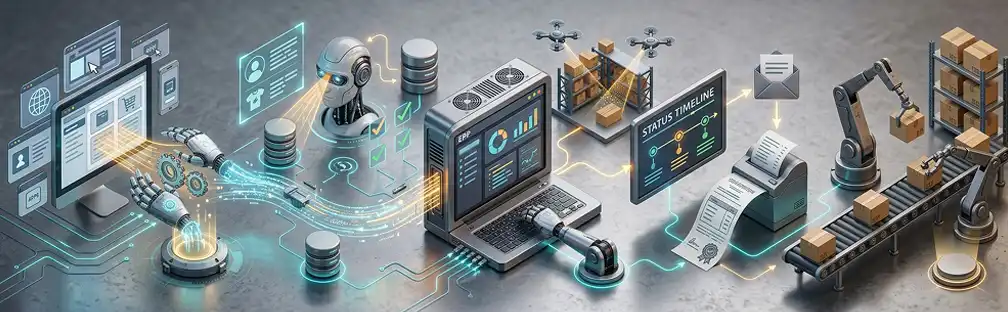
Automating these activities can help reduce processing times and minimize data-entry errors.
Shipment Scheduling & Tracking
Transportation teams must deal with shipment details, carrier information, schedules, updates on the status of shipments, and much more, on a regular basis.
RPA can gather tracking data from a carrier portal, update a transportation system, send a notification, and flag a shipment for attention.
This can save logistics teams from spending time manually tracking multiple systems.
Warehouse Operations
Warehouses collect a wealth of data from many sources throughout the day, including receipts, inventory movement, picks, packaging, shipping, and returns.
RPA may automate warehouse administration duties including data input, inventory management, shipment paperwork, and reporting. RPA can automate warehouse administrative tasks, such as data entry, inventory management, shipment documentation, and reporting.
In tandem with warehouse management systems, RPA can be used to decrease manual administrative tasks without having to fully automate all tasks performed in the warehouse.
Inventory Management
Avoiding stockouts, overstocking, and fulfillment delays depends on having accurate inventory data.
RPA can automate data consolidation, inventory reconciliation, exception notices, and updates across linked systems. It's also possible for bots to compile data from numerous inventory sources and make it ready for analysis or prediction.
Returns Processing
Returns may involve complicated operations including inventory systems, financial teams, logistics providers, consumers, and warehouses.
RPA can automate the checking of return authorizations, updating order records, creating documentation, sending notifications to stakeholders, and initiating predetermined refund or replacement processes.
This could make returns processing more regular while lowering human effort.
Customer Service
Increasingly, consumers demand real-time orders and shipping details.
RPA may automatically obtain information from backend systems and update client service platforms. In addition to status updates and regular notifications, bots can also help.
Customer service teams may dedicate more time to resolving complicated customer problems by automating routine information-retrieval duties.
Supplier & Vendor Management
Organizations must gather, validate, and store massive information when it comes to supplier management.
Activities that can be assisted by RPA include supplier onboarding, document collection, data validation, purchase order updates, invoice matching, and supplier communication.
This can help in the reduction of administrative work and better record keeping with suppliers for procurement teams.
Compliance Management & Reporting
Compliance processes often require information from multiple systems and departments. RPA can collect required data, validate documentation, populate reports, maintain records, and distribute reports according to predefined schedules.
This can help organizations improve reporting consistency and reduce the risk of manual omissions.
RPA vs. AI & Machine Learning in Supply Chain Automation
RPA and AI are comparable technologies, but they are used in different ways. Repetitive, rule-based, and structured procedures are ideal for RPA. It may execute tasks in the same manner each time and run in accordance with the pre-established instructions.
AI and machine learning can process complex data, detect patterns, make predictions, and act as an aid to decision-making.
For instance, any given company may utilize machine learning to predict demand, and RPA to gather inventory data, import the forecasting results to an ERP system, and send notifications to the proper teams.
This is a wider intelligent automation plan where repetitive actions are performed by RPA and more complex analysis, and decision making is performed by AI.
Core Technologies Behind RPA in Supply Chain
RPA solutions can work alongside several technologies to automate more sophisticated supply chain processes.
UI Automation
Software robots may communicate with applications in ways that are comparable to people by using UI automation. Bots can navigate screens, enter data, retrieve data, and execute pre-determined activities. This might be helpful when businesses must automate processes using outdated applications that are devoid of contemporary integration functionalities.
Optical Character Recognition (OCR)
OCR technology may be used to convert data from documents and photographs into formats that machines can read. OCR may be used in conjunction with RPA to automatically process shipping papers, bills of lading, invoices, purchase orders, and other supply chain information.
Natural Language Processing (NLP)
NLP allows systems to process and understand human language. NLP can aid in email processing, document classification, information extraction, and automated replies to routine queries in supply chain scenarios.
Machine Learning (ML)
Machine learning can make predictions or categorizations by finding patterns in past data. By automating processes that call for more complicated, pre-programmed rules like prioritizing exceptions or spotting anomalies, ML can help businesses do so when used with RPA.
APIs & System Integration
APIs enable applications to exchange information directly. RPA and APIs can complement one another. APIs can provide direct, scalable system integration, while RPA can automate processes where APIs are unavailable, difficult to implement, or impractical.
Benefits of RPA in Supply Chain Management
Organizations can achieve several operational benefits by strategically implementing RPA across supply chain processes.
Higher Team Productivity
Automation of monotonous tasks lets staff members concentrate less on data entry, reconciliation, document processing, and regular reporting. Teams can instead concentrate on supplier connections, exception management, strategic planning, and process improvement.
Lower Operational Costs
RPA can reduce the amount of manual effort required to execute high-volume processes. Because software bots can perform repetitive tasks consistently and at scale, organizations can improve process efficiency while making better use of existing resources.
More Accurate Documentation
Errors can occur during manual data entry if values are entered incorrectly; information is duplicated, or records are incomplete. By adhering to predetermined norms and procedures, RPA contributes to consistency in system upgrades and documentation.
Improved Customer Experience
Better customer experience can be achieved by quicker order processing, precise shipment updates, and prompt communication. Without forcing people to manually monitor and report every status change, RPA may assist businesses in delivering more consistent updates.
Better Compliance & Risk Management
Defined business rules may be applied consistently, and more standardized records can be generated via automated workflows. Organizations can enhance process visibility, satisfy audit demands, and lower the risks connected to missing or incomplete documentation with its assistance.
Who Benefits from Supply Chain RPA?
RPA can benefit organizations across the supply chain ecosystem, including:
Manufacturers
Distributors
Wholesalers
Retailers
Logistics service
providers
providers
Third-party logistics
(3PL) providers
(3PL) providers
Freight and
transportation companies
transportation companies
Warehousing
organizations
organizations
E-commerce
businesses
businesses
Procurement
organizations
organizations
Healthcare supply
chains
chains
Food and beverage
companies
companies
Automotive
companies
companies
Consumer goods
organizations
organizations
The greatest opportunities typically exist where organizations process large volumes of transactions across multiple systems and rely heavily on repetitive manual workflows.
What to Look for in an Automated Supply Chain Solution
Choosing the right automation approach requires more than selecting an RPA platform. Organizations should evaluate how the solution will fit into their broader technology ecosystem and operational strategy.
Key considerations include:
Scalability: The solution should support increasing transaction volumes and additional workflows as automation expands.
Integration capabilities: It should work with existing ERP, WMS, TMS, CRM, procurement, and other enterprise systems.
Security: Automation workflows should follow appropriate access controls, authentication requirements, and data protection practices.
Exception handling: The solution should allow unusual or complex cases to be routed to human employees.
Monitoring and analytics: Teams should have visibility into bot performance, process outcomes, errors, and exceptions.
Governance: Organizations should establish policies for both access, development, testing, deployment, and maintenance.
AI readiness: Organizations should consider whether the automation architecture can incorporate AI, ML, OCR, NLP, and other intelligent technologies as their requirements evolve.
How to Implement RPA in Supply Chain & Logistics
Successful RPA implementation requires a structured approach. Automating a poor process without addressing underlying issues can simply make an inefficient process run faster.
Assess & Prioritize Processes
Start by identifying repetitive, high-volume, and rule-based processes.
Evaluate each process based on factors such as:
Transaction volume
Manual effort
Error frequency
Process complexity
Business impact
Standardization
Integration requirements
Potential return on investment
Prioritize processes where automation can deliver measurable operational value.

Select the Right RPA Platform or Partner
Organizations should evaluate RPA platforms and implementation partners based on their existing technology environment, business requirements, scalability needs, security requirements, and integration landscape.
The right partner should understand both automation technology and supply chain operations.
Pilot, Test & Scale
Rather than attempting to automate an entire supply chain simultaneously, begin with a well-defined process.
Develop a pilot, test it against real-world scenarios, measure the results, address exceptions, and refine the workflow.
Once the pilot demonstrates measurable value, organizations can expand automation to additional processes.
Establish Governance & Continuous Improvement
RPA is not a one-time implementation. Organizations need ongoing monitoring, maintenance, security reviews, bot performance analysis, and workflow optimization.
As business processes change, automated workflows must also be updated.
A governance framework can help establish ownership, approval processes, security controls, testing standards, and performance requirements.
Challenges of Implementing RPA in Supply Chain
Despite its benefits, RPA implementation can introduce challenges that organizations need to address.
Legacy System Dependencies
Many supply chains still rely on legacy applications. Changes to these systems can affect automation of workflows.
Organizations should assess system dependencies before deploying bots.
Process Standardization
RPA works best when processes are clearly defined and rule based. Automating highly inconsistent processes without first standardizing them can create additional complexity.
Exception Handling
Not every transaction will follow the standard workflow.
Automation solutions need mechanisms for identifying exceptions and routing them to the appropriate employees.
Data Quality
Poor-quality data can reduce the effectiveness of automated processes. Organizations should establish data validation and governance practices before scaling automation.
Security & Access Management
Bots often need access to business applications and sensitive information. Appropriate authentication, authorization, monitoring, and access controls are essential.
Change Management
Employees may need to adapt to new workflows and responsibilities following automation.
Organizations should clearly communicate how automation will affect roles and provide appropriate training and support.
Getting Started with Supply Chain RPA, Why Partner with Chetu?
Implementing RPA across supply chain operations requires more than deploying software bots. Organizations need to identify the right automation opportunities, integrate disparate systems, manage exceptions, and build workflows that can scale as business requirements evolve.
Chetu helps organizations develop and implement automation solutions tailored to their operational and technology environments. Our approach can combine RPA, AI, machine learning, OCR, NLP, APIs, and enterprise system integration to automate workflows across supply chain and logistics operations.
From order processing and inventory management to shipment tracking, supplier management, document processing, and reporting, we can help organizations identify opportunities for automation and develop solutions designed around their business processes.
By connecting automation with existing enterprise applications, organizations can reduce manual work, improve process consistency, and create a foundation for broader digital transformation.
Ready to automate repetitive supply chain processes and improve operational efficiency? Speak with a Chetu supply chain automation expert to explore your requirements.
Disclaimer:
This content has been made available for information purposes only. Views and opinions expressed in this content are those of the individual author only and do not necessarily represent the opinions and views of Chetu. Chetu, and its representatives, make no representation or warranty of any kind, express or implied, regarding the accuracy, adequacy, validity, reliability, availability, or completeness of any information of this content. Under no circumstances shall Chetu, or its representatives, have any liability to you or any loss or damage of any kind incurred as a result of the use of this content or reliance on any information provided in this content. Your use of this website and your reliance on any information on this content is solely at your own risk.
About Chetu:
Founded in 2000, Chetu empowers businesses with AI and digital transformation solutions, supporting startups, SMBs, and Fortune 5000 companies. We deliver end-to-end software solutions backed by global digital intelligence and industry expertise. Our customized software delivery model and one-stop-shop approach span the full technology spectrum. Headquartered in Sunrise, Florida, Chetu operates 13 locations across the U.S., Europe, and Asia.
See more at: Chetu Blogs
Share


Limited Time Offer for a Free E-Book
FAQs About RPA in Supply Chain
RPA in logistics can automate shipment tracking, scheduling, order processing, documentation, carrier updates, invoice processing, returns, and routine communication between logistics stakeholders.
Key benefits include higher productivity, reduced manual effort, improved data accuracy, faster processing, lower operational costs, better compliance, and improved visibility across repetitive workflows.
Yes. RPA can interact with many enterprise applications, including ERP, WMS, TMS, CRM, procurement, and logistics systems. APIs and other integration technologies can also be used where direct system integration is more appropriate.
No. RPA primarily automates repetitive, rule-based tasks, while AI can analyze complex information, identify patterns, generate predictions, and support decision-making. The two technologies can be combined to create intelligent automation workflows.
RPA can automate many inventory-related administrative processes, including data collection, reconciliation, record updates, reporting, and alerts. More advanced activities such as demand forecasting can be supported by integrating RPA with AI and machine learning.
Look for processes that are repetitive, high-volume, rule-based, standardized, and prone to manual errors. Processes involving multiple systems and significant administrative effort can also be strong candidates for automation.
Implementation timelines vary depending on process complexity, system integrations, data quality, security requirements, and the number of workflows involved. Starting with a focused pilot can help organizations validate the approach before scaling.
Traditional integration typically connects systems directly through APIs or other integration methods. RPA uses software bots to interact with applications and can be useful when direct integration is unavailable or impractical. In many environments, both approaches can work together.
RPA is increasingly being combined with AI, machine learning, intelligent document processing, analytics, and enterprise integration. This convergence can help organizations move from basic task automation toward more intelligent, end-to-end supply chain automation.
Suggested
Reading
Read our blogs on automation strategies, technology and business solutions.