The Evolution to Autonomous CRM
CRM software has spent twenty years being passive, a filing cabinet that waits for humans to update it. That's changing. AI in CRM has moved through three waves:
Wave 1: Predictive analytics (lead scoring, churn forecasting)
Wave 2: Generative copilots (draft an email, summarize a case — only when asked)
Wave 3: Autonomous agents (pursue a goal without step-by-step instruction)
Salesforce Agentforce is the clearest example of this third stage, and it represents one of the biggest autonomous AI trends in enterprise software today. Its core idea is simple: shift work away from human data entry and toward goal-oriented delegation. Instead of a sales rep manually updating a Lead record after a call, an agent qualifies the Lead, updates the record, and books the follow-up meeting on its own. The human's job becomes reviewing the outcome, not performing the task.
This isn't just a bold claim from a keynote stage. Agentforce has become one of the fastest-growing products in Salesforce's history, with revenue climbing sharply since its 2024 launch. That kind of growth tells you real budgets are shifting toward this technology, not just attention.
What Is Agentforce?
Agentforce is Salesforce's enterprise AI agent platform for deploying always-on digital labor across sales, service, marketing, and commerce. It's built to be an enterprise-grade platform in the way that matters most to a CIO: designed to run continuously, at scale, inside the governance rules a large company already has in place, rather than as a one-off experiment.
The most important thing to understand is how an autonomous agent differs from a traditional chatbot:
| How it works | Traditional Chatbot | Autonomous Agent |
|---|
| How it works | Follows a fixed decision tree or script | Reasons through steps to reach a goal |
| When something unexpected happens | Breaks or gives an unhelpful answer | Re-plans and tries a different path |
| Oversight needed | Minimal | Significant - it takes real actions, not just replies |
Salesforce describes its building philosophy as "clicks, not code," reflecting a low-code AI platform approach where an agent's topics, instructions, and available actions can be configured without writing software. That's a fair description of how you set up an agent. It's a less accurate description of the automation underneath it. The Flows, Apex code, and API integrations that an agent actually calls on still need the same engineering discipline that any serious Salesforce implementation has always required.
The Architectural Backbone: How Agentforce Thinks and Acts
Agentforce's architecture can be understood as four layers, stacked on top of one another.
Data Cloud (recently rebranded Data 360) is the foundation. It unifies and cleans up data from across your entire organization so agents have one consistent picture to work from.
CRM objects and processes — your existing Leads, Cases, Flows, and Apex code — make up the operational layer the agent actually interacts with.
AI models provide the reasoning layer, the part that interprets a request and decides what to do about it.
Agents sit on top as the execution layer, deciding on a course of action and carrying it out by calling down through the layers below.
The reasoning layer runs on what Salesforce calls the Atlas Reasoning Engine, which works in a loop: plan a course of action, take a step, evaluate whether it worked, and correct course if it didn't. Explaining that loop is the easy part. What actually matters for a real deployment is what happens when something goes wrong, for example when an Apex action returns no result or a Flow is blocked by a validation rule the agent didn't anticipate. Does the agent try a different approach? Does it hand the case to a human? Or does it quietly move on and report that everything went fine? That question, more than any feature on a slide, is what determines whether an agent is safe to put in front of real customers.
This connects to a second core idea, sometimes called grounding through metadata: Agentforce reasons using the business logic you already have, your existing Flows, Apex classes, and standard or custom objects, instead of requiring you to rebuild everything from scratch. This is efficient, but it comes with a tradeoff worth remembering as you read the rest of this article:
An agent is only as reliable as the data model it's grounded in. An agent connected to a well-maintained Knowledge Base and clean Case records will perform well. The same agent connected to outdated articles and incomplete records will still sound confident, but it will be wrong, and it will make that mistake much faster than a human ever could.
Crucial Features Every Leader Must Know
Not every feature on the spec sheet matters equally. These are the ones that actually decide whether an agent is safe to trust with real customer interactions, and whether it can operate cleanly across your whole business rather than in just one corner of it.
Guardrails and trust
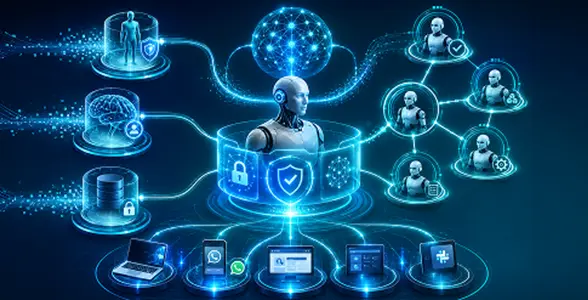
Guardrails and trust are often described as a flat feature list, data masking, bias prevention, hallucination safety, but it's more useful to think of them as sitting at three points in the pipeline. Input-layer protections mask sensitive data before it reaches the model. Reasoning-layer protections evaluate the agent's plan against trust policies before it acts. Output-layer protections check for hallucinated or unauthorized actions before execution. For any leader in a regulated industry, that's the question to ask a vendor: not "do you have guardrails," but "at which layer does masking happen relative to the model call."
Omnichannel deployment
It means the same agent, with the same instructions and grounding, can operate across web, WhatsApp, portals, and Slack without being rebuilt per channel, which matters operationally because it means your governance and testing effort doesn't multiply by channel count.
Multi-agent networks
A coordinator agent that delegates sub-tasks to specialized sub-agents, e.g., a billing question routes to a finance-trained agent, a technical one to support. This is powerful and also where testing complexity grows fastest, since failures can now cascade across agent boundaries.
Real-World Enterprise Use Cases
Agentforce looks different depending on which team is using it. The examples below show how the same core idea, an agent that acts instead of just responding, plays out across service, sales, and marketing.
Customer Service
Service Cloud agents can handle tier-1 cases from start to finish: looking up the right Knowledge Article, applying the same resolution steps a trained human agent would use, and either closing the case or escalating it with useful context attached. This is one of the clearest examples of autonomous customer service in production today:
SharkNinja has used Agentforce to handle customer questions, product recommendations, and post-purchase support, and reports customers are noticeably happier with the faster response.
Engie, an energy provider, uses Agentforce to answer common billing and clean-energy questions, and now handles 83% of those interactions through the agent without a human stepping in.
Finnair is using Agentforce to aim for automating up to 80% of routine customer service questions, while also cutting the time it takes to onboard new travel service representatives.
The catch, and it's an important one, is that all of this only works if the underlying Knowledge Base is kept current. A stale article library quietly drags the resolution rate down, no matter how good the reasoning engine is.
Sales Operations
Agents can handle autonomous lead qualification, update CRM records, and prepare meeting briefs ahead of a sales call, giving reps AI lead qualification support without extra manual work.
Asymbl uses Agentforce to automate daily lead engagement across inbound, outbound, and nurture channels, freeing its human sales reps to focus on higher-value conversations. The company reports this delivers coverage comparable to a sales team five times larger, saving roughly $575,000 a year.
Siemens uses AI agents to personalize follow-up communication for 100% of its leads, something that would be very difficult to do manually at that scale.
The limiting factor here is Lead and Contact data completeness. An organization with large gaps in required fields will still get a confident-sounding lead score from the agent, it just won't be an accurate one.
Marketing Automation
Agents can run proactive audience segmentation, manage continuous A/B testing, and generate landing page content, turning marketing from a series of periodic campaign builds into a program that adjusts itself continuously. PepsiCo has described this as a genuine growth driver rather than only a cost-saving measure, reporting efficiency gains in the range of 25 to 30% in the areas where it has deployed Agentforce agents.
Across every one of these examples, the same caveat from the architecture section applies: the agent inherits the condition of your data. A team with clean, well-maintained records gets a real productivity gain. A team with messy records gets an AI-shaped mirror of its existing problems, just running much faster.
Preparing Your CRM for an Autonomous Future - The Implementation Roadmap
Deploying Agentforce well means treating it as a data governance project first and an AI project second. Here's the practical sequence:
![Preparing Your CRM for an Autonomous Future]()
Run a Data Cloud maturity and governance audit before configuring a single agent. This step matters more than anything else on this list. Adoption data shows why: as of late 2025, fewer than 13% of Salesforce's roughly 150,000 customers had signed an Agentforce agreement, and the most common reason cited was data quality, not a lack of AI capability. Salesforce's own $8 billion acquisition of Informatica was a direct response to this exact gap.
Check three specific readiness gates before deploying anything into production. Are your Knowledge Articles current and complete? Is Case and Lead field completeness above a workable threshold? Does your Flow error handling actually surface failures, or does it fail silently and hide problems from view?
Start with one low-risk, high-volume use case. Tier-1 support deflection is the standard, well-tested entry point for most organizations.
Test thoroughly in a sandbox environment before scaling to production.
Keep a human-in-the-loop on every customer-facing or financially binding decision. Autonomous agents are meant to expand what your workforce can handle, not to remove human judgment from situations where it's still needed.
This phased approach reflects how real deployments have actually gone. Consultants who have implemented Agentforce across enterprise and nonprofit clients report that the platform has matured significantly compared to its early, buggier days in 2025, though familiar roadblocks like unclear pricing and messy source data haven't disappeared, they've simply changed shape as the ecosystem has learned more about what a successful rollout requires.
Conclusion: The Paradigm Shift in CRM
The idea that "CRM is no longer just a system of record, it's now a system of autonomous action" is true, and it's also become a cliché repeated in nearly every Agentforce article published this year. Here's a sharper, more useful version of that idea:
Over the next 12 months, the real bottleneck for autonomous enterprise adoption won't be AI capability, it will be data governance. Organizations with mature data practices will scale their agents quickly and see results like the ones above. Organizations without that foundation will spend most of their AI budget cleaning up the data problems their agents expose, rather than building new capability on top of them.
So the question worth bringing back to your team isn't "will autonomous agents work." It's "is our data model ready for a system that will act on it without waiting to be asked?"
Disclaimer:
This content has been made available for information purposes only. Views and opinions expressed in this content are those of the individual author only and do not necessarily represent the opinions and views of Chetu. Chetu, and its representatives, make no representation or warranty of any kind, express or implied, regarding the accuracy, adequacy, validity, reliability, availability, or completeness of any information of this content. Under no circumstances shall Chetu, or its representatives, have any liability to you or any loss or damage of any kind incurred as a result of the use of this content or reliance on any information provided in this content. Your use of this website and your reliance on any information on this content is solely at your own risk.
About Chetu:
Founded in 2000, Chetu empowers businesses with AI and digital transformation solutions, supporting startups, SMBs, and Fortune 5000 companies. We deliver end-to-end software solutions backed by global digital intelligence and industry expertise. Our customized software delivery model and one-stop-shop approach span the full technology spectrum. Headquartered in Sunrise, Florida, Chetu operates 13 locations across the U.S., Europe, and Asia.
See more at: Chetu Blogs