





AI consulting helps organizations identify, plan, and implement AI solutions that align with business goals. It provides strategic guidance, technical expertise, and implementation support to reduce risk, accelerate adoption, improve operational efficiency, and ensure AI investments deliver measurable business outcomes.
AI CONSULTING SERVICES & ENTERPRISE AI SYSTEMS BUILT FOR BUSINESS GROWTH
AI consulting paired with direct implementation for scalable, secure systems governed by clear enterprise standards.
Trusted By
Key Takeaways
From AI Strategy to Measurable Business Results with Chetu
Enterprise AI Strategy
Develop practical Artificial Intelligence (AI) roadmaps, prioritize high-value use cases, and plan scalable adoption around defined business goals.
AI That Delivers Business Results
Automate workflows, support better decisions, improve productivity, and generate measurable value from AI investments.
Growth & Operational Efficiency
Reduce costs, streamline processes, and move digital initiatives forward through targeted automation.
Proven AI Consulting Experience
Apply 26+ years of software engineering experience, work across 7,500+ client engagements, and access consulting backed by direct implementation support.
Watch
How Our AI Consulting Team Supports Your Enterprise AI Program From Strategy Through Delivery
Strategy documents alone do not change operations; working software does. See how we move an organization from scattered AI ideas to a coordinated enterprise program using our proprietary Track2AI™ framework. The process covers early pilot validation, enterprise deployment, ongoing optimization, and clear ownership as the program expands across teams, systems, business units, and operating regions, with clear roles and approvals.
See What We Can Do For You
Free Download
Top 10 AI Use Cases Across Modern Businesses
This guide for business leaders shows actual application examples of AI. It reveals automation possibilities, increases team effectiveness, and establishes a growth strategy based on AI usage rather than just pursuing the technology.
What We Do
AI Consulting Services for Enterprise Teams
Our AI consulting services move organizations from planning to production by updating operations, automating processes, and scaling AI securely across the business with engineers who directly implement every agreed recommendation in production.
Enterprise AI Consulting
Expand successful AI pilots across departments using enterprise implementation plans, governance controls, and repeatable operating models that support adoption across business units and operating regions.
AI Automation Consulting
Find and automate high-impact workflows through process analysis, automation design, and a phased roadmap that targets early ROI before moving into more complex business use cases.
AI Integration & Implementation
Connect AI models with CRM, ERP, APIs, and legacy systems through secure integration, deployment, and workflow orchestration, adding human review where accuracy or compliance requires it.
Machine Learning Consulting
Build predictive models, forecasting systems, and recommendation engines that convert underused business data into practical insights teams can use to improve decisions and operational outcomes.
Deep AI Expertise
Across Enterprise Technology Stacks, Platforms, and Systems
Our AI consultants and engineers work across the full technology stack used in enterprise AI. These capabilities support how we assess requirements, design systems, build applications, deploy models, integrate platforms, and operate the solutions described above.
Generative AI Solutions
VMany organizations invest in generative AI, then find that a promising pilot cannot handle daily use. Hallucinations, data privacy concerns, high query costs, and disconnected tools can stop adoption. The main challenge is making an LLM useful, secure, affordable, scalable, and reliable inside routine operations after the initial launch.
We help organizations move from testing into measurable adoption by:
- Integrating ChatGPT and enterprise LLMs into existing systems and workflows.
- Building retrieval-augmented generation solutions grounded in your internal knowledge base.
- Embedding AI copilots directly into the tools employees already use.
We usually begin with a focused use case, such as internal knowledge search or first-draft content creation. After accuracy, adoption, governance, and cost are validated, we expand the solution across more teams and workflows while controlling operational risk at each stage.
AI Agents & Copilots
VEmployees often spend hours switching between systems, reviewing information, and completing repetitive multistep tasks that still require judgment. Basic chatbots may answer questions but often leave the work unchanged. Useful AI must assist, take approved actions, and escalate complex cases responsibly and transparently.
We design AI agents and copilots that:
- Triage support tickets, reconcile reports, and prepare contract redlines.
- Operate with clearly defined permissions, escalation paths, and human approvals.
- Log every action so decisions remain traceable and auditable.
Autonomous agents complete approved tasks across systems, while copilots guide users through existing software. Each workflow focuses on a real employee task and is measured by time saved, accuracy, and operational results. The outcome is a practical AI assistant that improves productivity while retaining human review for sensitive decisions, exceptions, and actions that require approval or documented oversight.
Machine Learning Solutions
VOrganizations often collect years of business data without converting it into dependable predictions or decisions. Generic models may test well but fail when customer behavior changes, data is incomplete, or production conditions differ. Without a lifecycle plan, model performance can decline steadily over time.
Our machine learning solutions cover the complete journey:
- Preparing data and engineering features from existing warehouses and operational systems.
- Selecting, training, and validating models against holdout data.
- Deploying models with monitoring, retraining, and performance controls.
We build classification, regression, and clustering solutions for forecasting, segmentation, risk scoring, and related business uses. When explainability matters, including lending or clinical support, we prioritize interpretable approaches. When predictive accuracy is the main goal, we use more advanced architectures. Every engagement includes retraining plans so models continue performing as new data, user behavior, business conditions, and performance requirements evolve over time.
Predictive Analytics
VPlanning teams often make high-impact decisions using historical reports, spreadsheets, and judgment. By the time trends appear, demand may have shifted, customers may have churned, or financial targets may already be at risk. A polished dashboard cannot solve the problem when its forecasts are unreliable or poorly validated.
We turn historical and operational data into forward-looking intelligence through:
- Demand, revenue, and resource forecasting.
- Customer churn prediction and risk scoring.
- Confidence intervals that show how much decision-makers can trust each forecast.
Our team combines statistical forecasting with machine learning based on the volume, quality, and volatility of your data. Every model is validated against a holdout period before it influences planning or financial decisions. The result is a forecast teams can use to set inventory, staffing, revenue, and retention priorities, instead of another analytics layer that remains disconnected from planning and operational action.
Intelligent Automation
VMany organizations automate individual tasks while leaving the surrounding process unchanged. This speeds up parts of a workflow that remains fragmented, exception-heavy, and dependent on manual handoffs. Automating a poorly designed process can create errors faster instead of improving overall operating performance at scale.
We begin by mapping the complete workflow and locating where effort, delays, and rework accumulate. Then we:
- Combine robotic process automation, workflow orchestration, and machine learning.
- Automate document reviews, approvals, routing, and exception handling.
- Sequence improvements around the highest-volume and highest-friction steps.
The process of automating a customer's operations is divided into several stages and starts off with a business process audit and establishing a baseline for time, cost, and error rates that can be measured. With automation, teams first test their results in a limited scope and then slowly expand. By adopting such method, a customer gets a connected operating model that saves them time on repeating tasks and makes their decision-making faster. On top of that, the biggest savings can be witnessed very early with this automated change implementation phase.
MLOps & Model Monitoring
VA model can perform well initially and lose accuracy when customer behavior, market conditions, or incoming data shifts. Without monitoring, that decline may stay hidden until employees or customers identify weak results. Manual model updates can also make releases slower, riskier, and harder to reverse safely.
Our MLOps process creates the operating foundation required to maintain reliable AI through:
- Automated performance tracking and drift detection.
- Scheduled or event-based model retraining.
- Model versioning, testing, and rollback functions.
- Phased deployments and threshold-triggered alerts.
We operate models with the formal controls applied to production software. Updates are measured against defined benchmarks before release, deployed in stages, and monitored afterward. When performance falls below an approved threshold, teams receive an alert before operational problems spread. This creates a repeatable operating process for improving results, and expanding AI safely as users, and data volumes increase over time.
Natural Language Processing
VCritical business information is often buried inside emails, contracts, support tickets, reports, and call transcripts. In many cases, employees need to go through this content manually which often means a slowdown and also the decisions made may vary a lot. Generic language models could be a problem because they may not understand industry-specific terms, shorten words, and variations of document formats used in the training examples from the public database.
We build NLP pipelines that turn unstructured text into structured, actionable information by:
- Classifying documents, messages, and customer interactions.
- Extracting entities, sentiment, topics, and key details.
- Summarizing content and feeding results into downstream workflows.
Based on accuracy, latency, and cost requirements, we combine traditional NLP models with modern LLM-based methods. Every solution is tested against the organization’s actual language patterns, not generic benchmarks. The output can trigger routing, tagging, alerts, approvals, or analytics automatically. This turns unstructured text into data teams can search, measure, classify, route, and use consistently across daily workflows at scale.
Computer Vision
VImage and video workflows often depend on employees manually inspecting products, documents, shelves, or equipment. This creates bottlenecks, inconsistent quality checks, and delayed responses, especially as inspection volumes rise. Generic computer vision models underperform because real environments include changing lighting, camera angles, backgrounds, and product variations.
We develop computer vision solutions that:
- Detect manufacturing defects and quality issues.
- Verify documents and identities.
- Count inventory and analyze shelf or facility imagery.
To ensure that models reflect real world conditions after deployment, they are trained using production images. We also design the operating workflow around the model, including on-device inference, latency requirements, edge cases, and low-confidence results. When confidence is low, the system routes the item to a human reviewer instead of making an unreliable decision. This supports faster and consistent visual inspection.
Intelligent Document Processing
VInvoices, contracts, claims forms, and other business documents often require employees to locate, verify, and enter information into downstream systems manually. While traditional OCR technology might identify and extract words the document layout, field relationship, or context might be overlooked which is why errors tend to remain in the workflow undetected and uncorrected.
Our intelligent document processing solutions combine:
- OCR for accurate text capture.
- Layout analysis to understand document structure.
- NLP-based extraction to identify and validate critical fields.
- Human review for low-confidence results and exceptions.
We usually begin with one high-volume document type, such as invoices or claims forms, and measure extraction accuracy, processing time, and manual effort. After the workflow is validated, the same pipeline can support additional formats. This phased process reduces repetitive data entry, improves consistency, and speeds processing without removing controls. The result is a scalable document workflow that sends structured data directly into the systems teams use across daily operational workflows.
AI Integration & APIs
VEven a precise Artificial Intelligence model provides little value when employees must exit their systems to access it. Siloed applications, unstable integrations, and aging platforms may prevent AI outputs from entering operational decisions. If an integration breaks silently, it can cause greater business disruption than having no AI capability in place.
We connect AI capabilities with your operational systems through:
- Secure API architecture and system integration.
- CRM, ERP, and platform connections.
- Middleware and adapter layers for older applications.
- Defined data contracts, monitoring, and failure handling.
Our process delivers AI recommendations, forecasts, and automated actions within the business tools employees already use. When current APIs are unavailable, we develop the connection required to integrate legacy systems securely. Building integration alongside the AI solution establishes dependable architecture that encourages adoption, limits manual handoffs, and embeds AI within routine business workflows as a working capability instead of an isolated experiment.
Cloud AI Platforms
VAI programs may encounter unplanned cost, performance, and compliance issues when cloud architecture is handled as a deployment detail. AI model that runs well through the testing phase may prove to be too expensive in volume production. Its deployment will not fit the regulation on data storage. This kind of change will not only cause cloud migration to be delayed but will increase total expenditure.
We develop and deploy AI solutions across AWS, Azure, and Google Cloud by:
- Choosing managed AI services suited to your environment.
- Designing secure, cost-efficient inference for enterprise scale.
- Creating CI/CD pipelines for dependable model releases.
- Meeting compliance, security, and regional data obligations.
Cloud planning happens with model design so infrastructure, performance, and governance function together from the start. We do not impose one vendor or demand a platform migration. We design architecture for your systems, priorities, and long-term requirements, allowing AI to enter production securely without needless complexity, preventable expense, or dependence on one provider.
AI Governance & Security
VAI programs may lose stakeholder trust when teams cannot explain how models process data, reach decisions, or restrict access. Apart from data leakage, prompt injection, and unauthorized AI usage, other major security threats like prompt stealing can bring significant regulatory issues and compliance failures. Implementing governance right before the end is usually not enough as it will be too late for architecture permissions governance, and monitoring aspects.
We incorporate governance and security throughout the AI lifecycle using:
- Role-based access controls and complete audit records.
- Bias evaluation, model records, and decision traceability.
- Secure data processing and output restrictions.
- Compliance support for HIPAA, SOC 2, and data residency.
Our frameworks reflect organizational risk profiles instead of relying on generic checklists. Organizational governance drives decision-making in architecture development deployment, and monitoring right at the beginning stage. As a result, AI systems get approved by the leaders of the departments, handled efficiently by the employees while following the rules and are easily understood by the auditors or the regulators when changes appear in the models, the working teams, priorities and the regulatory obligations.
Track2AI™ Framework
Plan Practical AI Programs, Implement Faster, and Scale with Control
Enterprise AI initiatives often stall when planning and execution run as separate workstreams. Track2AI™, Chetu’s proprietary AI consulting and adoption framework, connects them through direct implementation, system integration, controlled deployment, ongoing optimization, and clear ownership and controls.
Track2AI™ uses two distinct adoption paths based on the organization’s current technology environment, instead of applying one model to every program:
Our Framework
Track2AI™ Greenfield Framework — Build New AI Solutions
Designed for organizations developing AI solutions from the ground up, the Greenfield Framework follows an eight-step methodology:
Track2AI GreenfieldFramework
STEP 01Frame AI Problems & Goals
STEP 02Data Strategy Management
STEP 03AI Solution Feasibility & Build vs Buy
STEP 04Develop & Fine-Tune Models
STEP 05MLOps Model Deployment
STEP 06Drift Detection & Retraining
STEP 07AI Solution Documentation
STEP 08Responsible AI Handoff
This structured process moves organizations from opportunity identification and technical validation through secure deployment, governance, and long-term ownership.
Track2AI™ Brownfield Framework — AI-Enable Existing Applications
The Brownfield Framework helps organizations add AI capabilities without replacing their existing applications. A modular overlay architecture introduces intelligent search, copilots, predictive insights, automation, and related AI functions around current systems and workflows.
The framework includes:
Track2Al BrownfieldFramework
STEP 01Application Assessment & Use Case Discovery
STEP 02Data Layer Assessment & Abstraction
STEP 03Al Enablement Layer Architecture & Model Selection
STEP 04Integration and Deployment
STEP 05Monitoring Feedback & Continuous Learning
STEP 06Scale & Expand Al capabilities
Whether building a new AI solution or updating an established application, Track2AI™ provides a clear adoption roadmap, measurable implementation path, and scalable technical base for responsible enterprise AI delivery.
Advance AI adoption through targeted consulting, enterprise implementation, and the structured Track2AI™ framework.
AI Across Industries
AI Consulting Solutions Across Industries
Every industry has different operational processes, data requirements, compliance obligations, and customer expectations. Our AI consultants and engineers design solutions around these industry-specific needs, connecting intelligent automation, predictive analytics, AI agents, and enterprise integrations with the systems organizations already use.
Healthcare - Build secure AI solutions for clinical decision support, patient engagement, administrative automation, medical document processing, and connected healthcare operations.
Financial Services - Use AI for fraud detection, risk scoring, document analysis, regulatory reporting, customer service automation, and data-driven financial decision-making.
Retail & eCommerce - Improve demand forecasting, product recommendations, inventory planning, customer personalization, pricing strategies, and omnichannel commerce operations.
Manufacturing - Apply AI to predictive maintenance, production planning, quality inspection, equipment monitoring, supply chain forecasting, and operational automation.
Technology & SaaS - Integrate AI copilots, intelligent search, recommendation engines, automated support, predictive insights, and generative AI capabilities into software platforms.
Logistics & Supply Chain - Optimize transportation, warehouse operations, inventory levels, route planning, demand forecasting, order fulfillment, and supply chain visibility.
Insurance - Automate claims processing, policy administration, document extraction, fraud identification, underwriting support, and customer communications.
Education - Develop AI-powered student support systems, personalized learning experiences, administrative automation, intelligent content search, and institutional analytics.
Real Estate - Use AI to improve property search, lead qualification, valuation, document processing, portfolio analysis, tenant support, and property management workflows.
Professional Services - Automate knowledge retrieval, report preparation, contract analysis, client communications, resource planning, and repetitive back-office processes.
Supporting organizations across 40+ industries with practical AI strategy, implementation, integration, and ongoing optimization.
AI in Business
How AI Supports Modern Enterprise Operations
AI only produces measurable business gains when it works on a specific decision, workflow, or customer interaction instead of being a general initiative. Our organizations and teams have shown consistent ROI from these capabilities.
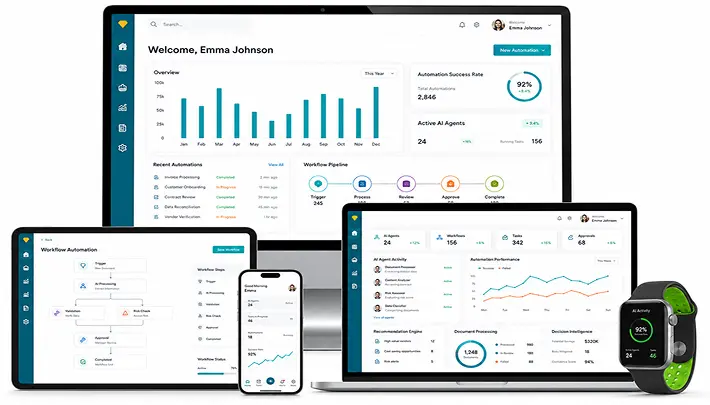
- AI Agents Performing independent tasks to support, operate, and handle back-office processes.
- AI Workflow Automation Automating entire workflow across handoffs and approvals.
- Recommendation Engines Personalized product, content, and promotion suggestions at scale.
- Generative AI Creating content like compilation or other types of content generation by directly inserting them into existing tools.
- Predictive Analytics Using business data you already capture, performing forecasting and risk scoring.
- Intelligent Document Processing Performing structured information extraction in documents like invoices, contracts, and claims.
- Decision Intelligence Data-based insight that is directly placed within routine business decisions.
Custom AI Solutions
Hire AI Consultants & AI Engineers
Organizations that have finished strategy work, or employ an internal AI lead without adequate engineering capacity, can hire dedicated AI consultants and engineers to accelerate implementation across teams without repeating discovery, revisiting completed planning, or postponing delivery.
The Numbers
Delivery Metrics Business Leaders Can Review
20,000+
Applications Delivered
2,800+
Software Developers
40+
Industries Supported
90 Days
Average AI MVP Delivery
Proof
AI Consulting Client Projects
Explore how Chetu delivers practical, scalable AI solutions that improve customer experiences, automate services, and drive measurable business outcomes.
Case Study 1
Mobile Artificial Intelligence App Supports Personal Safety
Chetu built an AI-powered solution for RightThere Corporation that helps citizens respond during potentially unsafe situations.

Case Study 2
Using Shopify AI to Support a Warranty Services Business
Chetu developed a simpler, more accessible platform that lets customers find detailed information about consumer products, post-purchase warranties, available support options, related service coverage, and service requests.

Client Testimonials
Hear What Our Clients Have to Say
Frequently Asked Questions About AI Consulting Services
AI consulting companies evaluate business objectives, existing technology, operational challenges, and data maturity before recommending solutions. They develop customized AI strategies, prioritize high-impact use cases, integrate with existing systems, and create scalable implementation roadmaps that align with each organization's unique requirements.
AI consultants help organizations transform data into actionable insights by implementing predictive analytics, machine learning, business intelligence, and AI-powered reporting. These solutions improve forecasting, identify trends, automate analysis, and enable faster, more informed decisions across business operations and strategic planning.
AI consulting generally begins with a business and technology assessment, followed by AI readiness evaluation, use case identification, solution design, implementation planning, system integration, testing, and deployment. Ongoing optimization, governance, and performance monitoring ensure AI solutions continue delivering measurable business value.
The right approach depends on your goals, resources, and timelines. Building in-house offers greater long-term control but requires specialized talent and significant investment. Expert AI consulting accelerates implementation, reduces risk, provides proven expertise, and helps organizations achieve faster results with scalable solutions.
AI consultants bring expertise in AI strategy, machine learning, generative AI, data engineering, predictive analytics, automation, cloud architecture, system integration, governance, cybersecurity, compliance, and change management. Their multidisciplinary knowledge helps organizations successfully plan, deploy, and scale enterprise AI initiatives.
AI consulting leverages technologies such as machine learning frameworks, large language models, cloud AI platforms, data lakes, vector databases, APIs, automation tools, analytics platforms, and enterprise integration technologies. The technology stack is selected based on business objectives, scalability, security, and existing infrastructure.
AI consulting delivers value across healthcare, finance, manufacturing, retail, logistics, insurance, hospitality, education, construction, gaming, real estate, and energy. Organizations use AI to automate workflows, optimize operations, improve customer experiences, strengthen decision-making, enhance compliance, and unlock new business opportunities.
Our
Portfolio
A showcase of our diverse solutions, services and industry expertise.
BLOG: AI Is The Core Of Modern Software Development And Digital Transformation

BLOG: Smart Searching with AI-Powered Personalized Search Engines
BLOG: AI & ML Solutions: Transforming Business Processes

BLOG: Soaring Above Modern Challenges With Ai-driven Drone Technology