










It is a cloud-based ERP solution that connects finance, operations, and supply chain processes, improving visibility and supporting better decisions.


Let's Talk !  (954) 862 3937
We have 25+ years of experience and 2,800+ developers, and we assist organizations in deploying scalable ERP solutions with full ownership of the source code and no licensing limitations. If you are trying to bring the basic functions of your business into one centralized place, enterprise resource planning (ERP) systems may help.
Live dashboards help finance teams stay on top of performance, keep records accurate, and close books faster without unnecessary delays.
Manage suppliers, track inventory, and handle procurement from one place. Demand forecasting helps reduce stockouts and excess inventory, so operations stay more consistent.
Gain greater control to plan, execute, and supervise projects and teams. Use resource scheduling, track project accounting, and collaborate through tools for faster progress. Use class-leading project management tools to stay on budget and complete work according to schedule.
This includes handling employee records, planning for future workforce needs, and managing roles and performance within a full HR system. It can also significantly reduce administrative burdens in HR by shifting tasks to employees and managers.
Effective implementation of ERP should be done by planning and integrating the system. The services that are included in Dynamics 365 ERP implementation are system architecture planning, data migration and integration with the existing enterprise systems.
Dynamics 365 ERP is also compatible with Microsoft 365, Azure, and Power Platform tools to create a completely integrated system of technologies. With this combined solution you have the ability to handle financial, operational and analytical data in a single tied digital environment to control financial, operational and analytical data.
Companies that operated on old-version ERP systems are mostly upgrading to Dynamics 365 to embrace the modern cloud technology. ERP migrations include system reconfigurations and data loads as well as platform upgrades.
These mechanisms help the organizations to move on to the new modern cloud ERP environment and reduce operational disruption. The upgrades also facilitate businesses to take advantage of the new AI-based analytics and automation industries in the Dynamics environment.
The ERP systems must always be optimized to suit the business changes. Managed ERP support services are provided with constant monitoring, system optimization, system maintenance, and technical services. Such services will provide business continuity, better performances and operating systems that are reliable when your needs change.
Basic accounting tools are no longer enough for modern organizations. They require technology that can foster growth, facilitate decisions and enhance agility of operations. Dynamics 365 ERP offers that background. Automation saves repetitive and manual work among teams and enables them to work on strategic initiatives rather than working routines. Immediate dashboards give an insight into financial performance, inventory and operational efficiency.

Analytics based on artificial intelligence will enable businesses to identify tendencies and anticipate the needs of the future more precisely.
Dynamics 365 ERP builds by integrating financial management and operational processes with analytics and automation into a single cloud platform. Dynamics 365 ERP enables organizations to:
Monitor financial performance with real-time reporting
Improve supply chain visibility and inventory management
Automate operational workflows and approvals
Connect business applications within one integrated ecosystem
This centralized model simplifies the management of business as well as enhancing team cooperation.
Built for small to mid-sized businesses, this brings finance, sales, and service into one place. It runs on the cloud, so day-to-day work becomes easier to manage. Not everything needs manual follow-ups anymore, and decisions tend to happen faster since the data is already there.
This is usually where larger organizations lean, especially when they’re dealing with global operations or more complex supply chains. It handles scale well. You still get visibility across functions, but without losing control as things grow.
A lot of businesses are still on older systems, and not all of them want to switch overnight. That’s where GP fits in. It gives you room to move gradually, keep critical data where it is, and still start using more updated, cloud-friendly tools.
Our methodical, low-risk implementation approach ensures faster deployment, minimal business disruption, and stable post-project operations.






Machine intelligence is permeating into mainstream business systems to assist in smarter business decision-making. The AI available in the Microsoft Dynamics 365 ERP encompasses predictive analytics, intelligent forecasting and workflow optimization. Such tools analyze operational data to determine patterns, risk and areas of improvement.
It is possible to predict demand trends using machine learning algorithms and automate the financial business and provide suggestions to improve operations using past performance. This consequently enables the organizations to react more quickly to the evolving market conditions.
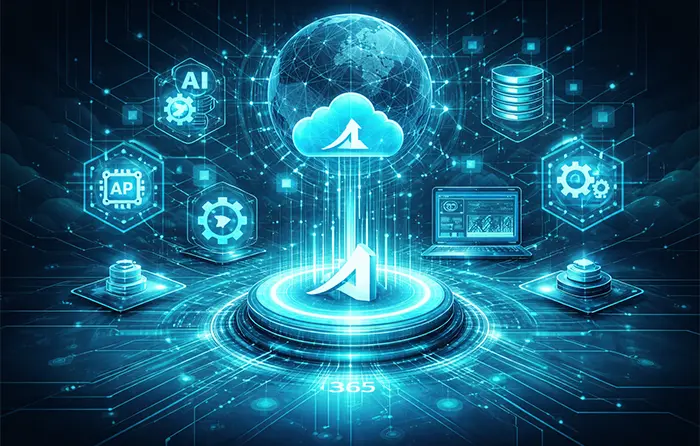
Modern ERP systems rely on a strong technology foundation:
Microsoft Azure cloud infrastructure
Microsoft Power Platform (Power BI, Power Apps, Power Automate)
Microsoft .NET framework and APIs
SQL Server and enterprise data platforms
Microsoft Copilot AI integrations
These technologies create a scalable and secure environment for enterprise operations.
“Our finance and operations teams were previously working in separate systems. With Dynamics ERP, we now have a unified view of the entire business.”
— Financial Operations Director
“The ERP implementation improved supply chain visibility across multiple warehouses. Our teams can now track inventory and operational performance in real time.”
— Supply Chain Operations Manager
Disconnected systems slow decisions, create inefficiencies and limit growth. Microsoft Dynamics 365 ERP unifies finance, supply chain and analytics, helping organizations improve efficiency, gain insights and scale with confidence.
It is a cloud-based ERP solution that connects finance, operations, and supply chain processes, improving visibility and supporting better decisions.
Yes. Solutions like Business Central are designed to scale as your needs grow.
It offers real-time reporting, automates accounting processes, and improves visibility across financial data.
Migration includes data transfer, system setup, integration, testing, and deployment.
Yes. It includes AI-driven analytics, forecasting, and workflow automation.
Yes. It integrates with Microsoft tools and third-party applications using APIs.
Privacy Policy | Legal Policy | Careers | Sitemap | Referral | Contact Us
Copyright © 2000- 2026 Chetu Inc. All Rights Reserved.


