Aviation MRO Software: Driving Digital Transformation in Maintenance, Repair & Overhaul
Rick Heicksen - Director of Sales | October 10, 2026
- Aviation MRO software streamlines maintenance operations by improving scheduling, work orders, inventory control, compliance, and aircraft availability.
- AI, IoT, predictive analytics, and digital twins are driving smarter MRO, enabling proactive maintenance, early issue detection, and reduced aircraft downtime.
- Custom, scalable MRO solutions provide a competitive advantage by adapting to specific fleet requirements, improving operational efficiency, and supporting long-term aviation growth.

What Is MRO in Aviation?
Maintenance, Repair, and Overhaul (MRO) refers to all the necessary tasks involved in maintaining aircraft and their components, so they remain safe, compliant, and fly-worthy, ranging from routine checks to major repairs, engine maintenance, and much more. These intricate processes demand efficient software solutions for scheduling maintenance tasks, issuing work orders, ensuring compliance, monitoring inventory, and managing operational data. It's not a single task; it's the umbrella term for the entire discipline that keeps planes in the sky legally and safely, governed by international airworthiness standards at every step.
For an industry where a single grounded aircraft can cost tens of thousands of dollars a day, MRO isn't a back-office function. It's the operational backbone that determines whether a fleet flies on schedule or sits on the tarmac. This is why aviation organizations require proper technology partners. Chetu designs and builds custom MRO software specifically designed to an organization's unique maintenance processes to streamline work ordering, maintenance planning, inventory control, compliance management and system integration. Chetu's scalable custom-built solutions enable MROs to cut down on manual tasks, gain operational visibility, and optimize the technology that powers their maintenance activities.
The MRO Forecast: Clear Skies Ahead
The signs indicate that there is only one way to go, and that is upwards. Boeing expects an increase of approximately $4.4 trillion in commercial aviation services, and IATA forecasts 4.6 billion annual passengers by 2030, well above pre-pandemic levels.

There is potential for growth in the global market for commercial aircrafts since it is estimated that it had a value of over $191 billion in 2018 and is expected to expand at a CAGR of 2.9% to reach a value of $255 billion by 2028. "The total market for commercial aviation expenditure throughout the world is expected to reach $2.3 trillion".
With the introduction of digital solutions, the aviation industry is becoming more efficient and improving its operational capabilities. As a result, the aviation market is evolving, which will lead to higher demand for MRO software.
The Chetu development team is here to help the industry face increased demand. The developers work hand in hand with MRO personnel and implement cutting-edge, specialized, and customized solutions that ensure maintenance operations are a tool, creating an opportunity to generate revenue instead of just acting as a cost.
Maintenance vs. Repair vs. Overhaul: Know the Difference
The three pillars of MRO sound very much alike but are very different from one another, and they are key to the way aviation MRO software should be actually constructed.
- Maintenance involves all pre-flight and anti-problem measures taken to prevent problems in the day-to-day running of the unit, and quality and compliance are maintained.
- When engine parts and other components are worn, damaged or have been flagged as defective, repair restores them to airworthiness.
- Overhaul is the deep dive: Full disassembly, inspection and testing of all relevant components to ensure optimum performance and safety of the engine.
All three are FAA regulated, and all three are critical to missing one on the chain of airworthiness compliance, and the whole chain is broken.
From Outsourced Afterthought to Strategic In-House Priority
MRO wasn't always treated as mission critical. Airframe Original Equipment Manufacturers historically focused on development and production, leaving airlines to outsource MRO services to third-party repair shops and system suppliers.
That's changed. Airline operators have increasingly brought MRO in-house to keep tighter control over Airworthiness Directives compliance across critical systems, including:
- EBis Software
- Hydraulic Power and Systems Units
- All Fuel Servicing Equipment
- Aircraft Servicing Equipment
- All Aircraft Fuselage Equipment
- Aircraft Landing Gear Components and Support Equipment
- Aircraft Engines
Modern MRO software is what makes that internalization actually work. As stakeholders finally recognize MRO's role in driving productivity, strengthening safety, and enabling innovation, investment has followed at scale.
The aviation MRO market has witnessed robust growth, climbing from $73.68 billion in 2023 to $79.01 billion in 2024, achieving a CAGR of 7.2%. The market is expected to reach $104 billion in 2028, maintaining a CAGR of 7.1% - The Business Research Company.
As that growth continues, leveraging the right technology to elevate the air travel experience isn't optional anymore; it's table stakes.
Why Aviation MRO Software Pays for Itself
The suitable maintenance management solution produces benefits on four levels:
- Increasing Efficiency of Operations: Streamlined scheduling, tracking spare parts and processes of technicians make the process of planning more cost-effective and profitable by minimizing the mechanical downtime of aircraft.
- Improving the Standards of Compliance and Safety: Automation of documentation and checks in terms of compliance significantly lowers the possibility of missing requirements set forth in orders like Airworthiness Directive.
- Minimizing Downtime and Maintenance Costs: By identifying threats to aircraft earlier and scheduling necessary maintenance work properly allows them to avoid the times when the aircraft are being under maintenance.
- Online Control and Reporting: Consistent monitoring is important as it gives insight into the condition of components and carries out maintenance activities.
The Technology Propelling MRO to New Heights
IoT is an important word in the tech world for a good reason, and the aviation industry is one of the industries that proves it. Used in MRO, IoT enables Condition-Based Maintenance and provides data-driven insights into operations, reducing maintenance delays, and facilitating predictive maintenance.
But IoT is just the opening act. Here's what else is reshaping aviation MRO software:
Predictive Analytics: It offers unique insights into the condition of important safety elements allowing for preventive supervision, and planning maintenance beforehand.
Digital Twin Technology: Provides real-time aircraft operation simulation and helps identify design flaws with utmost precision. When combined with predictive analytics, digital twins contribute to asset management savings and enhancing safety practices.
Artificial Intelligence: AI contributes to various advances everywhere including autopilot technology that supports flight management and studies data to increase effectiveness of operations.
Wearables: Being an IoT technology, wearables and robots provide maintenance teams with better tools for fast and efficient repairs.
Augmented Reality: AR addresses the problem of technician shortage by allowing remote connections between operators on site and qualified professionals.
Future Trends in MRO Software: What's Next
Looking ahead, three forces will define where aviation MRO software goes next:
Artificial Intelligence and Machine Learning, moving from assistive tools to genuine decision-support systems across maintenance planning.
Predictive Maintenance and Data Analytics, shifting MRO from reactive fixes to proactive, data-driven scheduling as the industry standard.
The Growing Impact of IoT on MRO Practices, deeper sensor integration, turning every component into a real-time data source.
The Hidden Secret to Sustainable MRO: Custom-Build
Plenty of airlines are shopping for MRO software solutions right now either upgrading legacy systems or buying for the first time. So, what separates reliable aviation MRO systems from the rest?
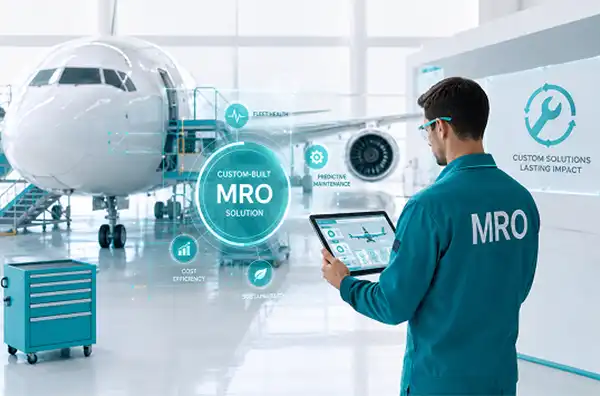
Look for configurability, genuine customization to your specific fleet and operations, and the ability to scale with your magnitude of demand. Sustainable MRO software should also offer end-to-end coverage from maintenance all the way through to the in-flight experience.
Above all, the right MRO management system for aviation should minimize time and effort on the back end, so your team can stay focused on the customer.
Technologically augmented MRO software isn't a nice-to-have anymore; it's how the aviation industry keeps pace with relentless travel demand for years to come. Chetu offers custom MRO software development built to streamline MRO processes, boost productivity, and help the aviation industry soar to new heights.
Why MRO Software Is the Industry's Next Competitive Edge
In several aspects, MRO software is one of the most worthwhile investments a company can make to keep its aircraft in compliance and satisfy airworthiness standards while transforming maintenance operations into an effective source of efficiency, stability, and profit.
Companies considering MRO software as an investment and a strategic resource rather than just a resource for back-office operations will be the most prepared for the future expansion of the aviation industry. The future of MRO software isn't just automating its own sake; it's smarter, safer, more connected operations built for an industry that isn't slowing down.
Disclaimer:
This content has been made available for information purposes only. Views and opinions expressed in this content are those of the individual author only and do not necessarily represent the opinions and views of Chetu. Chetu, and its representatives, make no representation or warranty of any kind, express or implied, regarding the accuracy, adequacy, validity, reliability, availability, or completeness of any information of this content. Under no circumstances shall Chetu, or its representatives, have any liability to you or any loss or damage of any kind incurred as a result of the use of this content or reliance on any information provided in this content. Your use of this website and your reliance on any information on this content is solely at your own risk.
About Chetu:
Founded in 2000, Chetu empowers businesses with AI and digital transformation solutions, supporting startups, SMBs, and Fortune 5000 companies. We deliver end-to-end software solutions backed by global digital intelligence and industry expertise. Our customized software delivery model and one-stop-shop approach span the full technology spectrum. Headquartered in Sunrise, Florida, Chetu operates 13 locations across the U.S., Europe, and Asia.
See more at: Chetu Blogs
Share


Limited Time Offer for a Free E-Book

Suggested
Reading
Read our blogs on automation strategies, technology and business solutions.