Thank you!
Your blog has been successfully shared.


Let's Talk !  954 342 5676
  +44 137 243 2466
If you are planning an NFT marketplace, this question tends to surface early. Sometimes before architecture decisions are finalized. Sometimes after costs begin to rise. ERC-721 or ERC-1155?
Both are established Ethereum standards. Both mint NFTs. But they solve very different problems once a platform starts to scale. Let’s walk through it carefully. No hype. No absolutes.
There is no universal answer. And that is worth stating upfront. The right standard depends on how your marketplace is expected to evolve. Not just at launch. But after users arrive. After volume increases. After operational costs matter. That is usually where the difference becomes clear.
ERC-721 and ERC-1155 are the Ethereum Token Standards that govern how an NFT is created, transferred and managed on the blockchain. They are not interchangeable. Each introduces a distinct operational model.
One prioritizes simplicity and strict uniqueness. The other prioritizes flexibility and efficiency at scale. Understanding this distinction early can prevent costly architectural changes later.
ERC-721 was the first widely adopted NFT standard. It established the concept of provable digital uniqueness. Each token represents a single asset. One token. One owner. That clarity made ERC-721 a natural choice for early NFT collections and digital art platforms.
Where ERC-721 Works Well
Clear ownership and provenance
Simple contract logic
Strong ecosystem support
Suitable for low-volume, high-value assets
But ERC-721 processes each token interaction individually. Over time, that creates friction. Higher gas fees. Slower throughput. And limited flexibility as asset types expand. For many enterprise platforms, those tradeoffs surface sooner than expected.
ERC-1155 was designed to address ERC-721’s limitations. Unlike ERC-721 which manages just one token every contract, ERC-1155 allows you to create multiple different token types in a single smart contract. NFTs, semi-fungible assets, and even cryptocurrencies can coexist. This approach significantly reduces operational overhead.
What Makes ERC-1155 More Scalable
Batch minting and transfers
Lower gas costs per transaction
Support for multiple asset types
Flexible metadata structures
Built-in transfer safety mechanisms
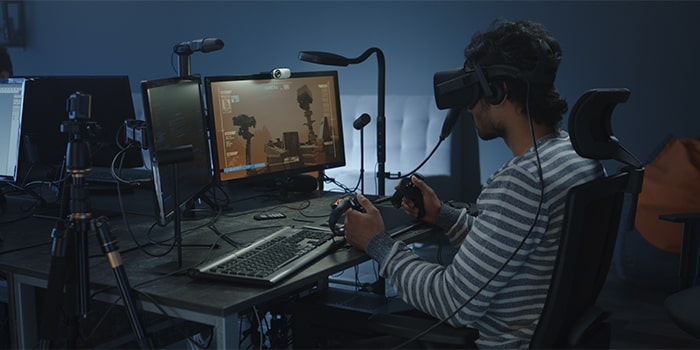
Such capabilities are extremely applicable to metaverse platforms that support blockchain-based games, gaming and virtual reality (VR), and multi-asset marketplaces within the metaverse.
To evaluate suitability, it helps to compare both standards directly.
For platforms expecting sustained growth, efficiency tends to outweigh simplicity.
NFT marketplaces vary widely in structure and intent. And token standards influence how flexible these platforms can become over time.
Types of NFT Marketplaces
Common marketplace models include:
Art and creator platforms
Gaming asset exchanges
Sports sector collectibles
Real estate tokenization platforms
Hybrid platforms supporting multiple asset classes
Once a marketplace supports more than one asset type, ERC-1155 typically aligns better with operational requirements.
Regardless of the token standard, modern NFT marketplaces rely on a layered technical stack.
This often includes:
Smart contracts built on blockchain technology
Front-end frameworks such as React.js
Back-end services using Node.js
Secure crypto wallets
Analytics, monitoring, and compliance layers
The ability to integrate with third-party technologies
Designing this architecture correctly requires experience. Especially when performance, security, and future extensibility are priorities.
This is where strategic choices begin to matter. ERC-1155 provides teams with more flexibility to build their own applications. It supports evolving use cases without forcing structural redesigns.
For platforms operating across digital asset trading, gaming, or enterprise-grade marketplaces, this flexibility often translates into long-term cost control and smoother scaling.
This is also where collaboration with blockchain experts and a reputable software development company becomes valuable. Not for experimentation. But for execution.
A well-designed marketplace should integrate cleanly with existing systems, adapt to regulatory changes, and remain performant as usage grows.
ERC-721 remains relevant. Especially for narrowly defined use cases. But for most modern NFT marketplaces, ERC-1155 reflects how platforms actually operate today. Multiple assets. Higher transaction volumes. Real users with real expectations.
Make the right choice in standard early and avoid hours of toil later. If you're thinking about NFT marketplace architecture or designing a plan for your platform you may want to have these conversations with a veteran group that has meaningful experience with both the OPS and DEV sides of the equation.
Disclaimer:
This content has been made available for information purposes only. Views and opinions expressed in this content are those of the individual author only and do not necessarily represent the opinions and views of Chetu. Chetu, and its representatives, make no representation or warranty of any kind, express or implied, regarding the accuracy, adequacy, validity, reliability, availability, or completeness of any information of this content. Under no circumstances shall Chetu, or its representatives, have any liability to you or any loss or damage of any kind incurred as a result of the use of this content or reliance on any information provided in this content. Your use of this website and your reliance on any information on this content is solely at your own risk.
About Chetu:
Founded in 2000, Chetu empowers businesses with AI and digital transformation solutions, supporting startups, SMBs, and Fortune 5000 companies. We deliver end-to-end software solutions backed by global digital intelligence and industry expertise. Our customized software delivery model and one-stop-shop approach span the full technology spectrum. Headquartered in Sunrise, Florida, Chetu operates 13 locations across the U.S., Europe, and Asia.
See more at: Chetu Blogs
Share


Limited Time Offer for a Free E-Book
Privacy Policy | Legal Policy | Careers | Sitemap | Referral | Contact Us
Copyright © 2000- 2026 Chetu Inc. All Rights Reserved.