Thank you!
Your blog has been successfully shared.
Let's Talk !  954 342 5676
  +44 137 243 2466
Nick Swanson – Director of Sales | Date - 04 June 2026
The food manufacturing and distribution industry has always worked to confront the evolving demands of consumers and retailers, from increasing farming yields to adherence to more stringent calls for food production safety and sustainability. Decision-makers implementing AI-driven resources have facilitated innovative strategies to optimize food manufacturing processes, elevate food quality control, reduce costly food waste, and work to decrease greenhouse gas emissions.
The versatility of AI has further enabled the food manufacturing and agriculture industry to take a modernized approach to mitigate costly production expenses, streamlining supply chain processes to reduce food spoilage and promoting safeguards during the delivery phase.
The United States Environmental Protection Agency (EPA) reported 66 million tons of wasted food attributed to retailers, food service, and residential sectors has resulted in $218 billion in expenses. Reinforced by the United Nations Environment Programme (UNEP) stating the U.S. loses $48.3 billion in revenue due to discarded food, these chilling statistics remain a reminder that the food manufacturing and distribution sectors need new strategies to mitigate the critical impacts on the environment and optimize how the industry develops, distributes, and delivers food within the U.S.
AI's role within food manufacturing enables more efficient and sustainable practices, facilitates increased crop yields through predictive analytics, counters costly pest infestations, improves weather forecasting accuracy, and elevates product quality to address the ongoing challenges faced by the U.S.
Leveraging predictive analytics within farming has created transformative impacts for an industry vital for the global economy. Analytics paired with IoT-driven sensors accurately capture data on irrigation processes, real-time crop conditions, and farm asset machinery performance. Utilizing predictive maintenance mitigates costly breakdowns of food production machinery by providing end-users data-driven insight into machinery performance and condition.
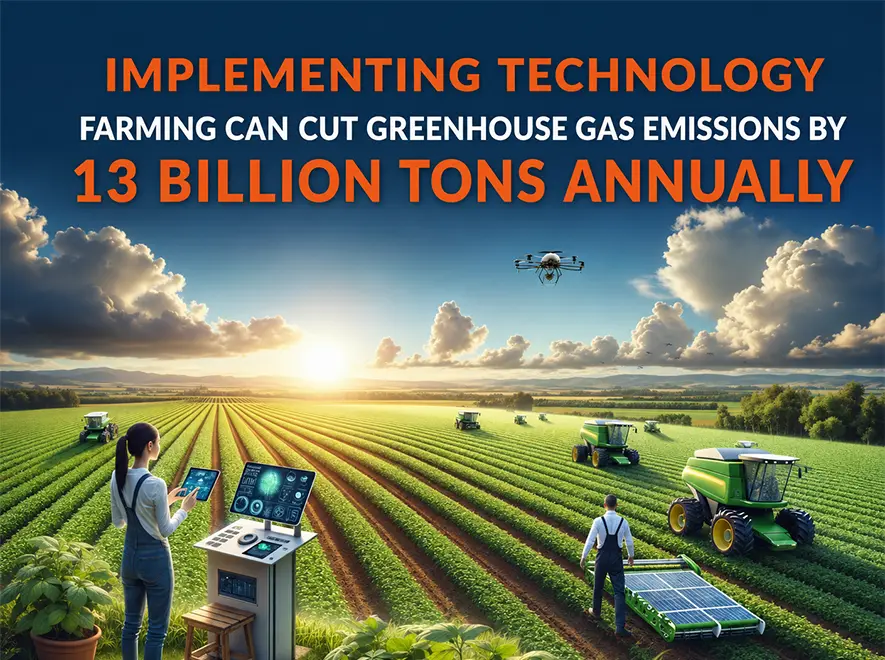
Analytics provide unprecedented, actionable insights into farming, facilitating modernized strategies to limit expenses associated with crop harvests, enabling farmers to focus on producing crops with greater yields and elevated quality. Food producers are empowered with data analytics to accurately predict yields, monitor soil conditions in real-time, and make more informed, data-driven decisions for which crops require less expenses to produce while minimizing impacts on the environment. The EPA reported agriculture is responsible for 11% of global greenhouse gas emissions, classifying the industry as a major contributor to climate change but a tech-based strategy can decrease greenhouse gas emissions. Climate research journal PLOS Climate reported implementing technology within the agriculture sector can reduce greenhouse gas emissions by 13 billion tons annually.
Time is a valuable commodity no industry overlooks, and operational efficiency remains a critical goal for food manufactures. Embracing an AI-driven strategy for predictive maintenance of machinery and assets such as mixers, cooling systems, and packaging reduces costly system downtime and enables a proactive approach for streamlined workflows. IoT-driven sensors gather, store, and monitor data on machinery performance and conditions, providing end-users with data-driven insights into asset performance and condition. Data can be accessed and monitored via the cloud or an on-site Computerized Maintenance Management System (CMMS).
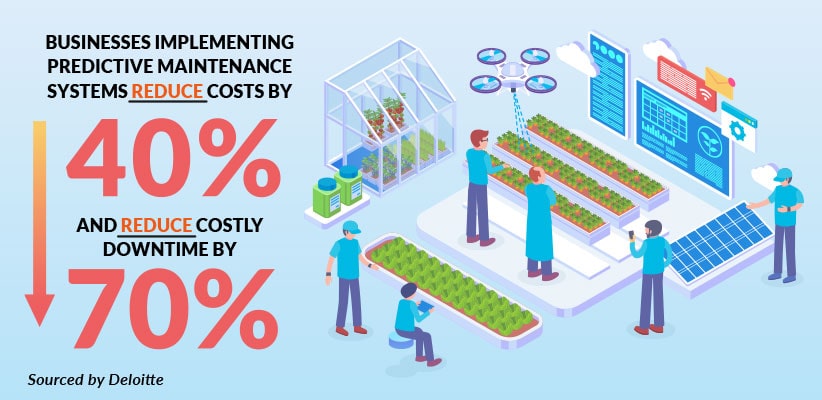
Predictive maintenance is predicated on Machine Learning algorithms to accurately identify patterns and anomalies, proactively alerting end-users of assets vulnerable to breakdowns, failures, and even safety risks to personnel. Deloitte recently reported businesses implementing a predictive maintenance system reduce maintenance costs by 40% and decrease costly downtime by 70%.
Packaging is a multifaceted challenge for food manufacturers and the four categories of packaging incur different costs. Metals, glass, cardboard, and plastics vary in expense, with Packaging Gateway reporting canned goods and drinks can incur 20% of production costs. Leveraging Artificial Intelligence optimizes package designs to ensure minimum material waste while upholding branding and package integrity. Augmented with AI-powered computer vision, automated package inspection accurately identifies defects such as packing materials, misaligned labels, and damaged seals. Chase & Associates, a leading packaging market research and executive search firm reported AI-powered food packaging technology extends food product shelf life by 40%, contributing to the reduction of costly food waste while promoting more efficient and cost-effective packaging processes.
AI optimizes delivery routes to ensure simplified arrivals, reducing food spoilage due to traffic congestion by identifying traffic pattern anomalies in real-time and proactively alerting end-users.
Logistics impact any primary industry, but it remains a fundamental component for food manufacturing because efficient supply chain management is necessary to transport and distribute food safely. The Food and Agriculture Organization, a specialized agency of the U.N., reported that 14% of transported food is disposed of due to spoilage or unsafe and improper packaging, amounting to U.S. supermarkets collectively losing $15 billion due to unsold food products.
Adopting an AI strategy within supply chain processes enables more accurate, data-driven demand forecasting. This provides end-users with clear reports on which food products are in demand at which times, mitigating waste from overproduction and satisfying consumer trends. Carefully analyzing historical sales data, AI provides key insights into consumer tastes to facilitate more accurate food production strategies, error-free inventory management, and minimizing food waste attributed to overproduction.
Adopting an AI-driven strategy within food manufacturing infrastructures requires careful assessment of needs and compatibility with legacy systems. Adept software developers create individualized strategies to mitigate unique food manufacturing challenges by leveraging cutting-edge software solutions to modernize manufacturing and supply chain processes.
Seamless integration of AI-powered resources empowers food manufacturers and the agriculture industry. With careful consultation, software developers provide access to innovation with minimal workflow disruption designed to reduce expenses, streamline processes, and boost operational efficiency.
Agriculture is a global economic driver, but additional steps must be taken to limit environmental impacts during the production and distribution cycles. Today's skilled software specialists play a crucial role in empowering and modernizing the processes of an industry integral to the global economy.
Disclaimer:
This content has been made available for information purposes only. Views and opinions expressed in this content are those of the individual author only and do not necessarily represent the opinions and views of Chetu. Chetu, and its representatives, make no representation or warranty of any kind, express or implied, regarding the accuracy, adequacy, validity, reliability, availability, or completeness of any information of this content. Under no circumstances shall Chetu, or its representatives, have any liability to you or any loss or damage of any kind incurred as a result of the use of this content or reliance on any information provided in this content. Your use of this website and your reliance on any information on this content is solely at your own risk.
About Chetu:
Founded in 2000, Chetu empowers businesses with AI and digital transformation solutions, supporting startups, SMBs, and Fortune 5000 companies. We deliver end-to-end software solutions backed by global digital intelligence and industry expertise. Our customized software delivery model and one-stop-shop approach span the full technology spectrum. Headquartered in Sunrise, Florida, Chetu operates 13 locations across the U.S., Europe, and Asia.
See more at: Chetu Blogs
Share


Limited Time Offer for a Free E-Book
Privacy Policy | Legal Policy | Careers | Sitemap | Referral | Contact Us
Copyright © 2000- 2026 Chetu Inc. All Rights Reserved.