(954) 862 3937
5 Key Benefits of BigCommerce Migration for Growing Businesses
Roland Burrell - Director of Sales | September 10, 2026
- BigCommerce provides scalable growth with the help of customizability options, B2B functions, integration options, as well as multichannel commerce options.
- Migration increases ecommerce efficiency while improving search engine optimization, security, and fraud prevention.
- A reliable migration partner decreases risk because of its experience in handling data, SEO needs, integrations, customizations, and platform transition processes.

Migrating to BigCommerce provides enterprises with greater efficiency and versatility in terms of them ecommerce systems. The expected benefits from migration depend on multiple factors including the platform that a company is currently using, how the migration is being planned, and the quality of integrations being made while setting up the new storefront.
The world of ecommerce is evolving, and the platform's choice for the storefront impacts everything from product management to customer relationships.
- SaaS-based ecommerce infrastructure
- B2B and B2C commerce capabilities
- API and integration flexibility
- Multi-channel selling capabilities
- Scalability and enterprise commerce features
BigCommerce gives businesses access to a mature ecommerce ecosystem that encompasses developers, technological associates, documentation, and other resources.
It helps customers develop websites, connect third-party systems, and meet the ongoing requirements of the platform.
What Is BigCommerce?
BigCommerce is a SaaS application that offers e-commerce solutions to their customers to create, operate, and manage online stores. It can be integrated with other eCommerce functions such as product management, catalog management, payment processing checkout, order management, shipping, tax calculation, cart abandonment recovery, and analytics.
It also offers the ability to integrate multi-channel commerce and offers APIs that enable businesses to integrate their ecommerce operations with other systems or services. Depending on their requirements, businesses can integrate BigCommerce with ERP, CRM, POS, marketplace, payment, inventory, and other business systems.
BigCommerce's FY2025 report revealed that the firm experienced a considerable gross merchandise volume (GMV) of $31.7 billion during the year, indicating a growth of 12% from the previous year’s figures. GMV refers to the value of all transactions taking place through BigCommerce’s platform, and it must be understood that this is not the same as the company’s revenue.
The report for FY2025 also disclosed that the amount of revenue coming from enterprise accounts was $287.2 million in terms of annual recurring revenue (ARR), which represented over 80% of that total amount of ARR.
BigCommerce does not limit itself to being only a regular online store, but it can become part of a big commercial system.
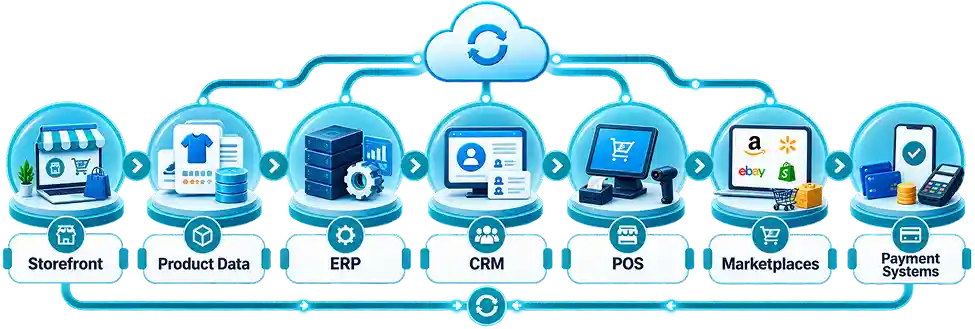
This flexibility can also support headless and composable commerce architectures, allowing businesses to separate the frontend experience from backend commerce functionality and integrate specialized technologies where needed.
How Can You Benefit from Migrating to BigCommerce?
Improve SEO and AI Readiness
The way customers discover products and brands is continuing to expand beyond traditional search engines. Businesses may now need to consider search engine visibility alongside emerging AI-powered discovery experiences.
BigCommerce can provide a technical foundation that supports several factors related to ecommerce discoverability, including:
- SEO-friendly and customizable URL structures
- Redirect management during website migration
- Mobile-responsive storefront experiences
- Crawlable and indexable site architecture
- Structured product and commerce data
- Product information management
- Logical site architecture and internal linking
- Content accessibility for search engines and AI-powered discovery systems
BigCommerce can provide a strong technical foundation, but rankings in search engines and visibility in AI-generated results are not guaranteed by the platform itself. Performance depends on factors such as content quality, authority, relevance, structured data, and technical accessibility.
Exceptional Support and Resources, Built for Large Enterprises
One of the most underrated BigCommerce benefits for large enterprises is the level of dedicated support that comes with enterprise plans:
- A named team of engineers, account managers, and strategists
- Proactive guidance on identifying growth opportunities, not just reactive troubleshooting
- Faster issue resolution during high-traffic periods (seasonal spikes, promotional launches)
Larger organizations tend to get the most value here, since bigger catalogs, more integrations, and higher traffic volumes typically mean more edge cases and having a dedicated team on the other end of that conversation shortens time-to-resolution considerably.
Advanced Customization, Including B2B and Integration Flexibility
BigCommerce doesn't lock businesses into a fixed layout. Key customization capabilities include:
- A large library of free and paid templates, all editable through a drag-and-drop interface
- Up to 250 product listing options per SKU, with support for large custom fields and bulk category editing
- Businesses with complex catalogs can use custom fields and API-based integrations to manage and exchange structured product information when standard product attributes do not meet their data requirements.
- Themes that adapt automatically across devices, so mobile shopping experiences don't need a separate build
For B2B sellers specifically, BigCommerce brings capabilities that many platforms treat as an afterthought:
- Native customer segmentation for account-based pricing and catalogs
- Conditional content hiding or showing products, categories, pricing, or payment/shipping options based on who's logged in
- Flexible payment method support beyond standard card checkout
- A strong API layer that supports integrations with ERP, accounting, and CRM systems important for businesses that need the storefront to stay in sync with back-office systems rather than operate as a silo
This combination is a big part of why BigCommerce shows up so often in BigCommerce migration services conversations for mid-market and enterprise B2B sellers moving off more rigid or self-hosted platforms.
Security and Fraud Management Capabilities
Security is consistently cited as one of the top big commerce features and benefits driving migration decisions, and for good reason:
- BigCommerce provides platform-level security capabilities and compliance infrastructure, while merchants may still have responsibilities depending on their payment setup, integrations, applications, and business operations.
- SSL certification and end-to-end data encryption
- Fraud prevention capabilities may be available through payment providers, payment gateways, or third-party services integrated with the ecommerce platform.
- Password encryption and account-level security controls
- A dedicated security team that continuously monitors for emerging threats
The division of PCI DSS responsibilities can vary depending on how a merchant accepts and processes payments. Businesses should review their specific payment architecture and compliance requirements rather than assuming that all PCI obligations are automatically transferred to the ecommerce platform.
For businesses handling sensitive payment data at volume, this reduces both the compliance burden and the operational risk of running a self-managed security stack.
Support Business Growth and Scalability
BigCommerce provides capabilities designed to support businesses as their catalogs, traffic, markets, and commerce requirements grow. Growth-oriented features include:
- Advanced merchandising and marketing tools that scale with catalog size
- Multi-currency support built into every theme, useful for businesses expanding into new markets
- Businesses can evaluate available BigCommerce plans and platform capabilities based on their transaction volumes, operational requirements, integrations, and growth objectives.
- Abandoned cart recovery with up to three automated follow-up emails to recapture lost sales
- A CMS built to support both B2C and B2B sales motions from the same backend
The result: The ability to expand functionality over time may help businesses reduce the need for frequent platform changes, although the long-term suitability of any ecommerce platform depends on a business's specific technical and operational requirements.
BigCommerce Migration Challenges to Consider
No ecommerce platform migration is entirely friction-free. Identifying potential challenges before development and data migration begins can help businesses reduce disruption during the transition.
- Product catalogs, customer records, order history, product attributes, categories, and other business data need to be mapped correctly to the BigCommerce data structure. Businesses should validate migrated data before launching to identify missing, duplicated, or incorrectly formatted information.
- SEO preservation rankings can dip if redirects and URL structures aren't handled carefully during cutover
- Highly customized legacy stores may include functionality that does not directly translate to BigCommerce. Businesses may need to redesign workflows, use third-party applications, or develop custom functionality to meet specific requirements.
- Existing connections with ERP, CRM, POS, accounting, marketing, payment, shipping, and other systems may need to be rebuilt or reconfigured. Integration requirements should be identified early to avoid operational disruptions after launch.
These challenges are manageable when they are identified and planned before the migration begins. An experienced BigCommerce migration partner plans each of them before cutover, which is a large part of why working with specialists rather than attempting a DIY migration tends to produce a smoother transition.
SEO Migration and Search Visibility
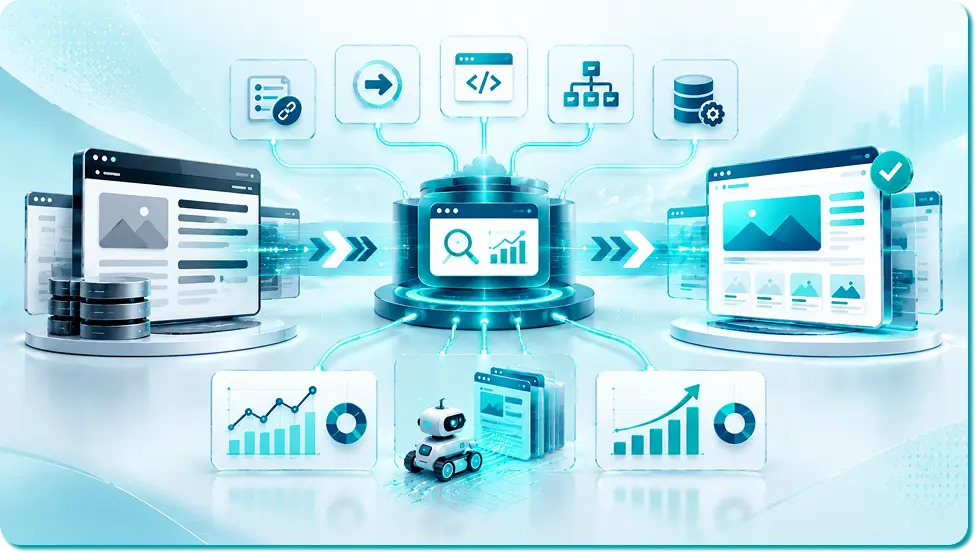
SEO should be included as part of the migration plan rather than addressed after launch. Poorly managed URL changes or technical issues can affect organic visibility and traffic.
Important SEO migration activities include:
- URL mapping
- 301 redirects
- Metadata preservation or optimization
- Canonical tag review
- XML sitemap validation
- Internal link updates
- Structured data implementation and validation
- Crawlability and indexing checks
- Search Console monitoring before and after launch
How Can You Migrate to BigCommerce?
The current section is too short and moves immediately into promoting a migration partner. Replace the content after this heading with the following:
Migrating to BigCommerce involves more than transferring products and customer records from one platform to another. A successful migration requires planning around data, storefront architecture, integrations, SEO, testing, and post-launch monitoring.
Audit the Existing Ecommerce Platform
Review the current ecommerce environment, including:
- Product and catalog structure
- Customer and order data
- Custom functionality
- Third-party integrations
- Payment and shipping configurations
- Existing URLs and SEO performance
- Technical limitations and business requirements
This audit helps identify what should be migrated, redesigned, replaced, or removed.
Define the BigCommerce Architecture
Determine how the new ecommerce environment will be structured. This may include decisions about:
- Storefront architecture
- Theme customization or headless development
- Product and category structure
- B2B or B2C functionality
- APIs and integrations
- Multi-channel requirements
- Payment and shipping workflows
Map and Migrate Data
Map existing data to the appropriate BigCommerce fields and structures.
This can include:
- Products and variants
- Categories
- Customer accounts
- Order history
- Product images and digital assets
- Custom fields
- Pricing and catalog information
Rebuild or Customize the Storefront
Recreate the storefront using an existing theme, customized theme, or headless architecture based on business requirements.
This stage can include:
- UX and UI implementation
- Product and category page development
- Navigation and search configuration
- Mobile optimization
- Content migration
- Custom functionality development
Recreate and Test Integrations
Rebuild and test connections with external systems, including:
- ERP systems
- CRM platforms
- PIM systems
- POS solutions
- Payment gateways
- Shipping providers
- Tax services
- Marketing and analytics tools
Implement SEO Redirects and Technical SEO Requirements
Before launching, create and test a complete SEO migration strategy.
This should include:
- URL mapping
- 301 redirect implementations
- Metadata review
- Canonical configuration
- XML sitemap generation
- Internal link updates
- Structured data validation
- Crawlability and indexing checks
Test the Store
Test critical customer and operational workflows, including:
- Product browsing and search
- Shopping cart functionality
- Checkout and payment processing
- Shipping and tax calculations
- Customer accounts
- Mobile responsiveness
- Third-party integrations
- Redirects and SEO requirements
Launch and Monitor
After launch, it is necessary to keep an eye on the store concerning technical, operational, and SEO problems. The difficulty of migration will depend on catalog size, quantity of customization, number of integrations, data requirements, and SEO issues. Companies with complex ecommerce environments may need the help of experienced developers or professional implementation specialists.
Post-launch monitoring can include:
- Website errors and performance
- Conversion and checkout performance
- Integration performance
- Crawl and indexing activity
- Search Console reports
- Organic traffic and rankings
- Redirect errors
- Customer feedback
Is BigCommerce Migration Right for Your Business?
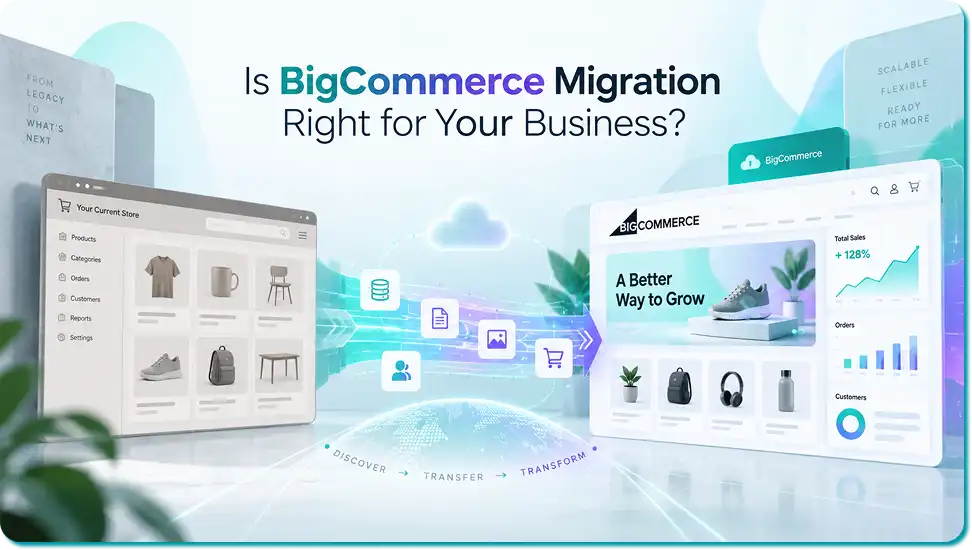
For companies looking for a more flexible eCommerce architecture, better integration possibilities, B2B or multi-channel capabilities knowing if migrating to BigCommerce would be a good idea is essential.
Nonetheless, migration fails to be a good solution for any business. The value is determined by various limitations of the current system, technical requirements, migration difficulties, availability of resources, and the plan for eCommerce.
Businesses should be aware of the need for planning their data migration process, storefront development, integration with other businesses, SEO continuity, as well as testing and monitoring to carry out the migration successfully. If they are knowledgeable about the essentials of the process, they will be able to determine whether BigCommerce would be the right choice for them.
Disclaimer:
This content has been made available for information purposes only. Views and opinions expressed in this content are those of the individual author only and do not necessarily represent the opinions and views of Chetu. Chetu, and its representatives, make no representation or warranty of any kind, express or implied, regarding the accuracy, adequacy, validity, reliability, availability, or completeness of any information of this content. Under no circumstances shall Chetu, or its representatives, have any liability to you or any loss or damage of any kind incurred as a result of the use of this content or reliance on any information provided in this content. Your use of this website and your reliance on any information on this content is solely at your own risk.
About Chetu:
Founded in 2000, Chetu empowers businesses with AI and digital transformation solutions, supporting startups, SMBs, and Fortune 5000 companies. We deliver end-to-end software solutions backed by global digital intelligence and industry expertise. Our customized software delivery model and one-stop-shop approach span the full technology spectrum. Headquartered in Sunrise, Florida, Chetu operates 13 locations across the U.S., Europe, and Asia.
See more at: Chetu Blogs
Share


Limited Time Offer for a Free E-Book

Suggested
Reading
Read our blogs on automation strategies, technology and business solutions.