Thank you!
Your blog has been successfully shared.


Let's Talk !  954 342 5676
  +44 137 243 2466
Matthew Jennings - Director of Operations | July 02, 2026
The retail sector is awash in AI pilots that never scale. The root cause isn't model quality it's integration of debt. Most retailers and SaaS teams rushing into AI adopt a model-first approach: they deploy recommendation engines, experiment with predictive analytics for retail, launch AI inventory forecasting solutions, or stand up chatbots, only to discover months later that these systems operate beside the business rather than within it.
The result? Models pull stale data, lack connectivity to operational systems, and require manual intervention to trigger business processes. Without proper retail systems integration, even the most advanced AI solution struggles to deliver measurable value.
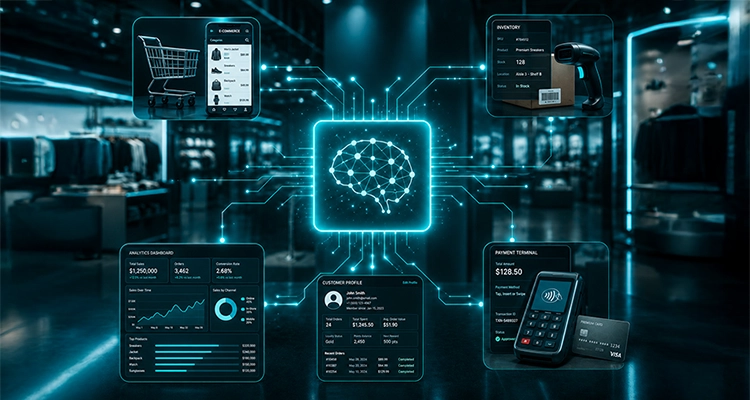
The real challenge in retail AI isn't building a model that predicts; it's building a system that acts. For that to happen, the AI layer must be connected to inventory platforms, POS integrations, CRM integrations, supplier networks, e-commerce platforms, and ERP software integrations from the start rather than as an afterthought.
This challenge becomes even more important in the era of agentic AI. An AI agent that can reason but cannot execute actions across an AI retail ecosystem is simply an expensive chatbot.
What they all have in common is the fact that they are focusing on the AI integration services, enterprise AI development, and AI-ready retail infrastructure as pillars of their strategy, and they are achieving meaningful results today. The integration architecture is seen as a business-critical deliverable and not a post-launch task.
Successful retail AI implementation starts with building a connected data and action framework before optimizing a single model.
Begin by mapping every decision the AI is expected to influence. Then identify:
The system that owns the required data
The integrations needed to access that data
The workflows required to execute resulting actions
The operational teams responsible for outcomes
Only after these elements are connected should model training begin.
This sequence is important because the value that AI brings is when it is used to directly inform business processes. From forecasting customer needs for retail to optimizing supply chains through AI predictions to creating custom promotions to a seamless omnichannel customer journey, these integrations are the key to success.
Walmart's adoption of AI is particularly notable in its quest to improve inventory accuracy problems across its vast network of stores.
In more than 10,000 stores around the world, and more than 100,000 SKUs per store, it has been hard to keep track of product availability. Lost sales, frustrated customers, and inefficiencies resulted as Phantom Inventory products showed up in the systems but didn't show on the shelves.
For Walmart, inventory visibility wasn't just a reporting issue. It was a barrier to delivering consistent omnichannel customer experience and enabling truly data-driven retail operations.
Rather than deploying a standalone AI model, Walmart developed the Intelligent Retail Lab, piloted in Levittown, New York.
What makes this Walmart AI case study particularly noteworthy is the focus on integration rather than model sophistication alone.
The solution combined:
Computer vision systems powered by shelf-scanning cameras
Inventory management platforms
Store operations systems
Associate task management applications
Real-time retail data pipelines
The AI continuously monitored store shelves, identified out-of-stock products, and automatically generated replenishment tasks delivered directly to associates through handheld devices.
This architecture created an intelligent supply chain workflow inside the store, transforming AI insights into immediate operational actions.
The system processed information from more than 1,500 cameras per store at one-second intervals, enabling near-real-time inventory monitoring.
Key outcomes included:
Reduced phantom inventory incidents
Faster replenishment response times
Improved associate productivity
Better product availability
Enhanced customer satisfaction
This retail AI success story demonstrates that the real value came not from the computer vision model itself, but from the connected infrastructure that enabled action.
The lesson from this retail AI case study is straightforward:
AI succeeds when intelligence is embedded into business workflows.
A highly accurate model disconnected from operational systems delivers limited value. A slightly less sophisticated model integrated into inventory systems, task management tools, and retail operations often generates far greater business impact.
This is the essence of successful AI retail transformation.
Reduced phantom inventory incidents
Faster replenishment response times
Improved associate productivity
Better product availability
Enhanced customer satisfaction
This retail AI success story demonstrates that the real value came not from the computer vision model itself, but from the connected infrastructure that enabled action.
Document every system the AI solution must access, including:
POS systems
ERP platforms
E-commerce applications
Loyalty platforms
Supplier portals
CRM environments
Marketing automation tools
This exercise often uncovers hidden dependencies that can derail AI projects.
One of the main challenges that retailers face is that their data environments were not built to support AI workloads.
By modernizing data warehouses and building them to be scalable, AI systems can get the right information on time.
In most cases, the overnight batch process is not enough. Streaming pipelines or near-real-time data pipelines are essential to modern AI solutions, providing high-speed data streams for quick analysis and decision-making.
Every prediction should have a defined business response.
Examples include:
| AI Output | Business Action |
|---|---|
| Product likely to stock out | Auto-trigger reorder |
| Demand spike predicted | Increase allocation |
| Customer likely to churn | Launch retention offer |
| Product recommendation generated | Modern Rails architecture |
If an action cannot be defined, the use case should be reconsidered.
For the first 60 days, route AI recommendations through human review processes.
This approach validates data quality, integration reliability, and operational readiness before introducing autonomous decision-making.
Track:
Data freshness
API response rates
Integration uptime
Workflow completion rates
System latency
Model accuracy alone cannot determine AI success.
Avoid launching multiple disconnected pilots.
Instead, fully integrate one use case such as AI inventory forecasting, retail demand forecasting, or AI supply chain optimization before expanding into additional initiatives.
Many retailers assume poor model performance stems from weak training data when the real issue is inconsistent with data sources between training and production environments.
Prevention: Use a unified feature store and consistent data governance practices.
As organizations pursue retail systems integration, they often identify additional systems that seem valuable but aren't essential to the initial business objective.
Prevention: Prioritize integrations required for the core value loop and phase in enhancements later.
Agentic AI systems can trigger purchasing decisions, pricing updates, inventory movements, and promotional actions.
Without safeguards, errors can create significant operational disruptions.
Prevention: Implement of rollback procedures, approval of workflows, and automated circuit breakers before enabling autonomous execution.
This provides immediate visibility into potential bottlenecks.
Create dashboards for your top three operational data sources and identify latency issues affecting AI performance.
Allow AI to generate recommendations while humans execute the resulting actions manually.
This validates workflow design before automation introduces risk.
Present integration metrics alongside model performance metrics.
Organizations pursuing AI retail transformation should view integration health as a strategic KPI, not merely a technical metric.
The future of retail AI will not be defined by who builds the most advanced model. It will be defined by who creates the most connected ecosystem.
From AI inventory forecasting to retail demand forecasting, from personalized recommendation engines to AI supply chain optimization, to providing a seamless omnichannel customer experience, integration is the key to success.
The best AI applications are created through AI-ready retail infrastructure, powered by enterprise AI development, and enhanced with CRM, POS, ERP software, and modern data architectures.
As the Walmart AI case study demonstrates, AI becomes transformational when it is embedded directly into operations, enabling smarter decisions, faster execution, and truly data-driven retail operations.
Chetu helps retailers accelerate AI retail transformation through end-to-end AI integration services, custom software development, and enterprise modernization initiatives.
From retail systems integration, data warehouse modernization, and scalable architecture design to AI supply chain optimization, CRM integrations, POS integrations, and custom enterprise AI development, Chetu builds the connected foundation organizations need to move from AI experimentation to production-ready business outcomes.
Disclaimer:
This content has been made available for information purposes only. Views and opinions expressed in this content are those of the individual author only and do not necessarily represent the opinions and views of Chetu. Chetu, and its representatives, make no representation or warranty of any kind, express or implied, regarding the accuracy, adequacy, validity, reliability, availability, or completeness of any information of this content. Under no circumstances shall Chetu, or its representatives, have any liability to you or any loss or damage of any kind incurred as a result of the use of this content or reliance on any information provided in this content. Your use of this website and your reliance on any information on this content is solely at your own risk.
About Chetu:
Founded in 2000, Chetu empowers businesses with AI and digital transformation solutions, supporting startups, SMBs, and Fortune 5000 companies. We deliver end-to-end software solutions backed by global digital intelligence and industry expertise. Our customized software delivery model and one-stop-shop approach span the full technology spectrum. Headquartered in Sunrise, Florida, Chetu operates 13 locations across the U.S., Europe, and Asia.
See more at: Chetu Blogs
Share


Limited Time Offer for a Free E-Book
Privacy Policy | Legal Policy | Careers | Sitemap | Referral | Contact Us
Copyright © 2000- 2026 Chetu Inc. All Rights Reserved.