How SoftPOS Is Redefining Modern Point of Sale Payments
Roland Burrell -Director of Sales | October 06, 2026
- Lower cost, greater flexibility. SoftPOS turns an NFC-enabled smartphone or tablet into a payment terminal, cutting hardware costs and letting businesses accept payments anywhere.
- Complement, not replacement. SoftPOS suits mobile and off-site sales, but cash handling and connectivity needs mean many businesses will run it alongside fixed terminals.
- Security and integration matters. Choose a solution with PCI MPoC certification and real-time sync to your POS, inventory, and reporting tools.

Retail was tested hard during the pandemic, and payment processing was one of the areas that changed fastest. Consumers pushed for contactless options, and merchants had to rethink how and where they accepted payments. That shift has not been reversed. Mobile point of sale (POS) has kept growing, and SoftPOS is now one of its most talked-about forms.
SoftPOS turns a connected phone/tablet device into a payment acceptance terminal. For merchants exploring cost-saving measures, that means less dedicated hardware to buy and maintain.
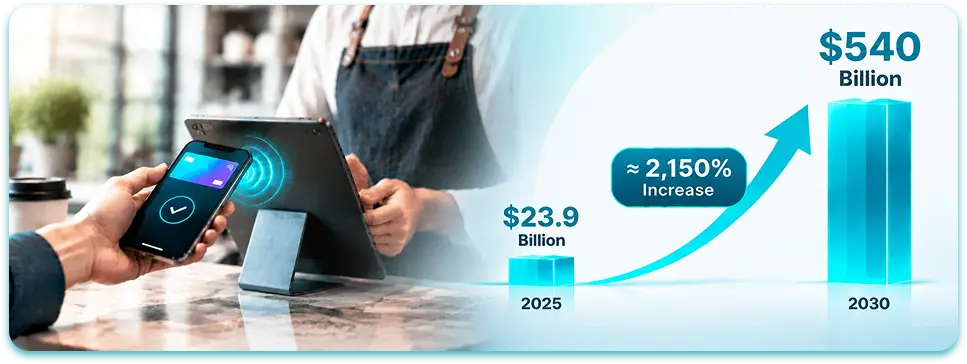
Juniper Research's May 2025 study found that global soft POS transaction value will reach $540 billion in 2030, up from $23.9 billion in 2025, roughly a 2,150% increase. Juniper attributes the growth to soft POS, helping micro and small businesses move away from cash by removing hardware costs.
What Is SoftPOS?
SoftPOS (software-based point of sale) is a payment technology that lets a merchant accept contactless card and mobile wallet payments using a smartphone or tablet with NFC, with no traditional payment terminal. The merchant installs a certified payment app, and the device reads the customer's card or wallet when they tap. The transaction is authorized and settled through the merchant's payment processor.
SoftPOS enables businesses to accept contactless payments directly through smartphones, eliminating the need for traditional payment terminals. For businesses expanding beyond the USA, SoftPOS availability depends on the target country, payment processor support, and device compatibility. These factors should be evaluated before planning a global rollout.
How a Soft POS Technology Works
A SoftPOS transaction follows five steps:
- The customer taps: A contactless card or mobile wallet is held to the NFC-enabled phone or tablet.
- The app reads and encrypts: The payment app captures the card data and encrypts it immediately.
- Data is tokenized: Sensitive card details are replaced with tokens before they travel onward. See our guide to payment processing security with tokenization technology.
- The processor is authorized: The transaction goes to the payment processor and card network, and the approval returns in seconds.
- Everything syncs: Sales data lands in the POS in real time, updating reports and stock levels.
On security, SoftPOS is not simply "encrypted versus not." Look for solutions certified under the PCI Security Standards Council's Mobile Payments on COTS (MPoC) standard, which covers attestation and monitoring of the software and the device it runs on.
From Cash Registers to Cloud POS
Understanding why SoftPOS matters starts with how the traditional POS system evolved:
- 1973: Computer-driven cash registers reach commercial use.
- POS terminal era: Businesses deploy dedicated terminals to speed up sales, receipts, and reporting.
- Software-driven features: Developers add contactless support and wider digital payment options.
- Cloud-based POS: SaaS vendors handle maintenance and updates, so businesses no longer manage licenses manually. Franchise owners can connect multiple stores and access sales reports and customer trends from one place.
- SoftPOS: The payment acceptance layer moves off dedicated hardware and onto the devices people already carry.
SoftPOS vs Traditional Payment Systems
| SoftPOS | Traditional POS terminal | |
|---|---|---|
| Hardware | Existing NFC smartphone or tablet | Dedicated terminal, often with a separate reader |
| Upfront cost | Low; app-based | Higher; hardware purchase and installation |
| Mobility | Accept payments anywhere with a signal | Usually fixed to a counter |
| Maintenance | Software updates through the vendor | Hardware upkeep and replacement |
| Cash handling | Not supported by the app itself | Integrated cash drawer |
| Connectivity | Requires internet connectivity for transaction processing | Often supports additional connectivity options depending on terminal setup |
| Scaling | Add a device and an app license | Add terminals, cabling, and setup |
Most businesses will not replace every soft POS terminal or fixed terminal overnight. Many will run both, with fixed terminals at the counter and SoftPOS for queue-busting, pop-ups, off-site sales, and tables in restaurants.
Key Benefits of Mobile Payments with SoftPOS
Lower hardware costs
SoftPOS turns a connected device into a payment processor, removing the need for costly terminals that also require maintenance. This helps small businesses.
Real-time data syncing
Real-time transaction data updates sales insights, inventory levels, and connected systems for better operational visibility.
Strong data protection
Transactions are encrypted, and certified solutions add device attestation and monitoring.
Flexibility and mobility
Staff can take payments at the table, the fitting room, the curb, or the customer's door.
Faster staff onboarding
Phones and tablets are familiar, which shortens training time.
Better labor use
With staffing pressures across retail, employees can process payments while moving through the floor instead of queuing at a fixed till.
Wider access to card payments
Micro-merchants and small businesses that found terminals too costly can now accept contactless payments.
Limitations to Plan For
SoftPOS is not a direct replacement in every situation. Plan around these:
- Cash. The app cannot handle cash, so businesses that take it need a separate process.
- Connectivity. Requires reliable connectivity through Wi-Fi or mobile data for smooth transaction processing.
- Integration depth. Some solutions may not connect to every existing business application, so confirm compatibility with your inventory, CRM, and accounting tools.
- Regional and device support. Supported devices, operating systems, and card acceptance rules vary by market and provider.
Where a SoftPOS Payment Solution Fits: A Beauty and Retail Example
Consider a three-location salon group whose stylists also handle on-site bridal and event appointments. With traditional terminals, each location has a machine at the front desk, while off-site payments are invoiced later or run through a separate personal reader with its own settlement reports.
With a SoftPOS payment solution built into the group's POS app, the makeup artist taps the client's card at the venue, and the sale posts to the same system. A retail add-on, such as a setting spray, updates stock immediately. Owners see all locations and mobile appointments in one report.
The gaps are worth planning for. Cash tips still need a fallback, and a venue with weak signal needs a backup plan. The same pattern applies to pop-up retail, restaurants with tableside payment, delivery, and field service.
Build or Buy Your SoftPOS Solution?
Off-the-shelf SoftPOS works for many companies. Businesses that want payments embedded in their own POS or app, tied to loyalty, inventory, or franchise reporting, often need custom development: certified SDK integration, tokenization, fraud controls, and back-office sync. Chetu's POS and payment processing developers build and integrate these solutions, and our custom POS guide covers when building makes sense.
Moving Forward with SoftPOS
Payment processing now sits at the center of how businesses compete on convenience, speed, and data. SoftPOS lowers the barrier to accepting digital payments while helping merchants connect in-store transactions with e-commerce platforms, inventory systems, and customer data for a more unified commerce experience. Whether you adopt it alongside fixed terminals or build it into your own platform, plan its limits as carefully as you plan for its benefits.
Disclaimer:
This content has been made available for information purposes only. Views and opinions expressed in this content are those of the individual author only and do not necessarily represent the opinions and views of Chetu. Chetu, and its representatives, make no representation or warranty of any kind, express or implied, regarding the accuracy, adequacy, validity, reliability, availability, or completeness of any information of this content. Under no circumstances shall Chetu, or its representatives, have any liability to you or any loss or damage of any kind incurred as a result of the use of this content or reliance on any information provided in this content. Your use of this website and your reliance on any information on this content is solely at your own risk.
About Chetu:
Founded in 2000, Chetu empowers businesses with AI and digital transformation solutions, supporting startups, SMBs, and Fortune 5000 companies. We deliver end-to-end software solutions backed by global digital intelligence and industry expertise. Our customized software delivery model and one-stop-shop approach span the full technology spectrum. Headquartered in Sunrise, Florida, Chetu operates 13 locations across the U.S., Europe, and Asia.
See more at: Chetu Blogs
Share


Limited Time Offer for a Free E-Book

Suggested
Reading
Read our blogs on automation strategies, technology and business solutions.