Thank you!
Your blog has been successfully shared.


Let's Talk !  954 342 5676
  +44 137 243 2466
Roland Burrell – Director of Sales | April 08, 2026
Retail has experienced a radical change in the last years. A couple of years down the line, the traffic on mobile commerce overtook the desktop traffic, a significant indication of the way consumers shop. Businesses soon followed suit and made their mobile experiences more productive, yet most of them did not consider a key issue: most retail systems are currently isolated.
The resulting disintegration brings about what many retailers are going through today: system dissonance and lack of communication between platforms. Although merchants can favour mobile, web, and in-store shopping: technologies of these channels cannot communicate effectively. The outcome is the disjointed customer experience.
To address this dilemma, retailers are turning to the concept of unified commerce, the new approach, which is a model that incorporates all retail channels into an interconnected system.
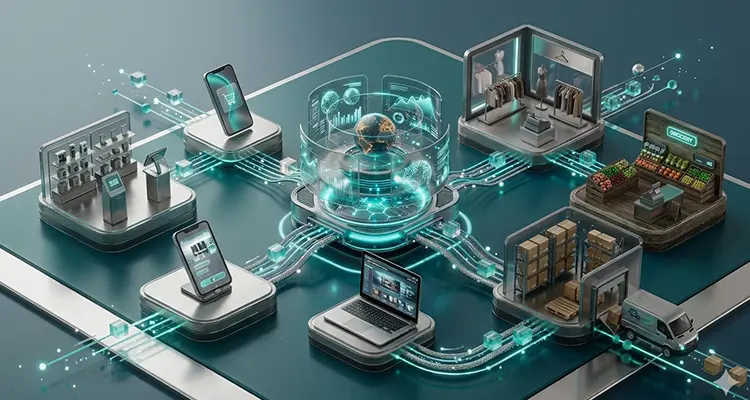
Unified commerce is the centralized system in which all the customer-facing and internal retail technologies are implemented on a single platform. Systems used in unified commerce retail, including mobile applications, eCommerce web apps, desktop portals, and point-of-sale (POS) systems, are fully integrated and share data.
This structure has resulted in a smooth flow of information through all the channels, thus providing uniform customer experience and operations.
Simply put, unified commerce retail eradicates the silos present in the traditional retail systems. Rather than working individually, each channel is a component of a single ecosystem.



The world retail environment is dynamic more than ever. The trends are short-lived, but one thing has remained constant and necessary, and that is unified commerce in retail.
With the quality of products and their prices getting more and more competitive amongst the brands, price and product quality are no longer the factors that define customer loyalty. Rather, customers seek experiences that are dynamic in accordance with their needs.
This is where unified retail commerce comes in. Combining all channels, companies will be able to provide a smarter and more personalized shopping experience.
As an illustration, a retailer with the help of unified commerce software can monitor customer purchasing patterns and purchase history. The information can help the businesses to prescribe pertinent products and customize the interactions in all channels.
The outcome is a better customer experience that builds long-term relationships.
Unified commerce vs. omnichannel are taken to be synonymous by many retailers, but their concepts are totally different.
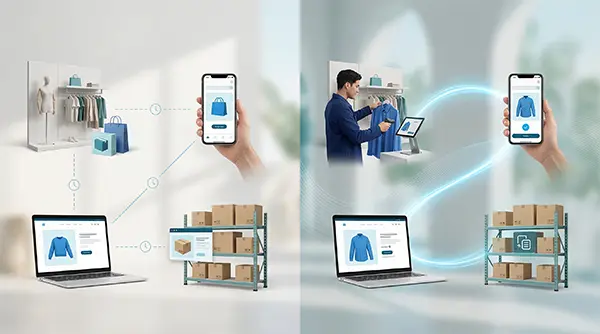
An omnichannel unified commerce approach integrates various channels that are usually based on distinct systems that interact via integrations. Although this enhances the customer experience as opposed to the usual retail models, data remains in various systems.
Unified commerce architecture, on the other hand, is performed on a centralized platform in which all channels use the same database.
Channels operate independently
Systems communicate through integrations
Data synchronization may be delayed
All channels operate within one ecosystem
Real-time data across every touchpoint
Complete visibility for both customers and retailers
This is particularly critical in the situation where customers switch across channels.
In multimedia commerce, as an example, a shopper can discover a commodity using his mobile phone and then go to the physical store to acquire the product. Unified commerce retail will allow store representatives to access real-time inventory information immediately and order the item in case it is out of stock in the store.
That opportunity can be missed without integration.
Retailers need to embrace technologies that will deliver seamless shopping experiences.
These are some of the key unified commerce capabilities that can support connected retail experiences:
A unified commerce solution allows both customers and store representatives to check product availability instantly across all locations.
This improves order fulfillment and prevents lost sales opportunities.
Retailers can store customer purchase history and behavior data within their unified commerce platform.
This allows brands to recommend products and promotions tailored to individual preferences.
Customers should be able to start their journey in one channel and finish it in another without disruption.
Whether shopping through mobile, desktop, or in-store, seamless shopping becomes possible when all channels are connected.
A unified system ensures smooth checkout processes across online stores, POS terminals, and mobile applications.
This simplifies transactions and enhances the overall customer experience.
The advantage of unified commerce extends beyond better customer experiences. Retailers also benefit from improved operational efficiency and stronger brand performance.
Key advantages include the following:
Stable infrastructure that supports integrated operations
Real-time inventory management across all channels
Consistent brand experience across digital and physical stores
Faster inventory turnover and order processing
Enhanced brand reputation for service and convenience
Improved customer loyalty and brand value
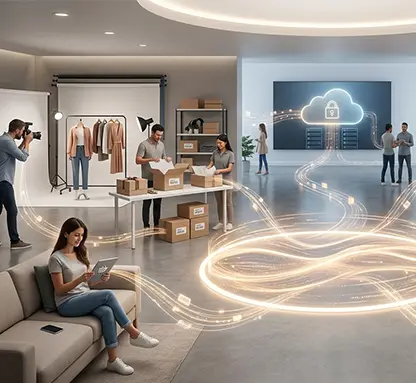
Additionally, many organizations are implementing cloud-based unified commerce solutions to support scalability, security, and data accessibility.
With cloud infrastructure, retailers gain the flexibility to expand operations while maintaining consistent performance.
The most important advantage of unified commerce is that it has the power to enhance customer relationships.
The impact of unified commerce on customer retention is directly connected with the quality of customer experience. When the shoppers feel that they receive uniform and customized service at the cross-channels, they tend to come back.
Unified commerce also gives customers power since it enables them to have greater control over their shopping experiences. Customers feel more attached to the brand, whether they are opting to have their deliveries be flexible or spot their inventory through the internet or receive back-in-stock alerts.
Happy customers will most certainly make loyal customers.
With the continued development of retail, the use of a powerful unified commerce strategy is becoming a necessity for both the retailer and the technology provider.
Companies should invest in systems that would enable full integration of channels, real-time information exchange, and scalability.
A collaboration with a long-term unified commerce partner will allow retailers to develop the appropriate system architecture and combine technologies needed in the operations of contemporary retail.
This method also is helpful in B2B unified commerce, where the distributors and manufacturers require a centralized system to handle the complicated supply chains and customer portal.
Disclaimer:
This content has been made available for information purposes only. Views and opinions expressed in this content are those of the individual author only and do not necessarily represent the opinions and views of Chetu. Chetu, and its representatives, make no representation or warranty of any kind, express or implied, regarding the accuracy, adequacy, validity, reliability, availability, or completeness of any information of this content. Under no circumstances shall Chetu, or its representatives, have any liability to you or any loss or damage of any kind incurred as a result of the use of this content or reliance on any information provided in this content. Your use of this website and your reliance on any information on this content is solely at your own risk.
About Chetu:
Founded in 2000, Chetu empowers businesses with AI and digital transformation solutions, supporting startups, SMBs, and Fortune 5000 companies. We deliver end-to-end software solutions backed by global digital intelligence and industry expertise. Our customized software delivery model and one-stop-shop approach span the full technology spectrum. Headquartered in Sunrise, Florida, Chetu operates 13 locations across the U.S., Europe, and Asia.
See more at: Chetu Blogs
Share


Limited Time Offer for a Free E-Book
Privacy Policy | Legal Policy | Careers | Sitemap | Referral | Contact Us
Copyright © 2000- 2026 Chetu Inc. All Rights Reserved.