Thank you!
Your blog has been successfully shared.
Let's Talk !  954 342 5676
  +44 137 243 2466
Roland Burrell - Director of Sales | July 22, 2026
There's a version of HR that most teams know well about chasing paperwork, manually screening resumes, rebuilding the same workforce report every quarter, and somehow still not having a clear picture of where talent gaps are forming. Traditional human capital management systems have helped standardize these processes. But standardizing a slow process just gives you a slow process with better documentation.
The challenge modern HR teams face isn't just administrative volume. It's the complexity underneath it, talent shortages that don't follow predictable patterns, retention concerns that surface too late, hybrid models that make workforce management harder, and a leadership expectation that HR will operate more like a business function and less like a back, office service. That gap between what's expected and what legacy HCM software actually supports is where AI enters the picture.
AI in HR doesn't replace human judgment, it gives HR teams something to make better judgments. Faster screening, predictive attrition signals, workforce demand forecasting, personalized learning; these capabilities shift HR from reactive administration to proactive workforce strategy. And for organizations navigating a competitive talent market, that shift isn't optional for much longer.
Human capital management covers the full employee lifecycle, recruiting and onboarding, payroll, performance management, workforce planning, and learning and development. Most HCM software does a reasonable job of managing these functions. The problem is that managing a function and optimizing it are two different things. A system that tracks performance reviews doesn't tell you which employees are disengaging. A payroll system that runs accurately doesn't warn you that your labor cost structure is drifting out of alignment with productivity.
That's the ceiling traditional HCM hits. It records. It processes. It doesn't predict.
The technologies doing the most meaningful work in AI in human resources right now fall into a few categories. Machine learning models analyze historical workforce data to surface patterns, turnover predictors, hiring success indicators, and skills adjacency. Natural language processing powers chatbots, analyzes open, end survey responses, and automates job description generation. Predictive Analytics ties workforce data with projections into the future to help guide planning decisions. And HR generative AI is being leveraged to compose messages, summarize reviews and evaluations, and customize learning materials on a large scale.
None of these technologies are new in isolation. What's changed is how well they integrate into HCM workflows, and how accessible they've become for organizations that aren't running dedicated data science teams.
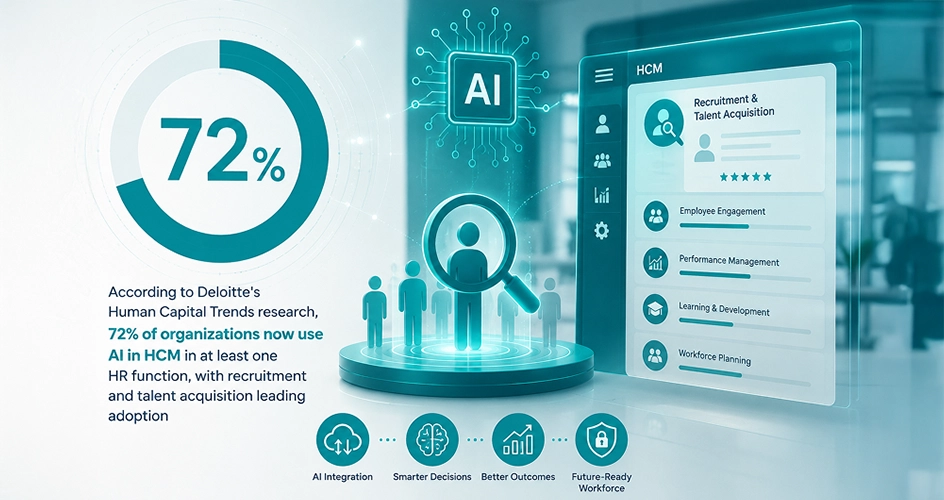
The workforce environment has changed faster than most workforce management software was designed to handle. Remote and hybrid models create scheduling and engagement challenges that require more dynamic data. Skills based hiring has complicated the relationship between job titles and actual capability. And the expectation that HR can surface workforce insights in real time, not after a manual reporting cycle, has raised the bar significantly. According to Deloitte's Human Capital Trends research, 72% of organizations now use AI in HCM in at least one HR function, with recruitment and talent acquisition leading adoption. The question has shifted from whether to adopt AI to how quickly and how well.
Recruitment is where most organizations first encounter practical AI in human resources, and for good reason. The volume challenge in hiring is very real: screening hundreds of applications to arrive at a short list of qualified candidates is a time-consuming, labor-intensive, inconsistent, and fatigued process – and carries with it the biases that come from being tired. AI recruitment software filters resume based on the job requirements, sorts of candidates, makes scheduling interviews easier, and uncovers passive candidates who meet the open position criteria. This leaves the pipeline quicker, and a recruiter's time freed up for the conversations that need human skill, relationship-building, culture fit evaluation and strong closing.
First impressions of onboarding matter more than most organizations act on. By streamlining documentation, triggering training protocols at the right time, and providing virtual assistants to help new hires with policy questions, AI-powered employee onboarding applications can also help. It can be more valuable in many ways, with an AI-powered onboarding program being able to implement a different approach for all new hires based on the role, location, and gaps they discover.
Labor demand forecasting has historically been a best guess exercise. AI workforce management transforms by leveraging historical staffing patterns, business cycle data, seasonal trends, and real-time signals from operations to accurately predict workforce needs with meaningful precision. Especially this feature enables organizations with shift-based workforces, such as retail stores, healthcare and logistics, to significantly minimize overtime expenses, scheduling issues, and coverage gaps that impact both the business and employee experience.
Continuous performance monitoring is not the same thing as surveillance; it consists of replacing the "one moment in time" problem created by an annual review with an ongoing, comprehensive picture of performance over time. AI talent management tools can track progress toward goals, alert when performance is trending negatively, identify skill gaps in relation to job requirements, and provide managers with coaching prompts based on real performance data rather than memory. Transitioning from periodic to continuous provides both managers and employees with a much clearer picture of performance and a less stressful performance discussion.
The workforce analytics market is projected to exceed $8 billion by 2030, according to Grand View Research, driven largely by the demand for predictive capabilities rather than descriptive ones. Descriptive analytics tells you what happened. Predictive workforce planning tells you what's likely to happen next. In workforce terms, that means identifying which employees are showing early signs of disengagement, which roles are becoming structurally hard to fill, and which teams are approaching capacity constraints before those constraints become visible problems. HR analytics software that operates at this level of intelligence isn't a reporting tool anymore; it's a planning tool.
AI-driven workforce planning connects business projections to headcount decisions in a way that manual planning rarely achieves. AI models incorporate business growth assumptions, seasonal demand curves, market conditions, and historical hiring velocity to produce staffing projections that HR and finance can use together. The organizations getting the most value from this aren't just forecasting how many people they need; they're forecasting which skills they need, by when, and from which sources: hiring, development, or reskilling.
Identifying high potential employees has always been part art. Intelligent workforce management gives it more structure, analyzing performance data, skills profiles, engagement signals, and career progression patterns to surface internal candidates for leadership pipelines before the need becomes urgent. More importantly, it makes internal mobility visible in a way that most organizations currently aren't taking advantage of. The cost of filling a role externally versus developing and promoting internally is significant, and AI makes the internal option more discoverable.
Generic training programs have a well-documented adoption problem. Employees complete them because they're required, not because the content connects to where they're trying to go. AI talent management platforms build personalized pathways based on identified skills gaps, stated career goals, and role requirements, delivering content that's relevant to each employee's actual development trajectory. Organizations leveraging AI-driven employee management software report up to 25% higher employee engagement and retention rates, according to IBM HR Transformation Insights. That's not a marginal outcome.
Engagement surveys give you a snapshot. Employee engagement analytics give you a trend. Natural language processing tools analyze open-ended survey responses, communication patterns, and feedback data to identify sentiment shifts across teams before they show up as turnover. For HR teams that currently rely on quarterly pulse surveys, this represents a meaningful upgrade in early warning capability, and a fundamentally different relationship with workforce data.
HR automation for employee support takes care of all the high volume, low complexity queries in HR that are currently taking up a lot of HR capacity, benefits queries, leave request status, policy clarity, access to pay slips etc. HR teams save a lot of time when they can get accurate answers at any time of the day. Most significantly, employee experience is enhanced: for an employee, a quick, correct answer is better than one; they must wait 2 days for a simple question.
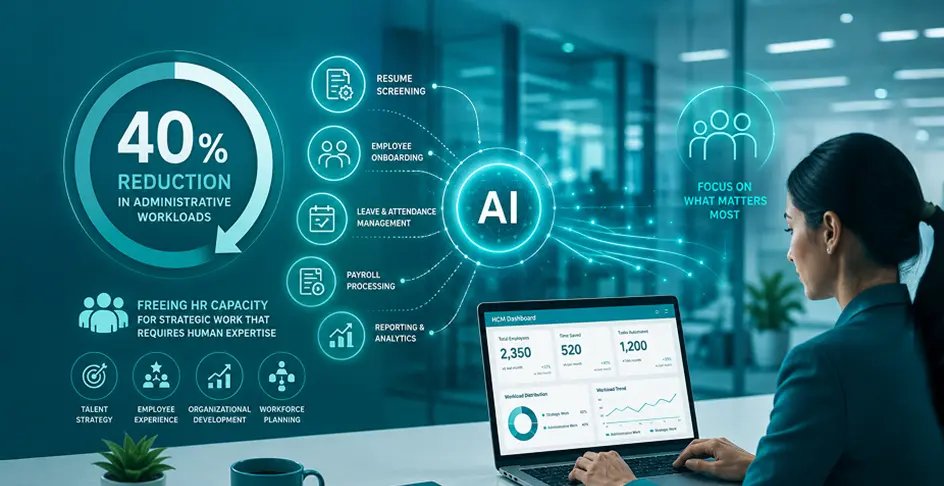
The efficiency case for AI in HCM is well documented. Companies implementing HR automation report up to 40% reductions in administrative workloads, according to McKinsey's Future of Work research, freeing HR capacity for the strategic work that requires human expertise.
But the more compelling case is strategic. Better AI-driven workforce planning means fewer expensive reactive hires. Earlier attrition signals mean retention interventions that have time to work. Personalized development means employees with a clearer line of sight to growth within the organization. And faster, higher quality hiring decisions, powered by ai recruitment software, mean better outcomes at the point where workforce quality is determined: before someone starts.
Reduced hiring costs, improved retention, higher workforce productivity, and more informed decision making aren't independent benefits. They compound. An HR function operating with better data, less administrative burden, and more predictive capability doesn't just run more efficiently; it contributes differently to business outcomes.
AI in human resources runs on employee data, and the obligations around that data are real. GDPR, CCPA, and industry specific regulations govern how employee data can be collected, stored, processed, and used. Any AI implementation in HR needs a clear data governance framework established before deployment, not retrofitted afterward. This applies equally to cloud-based workforce management software and custom-built platforms.
AI models trained on historical data can encode historical biases, particularly in recruitment, where patterns of past hiring can inadvertently replicate demographic skews. Ethical AI practice in human capital management requires ongoing auditing of model outputs for disparate impact, transparent criteria for automated decisions, and human review at high- stakes decision points. This isn't just an ethical obligation; in many jurisdictions it's increasingly a legal one.
The technical reality of most enterprise HR environments is a mix of legacy platforms, point solutions, and custom integrations built over time. Connecting AI workforce management capabilities to this environment requires thoughtful integration architecture and often surfaces data quality issues that need resolution before AI can deliver reliable outputs. The integration challenge is worth planning explicitly rather than treating an afterthought.
Technology adoption in HR fails more often from organizational resistance than from technical limitations. HR teams need to understand how AI tools change their workflows, not just that they do. Managers need confidence that HR analytics software insights are supporting their judgment, not replacing it. And employees need clarity on how their data is being used. Change management is the part most AI implementations underinvest in, and it's frequently where value gets left on the table.
More than 65% of HR leaders are actively evaluating or implementing generative AI in HR initiatives, according to Gartner HR Research. The use cases are expanding quickly: job description generation, policy documentation, employee communications, performance review summarization, and learning content creation are all areas where generative AI is reducing production time and improving consistency across large, distributed HR teams.
The shift from job title based to skills based intelligent workforce management is one of the more significant structural changes happening in HR right now. AI makes this practical by analyzing skills across a workforce at a level of granularity that manual approaches can't sustain, mapping existing capabilities, identifying gaps, and matching internal talent to opportunities based on what people can actually do rather than what their title says they've done.
Personalized career development has historically been limited to whoever an employee happened to have as a manager or mentor. AI talent management platforms analyze skills profiles, performance data, and internal mobility patterns to surface development recommendations and career trajectories specific to each employee, making meaningful career conversations less dependent on individual manager quality and more accessible across the entire organization.
Agentic AI systems that don't just respond to queries but proactively take actions across workflows, are beginning to appear in AI in HR contexts in meaningful ways. Autonomous recruiting assistants that manage candidate pipelines end to end, AI- driven workforce planning agents that monitor staffing signals and flag emerging gaps, and HR support agents that handle employee requests without human intervention are moving from experimental to production deployments. This is early, but the trajectory is clear.
Assess existing HR processes before adding AI. The highest value implementations of AI in human resources start with a clear-eyed audit of where manual effort is concentrated and where data quality is sufficient to support automation. AI amplifies what's there. If the underlying processes are broken, AI makes broken processes faster.
Build a data foundation. Workforce data quality is the single biggest determinant of AI output quality in any HCM software environment. Inconsistent job codes, incomplete employee profiles, and fragmented data across systems all degrade model performance. Investing in data infrastructure before AI deployment is slower, and almost always the right call.
Start with high impact, lower risk use cases. AI recruitment software, workforce scheduling optimization, and employee engagement analytics offer meaningful ROI with relatively contained risk profiles. They're also good environments for building internal AI literacy before moving into higher stakes applications like performance management or succession planning.
Establish governance and oversight from the start. Define who owns AI model performance, how often models are audited, what triggers a human review of automated decisions, and how employees can contest AI- generated outputs across your employee management software ecosystem. These structures are easier to build than to retrofit after something goes wrong.
AI in HCM is reshaping human capital management in ways that go well beyond efficiency gains. The organizations getting ahead aren't just automating administrative tasks with HR automation tools; they're building workforce intelligence capabilities that change how HR contributes to business strategy. Hiring decisions backed by better data. Retention interventions that happen before someone has already decided to leave. Workforce management plans that reflect actual business dynamics rather than last year's headcount model.
The future of AI workforce management will combine intelligent automation with human-centered decision-making, and that combination is more powerful than either element alone. Companies that invest in AI-enabled workforce management software today aren't just solving their current HR problems. They're building the infrastructure to compete for talent more effectively as the landscape continues to shift. That's a different kind of advantage, and it compounds over time.
Disclaimer:
This content has been made available for information purposes only. Views and opinions expressed in this content are those of the individual author only and do not necessarily represent the opinions and views of Chetu. Chetu, and its representatives, make no representation or warranty of any kind, express or implied, regarding the accuracy, adequacy, validity, reliability, availability, or completeness of any information of this content. Under no circumstances shall Chetu, or its representatives, have any liability to you or any loss or damage of any kind incurred as a result of the use of this content or reliance on any information provided in this content. Your use of this website and your reliance on any information on this content is solely at your own risk.
About Chetu:
Founded in 2000, Chetu empowers businesses with AI and digital transformation solutions, supporting startups, SMBs, and Fortune 5000 companies. We deliver end-to-end software solutions backed by global digital intelligence and industry expertise. Our customized software delivery model and one-stop-shop approach span the full technology spectrum. Headquartered in Sunrise, Florida, Chetu operates 13 locations across the U.S., Europe, and Asia.
See more at: Chetu Blogs
Share


Limited Time Offer for a Free E-Book
Privacy Policy | Legal Policy | Careers | Sitemap | Referral | Contact Us
Copyright © 2000- 2026 Chetu Inc. All Rights Reserved.