Let's Talk !  954 342 5676
  +44 137 243 2466

Personalization has become a pillar of digital marketing, as it is the hook that draws in consumers. While the internet has become a repository of personal information, overabundance can muddle personalization without the proper tools.
Consumers have become so used to targeted marketing that they expect organizations to deliver personalized interactions; over 76% get frustrated when this doesn't occur. Over 92% of organizations are looking at AI for personalization to better service consumers' demands.
AI personalization targets customer data using AI to deliver tailored engagement, like product recommendations, content, and marketing messages. Customer data analysis is based on specific preferences and behaviors, creating a chamber of customizations and relevant interactions for each person. People are segmented into categories based on their demographics, past behavior, and social interactions, and their predictive behavior shapes personalized recommendations.
The power of AI personalization is unmatched, and every industry can benefit from advanced marketing materials. It improves customer engagement by 50% and enhances customer satisfaction by 25%. While there might be data privacy concerns, approaching the technology with compliance and understanding will help mitigate any unsavory consequences.
A survey of hundreds of CEOs from the IBM Institute for Business Value found organizations prioritizing customer experience stood to see three times the revenue growth of their peers. 86% of those leaders considered personalization an essential part of their CX campaigns.
AI personalization provides a customer experience that constantly adapts to become the best version of itself. Tailored experiences positively impact customer satisfaction and loyalty, providing a fine-tuned digital experience for each customer and resulting in positive relationships with a brand.
Content personalization maintains customer engagement for longer by drawing them in with the information they most likely need. Relevant recommendations increase the likelihood of a purchase, leading to a higher number of sales.
Businesses can enable automation with AI to create numerous marketing campaigns, product recommendations, or customer service experiences, freeing up resources to deploy in other areas. Some studies indicate that a personalization program reduces customer acquisition costs by as much as 50%. Companies leveraging AI are seeing an average revenue increase of 10% to 12%, and the technology is projected to enhance profitability by 59% by 2035.
Data is power. As AI personalization uncovers detailed data about users, the technology can be used to gain insights into current and future customer behavior, enabling data-driven decision-making. Businesses also gain valuable information about their most loyal customers, allowing them to adapt quickly to maintain loyalty and longevity.
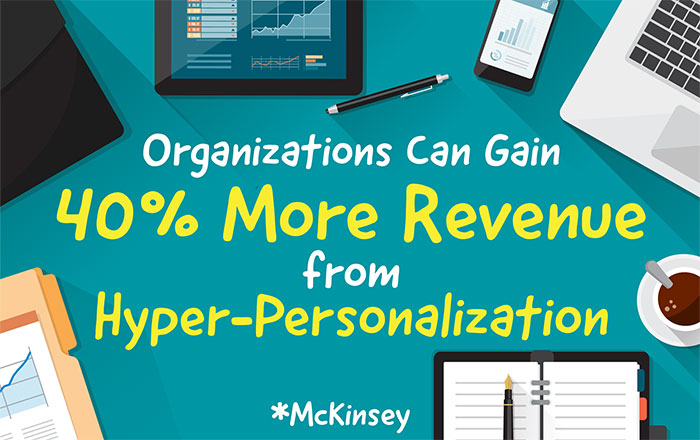
AI personalization encompasses several technologies that can work in tandem to offer tailored materials for heightened customer engagement. According to research by McKinsey, fast-growing organizations gain 40% more revenue from hyper-personalization compared to slow-growing competitors.
AI-powered chatbots provide answers and feedback to customers in real time. They utilize customer profiles to determine the tone and style of communication that will garner the best results. AI enables and leverages sentiment analysis to generate the best response based on the customer's determined attitude.
Predictive personalization uses Machine Learning and algorithms to anticipate customer preferences and behaviors, allowing businesses to better engage with customers. AI tools, such as customized content and offers, can dynamically tailor content and experiences based on this predictive nature. These profiles are used for future marketing strategies and will only become more intuitive as more information is collected.
AI personalization touches every industry in one way or another. It drives personalized product recommendations for e-commerce, fashion, and online streaming. When customers make a first-time purchase, 67% value relevant product recommendations as the most critical factor when deciding whether or not to check out.
Modern web platforms like Amazon, Netflix, and Spotify use AI to tailor product recommendations, from books and gadgets to movies and music. One tactic that is very common with Amazon is the recommended products at checkout. They label these products as "Customers also purchased," based on the products in your shopping cart. This strategy influences a person's decision-making, successfully increasing order values. AI delivers real-time relevant suggestions, improving customer satisfaction, boosting conversion rates, and incentivizing repeat purchases.
When we discuss AI personalization, it can seem like an abstract concept. While it can be easy to understand the results achieved through AI usage, what specific actions are influential? Take website content as an example.
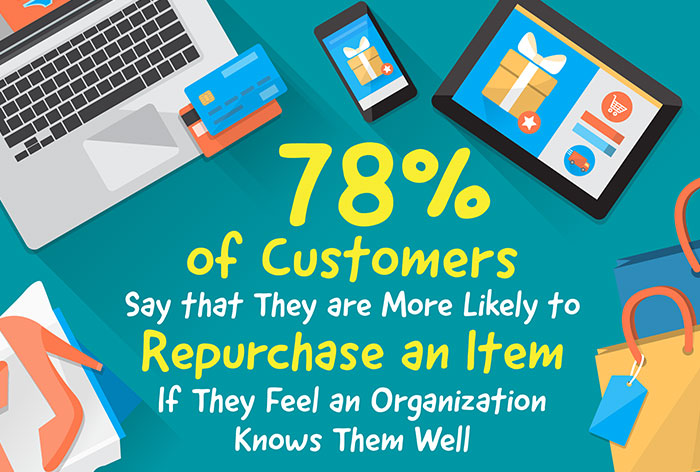
AI can personalize website elements such as homepage balnners, product recommendations, navigation menus, and calls-to-action based on an individual's behavior. AI analyzes browsing history, previous online behavior, and even time spent on certain changes. Using this information, the AI can customize website content for each visitor. For example, a returning user might see personalized product suggestions on the homepage, while a first-time visitor might be shown an introductory offer or targeted content based on their location. This level of personalization enhances user experience and boosts conversion rates. 78% of customers say that they are more likely to repurchase an item if they feel an organization knows them well.
Everyone responds differently to ads. Some people require more engaging visuals, while others only pay attention if a promotion is offered. The average person sees between 4,000 and 10,000 ads every day. Because of the high volume of ads, it can be difficult to make your marketing material stand out amongst the crowd. Additionally, it can be a waste of time and resources if ads are shown to people who do not fall into the target audience.
By segmenting audiences into smaller, more defined groups, AI can show relevant ads to individuals based on their interests, demographics, and behavior patterns. For example, users who frequently view fitness products may be shown targeted ads for workout gear or health supplements. This leads to higher engagement, better ad spending ROI, and a seamless customer advertising experience.
While AI personalization offers many advantages for both companies and consumers, there is a concern about data privacy. According to a report conducted by Twilio Segment, only 51% of customers trust organizations with their data. Thus, when companies are implementing AI personalization into their marketing processes, they must do it with enough transparency to demonstrate to consumers that they care. There are a few ways to maintain data privacy.
Anonymizing data is an effective way to achieve personalization without sacrificing customer privacy. Data collection technology is powerful enough to personalize user experiences without having to collect personally identifiable information. It can be achieved through aggregating across a large group or using encryption techniques.
Giving users the ability to control how their data is collected is another good way to respect privacy concerns while strengthening the trust between consumers and companies. These granular controls give consumers the agency to determine the extent of their AI personalization.
These implementations can be done with a trusted software service provider. Finding the right provider that provides end-to-end development, from AI personalization integration to data privacy integration, is key to a successful project. You should decide on a software service provider based on their expertise, their past projects, and their customization capabilities. Using these criteria will be helpful in the search for the perfect service provider for your business needs.
Disclaimer:
This content has been made available for information purposes only. Views and opinions expressed in this content are those of the individual author only and do not necessarily represent the opinions and views of Chetu. Chetu, and its representatives, make no representation or warranty of any kind, express or implied, regarding the accuracy, adequacy, validity, reliability, availability, or completeness of any information of this content. Under no circumstances shall Chetu, or its representatives, have any liability to you or any loss or damage of any kind incurred as a result of the use of this content or reliance on any information provided in this content. Your use of this website and your reliance on any information on this content is solely at your own risk.
About Chetu:
Founded in 2000, Chetu empowers businesses with AI and digital transformation solutions, supporting startups, SMBs, and Fortune 5000 companies. We deliver end-to-end software solutions backed by global digital intelligence and industry expertise. Our customized software delivery model and one-stop-shop approach span the full technology spectrum. Headquartered in Sunrise, Florida, Chetu operates 13 locations across the U.S., Europe, and Asia.
See more at: Chetu Blogs


Limited Time Offer for a Free E-Book
Privacy Policy | Legal Policy | Careers | Sitemap | Referral | Contact Us
Copyright © 2000- 2026 Chetu Inc. All Rights Reserved.


 By: Jeff Parcheta