Thank you!
Your blog has been successfully shared.


Let's Talk !  954 342 5676
  +44 137 243 2466
Rick Heicksen - Director of Sales | May 21, 2026
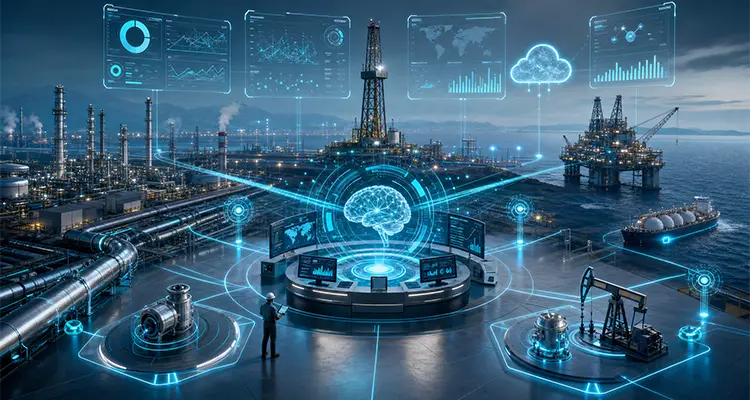
The industrial internet of things (IIoT) is changing the way the oil and gas industry operates around the world by providing connectivity among machines, sensors, and data analytics to create an intelligent, integrated environment. The IIoT utilizes existing and future technology, such as telecommunications (IoT), semiconductors & technical computing (e.g., machine learning), and large-scale data management (Big Data) to enable oil and gas organizations to operate more efficiently and make better decisions.
By utilizing IoT sensors on their oil platforms, operators can monitor the performance of their equipment, the health of their systems, and the condition of their surrounding environment continually. IoT sensors send real-time performance information back to the operator regarding their equipment performance. Because of this real-time visibility into equipment performance, operators can identify problems sooner and address those problems before they escalate into larger incidents. The IIoT allows oil and gas companies to shift their focus from reactive operations to proactive operations based on data (enabled by Industry 4.0).
The Internet of Things (IoT) in the oil and gas sector helps address traditional issues, including equipment breakdowns, safety hazards, and price fluctuations. Companies can enhance efficiency and enhance performance by deploying industrial IoT technologies.
The following are some benefits that result from deploying IoT systems:
Decreased amount of time on both onshore/offshore operations.
Better safety through constant supervision.
Increased efficiency in oil production.
Reduced oil pricing as a result of applying technologies that improve oil production/machine efficiency.
The oil & gas industry is one of the most competitive sectors. Therefore, by taking full advantage of IoT-based solutions, an organization will maintain operational efficiency while keeping their costs to a minimum by avoiding excess use of natural resources.
IoT applications enable real-time communications between assets using many different types of connectivity (for example, “Machine to Machine”) through the use of advanced connectivity protocols, providing for a plethora of different types of assets to communicate with one another, allowing drilling rigs, pumps, pipelines to communicate, and resulting in central depositories of data from many sources for energy companies, creating a unified picture of their entire business through dashboards; providing businesses a lens from which to look at their operations across upstream and downstream segments within the business; and, through this, increasing the ability to share and coordinate across segments all of the business.
Additionally, improved efficiencies in operations with decreased latency and improved decision-making capability as a result of the introduction of edge computing technology, enabling data to be processed closer to the point of origin and thus allowing for increased efficiencies and improved response times in operations where there may be time pressures.
Predictive Maintenance in the Oil and Gas Industry Using IIoT is an Effective Implementation of IIoT. The traditional maintenance approach is reactive (scheduled inspection type) and cannot prevent equipment failures.
Using Predictive Maintenance, IIoT Algorithms Can Analyze Real-time IoT Sensor Data from Oil Rigs to Predict When Equipment Will Fail. This helps to avoid equipment failure and extend the life of equipment while reducing the total cost of maintenance. Many companies that are utilizing IIoT to support predictive maintenance have significantly improved their reliability and productivity.
The ability to use advanced offshore monitoring technologies to enable operators to monitor and manage their daily operations from a centralized location is one of the greatest benefits of the IIoT. In addition to reducing the number of employees on oil rigs, which reduces the likelihood of workplace injuries, the ability to provide operators with real-time alerts will allow them to react quickly when required to do so.
IIoT products and solutions will also enable companies to enhance the visibility and transparency of their operations, improve the quality of decision-making, and enhance operational efficiency. Because they are an important component of improving safety and increasing efficiency for any organization's onshore and offshore operations, IIoT products and solutions are particularly critical in hazardous operating environments where safety and efficiency are critical to success.
The oil & gas industry uses the Internet of Things (IoT) in its pipeline monitoring because of its ability to ensure the upkeep and integrity of a company's oil and gas infrastructure as well as catch leaks and other anomalies, therefore preventing catastrophic failure. The Industrial Internet of Things (IIoT) systems measure pressure, temperature, and flow rates in real-time. A company can immediately detect any leaks or anomalies, resulting in them being able to take corrective action quickly, thus avoiding potential catastrophic failures from occurring.
IIoT also allows a company to track assets throughout their lifecycle, produce oil at optimal levels, and use resources more efficiently. When an industrial automation system is implemented by a company, it will increase productivity while decreasing waste and operational expenses.
Health and safety is always a prime concern for the oil and gas industry. By leveraging innovative IoT solutions, organizations can monitor unsafe conditions to prevent potential accidents.
IoT sensors in the oil industry are used to:
Sensing pressure and gas leaks
Monitoring environmental conditions
Detecting equipment failures
This helps mitigate accidents, comply with regulations, and improve working conditions.
Through Industrial Internet-of-Things (IIoT), organizations collect large volumes of data that they can utilize to develop statistically valid forecasting and predictive models, enabling them to determine how much operational improvement they can achieve by making specific changes in processes to gain maximum return on investment (ROI).
Organizations can utilize IoT solutions that incorporate integrated dashboards and analytic tools to allow them to: 1) make decisions that are based upon real-time data; 2) facilitate collaboration across various functional departments within their organization; and 3) eliminate operational silos.
By enabling access to common real-time data among all stakeholders within an organization through IoT applications, organizations will benefit from enhanced operational improvements and performance as organizations will make decisions based on accurate, timely, and reliable data.
In the oil and gas sector, the IIoT is unleashing a wave of innovation in the IoT by providing connected solutions that are enabling improvements in operational efficiencies, safety, and productivity.
The range of applications for IIoT is wide-ranging and disruptive, from predictive maintenance of equipment to pipeline performance monitoring through IoT devices. Therefore, leveraging emerging technology, particularly IIoT, across the industry’s companies will be crucial to remain competitive in an increasingly agile, adaptive environment as Industry 4.0 continues to develop within the oil and gas sector.
By adopting new-generation IIoT applications and technologies today, companies will minimize equipment downtime, maximize production capacity, and support future long-term growth.
Disclaimer:
This content has been made available for information purposes only. Views and opinions expressed in this content are those of the individual author only and do not necessarily represent the opinions and views of Chetu. Chetu, and its representatives, make no representation or warranty of any kind, express or implied, regarding the accuracy, adequacy, validity, reliability, availability, or completeness of any information of this content. Under no circumstances shall Chetu, or its representatives, have any liability to you or any loss or damage of any kind incurred as a result of the use of this content or reliance on any information provided in this content. Your use of this website and your reliance on any information on this content is solely at your own risk.
About Chetu:
Founded in 2000, Chetu empowers businesses with AI and digital transformation solutions, supporting startups, SMBs, and Fortune 5000 companies. We deliver end-to-end software solutions backed by global digital intelligence and industry expertise. Our customized software delivery model and one-stop-shop approach span the full technology spectrum. Headquartered in Sunrise, Florida, Chetu operates 13 locations across the U.S., Europe, and Asia.
See more at: Chetu Blogs
Share


Limited Time Offer for a Free E-Book
Privacy Policy | Legal Policy | Careers | Sitemap | Referral | Contact Us
Copyright © 2000- 2026 Chetu Inc. All Rights Reserved.