Thank you!
Your blog has been successfully shared.
Let's Talk !  954 342 5676
  +44 137 243 2466
Roland Burrell - Director of Sales | July 22, 2026
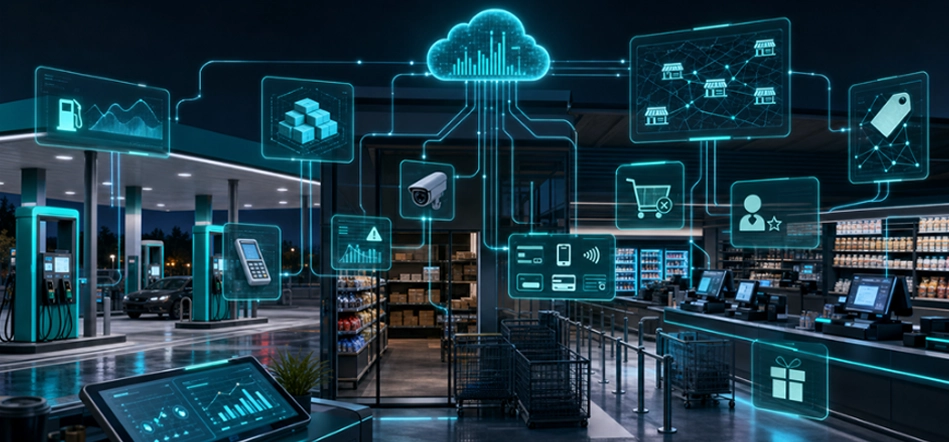
The convenience store's business has never been easy, but the operational pressures hitting c-store operators today are compounding in ways that legacy systems simply weren't built to handle. Shrink margins in core categories. Rising labor costs that make every inefficiency visible. Inventory inaccuracies that quietly drain profitability. Payment complexity that's multiplied as customer expectations around speed and payment method have shifted dramatically.
Most c-store operators are running a convenience store POS system that was designed to be a billing tool. Cloud-based POS solutions for c-stores are that platform. This guide takes you through what they are, what to see, and why a c store operator's most leveraged action is choosing the right c store pos software.
Legacy on-premises POS systems were built for a different retail environment one where a single register, a local server, and an end-of-day report covered most operational needs.
The failure points of traditional systems are well-documented in practice:
Local server failures take the entire operation offline no transactions, no visibility, no fallback
No remote visibility operators cannot see what is going on at a location if they are not there.
Limited integrations result in data silos between your POS, inventory, accounting, and fuel management systems.
Difficult software updates require on-site IT involvement for every patch or version change
Poor scalability makes adding locations a painful process of replicating infrastructure rather than extending a platform
High maintenance costs for hardware and on-site server infrastructure add overhead that cloud eliminates
According to the National Association of Convenience Stores, c-store operators that modernize their retail POS software infrastructure report on measurable improvements in transaction speed, inventory accuracy, and shrinkage rates.
Understanding why cloud-based retail management delivers value starts with being specific about what c-store operators are dealing with:
Stocking errors or discrepancies between batch and stocking. Those blind spots are losing sales and stockouts for high velocity SKUs.
It's system-level controls. Loss prevention in a c-store isn't just about policies – it's about system-level controls. Shrinkage is hard to detect and prove without role-based permissions, exception reporting, and transaction-level audit trails.
Fuel locations with disconnected fuel management and in-store point-of-sale cause recon headaches for employees, accounting errors.
Speed at the register is a competitive differentiator in convenience retail. Slow POS terminals and payment processing that doesn't support modern payment methods to create friction that customers notice immediately.
Customers expect to pay with whatever they have cash, card, contactless, digital wallet, EBT, fleet card. A system that handles some, but not all creates awkward transactions and lost sales.
Loyalty programs that are not connected to purchase data mean that rewards offered are generic and have a small retention impact.
Price changes, promotions, and inventory updates pushed manually across locations is the single biggest operational time drain for multi-location c-store operators.
If the price doesn't update automatically, the customer's register price will not match the shelf price, resulting in disputes, refunds, and loss of customer trust.
End-of-day data is taken from each individual register and is already out-of-date and time-consuming to put together in a meaningful way.
When inventory levels aren't monitored in real-time and the order to replenish isn't triggered automatically, the stockout of items with higher velocity occurs before anyone realizes it, and by then the sale is gone.
Real-time inventory visibility across every SKU is the foundation of modern C- store point of sale systems. Livestock counts that update with every transaction, receiving event, and return eliminate the blind spots that manual processes create and feed the replenishment logic that prevents stockouts.
The three most frequent areas of inventory data breakdown are eliminated by barcode scanning at receiving, at the register and during cycle counts. By linking directly to scanning, SKU management guarantees that each individual item in the system is recorded consistently and accurately.
Cloud based POS terminals for multi-location retail operations help to streamline price book management, promotions, inventory visibility and performance reporting at all locations. Price changes and promotions are pushed from one single dashboard, and there are no manual changes at individual registers.
Mobile POS capability turns any tablet or mobile device into a transaction point useful during peak hours, outdoor events, or when fixed register capacity isn't enough to handle traffic volume.
Integrated customer loyalty management connects purchase history to rewards automatically, enabling personalized promotions and repeat visit incentives without manual tracking or separate loyalty platform management.
Fuel management integration connects pump control, fuel transaction logging, and price-per-gallon updates directly to the POS eliminating the manual reconciliation between fuel and in-store sales that standalone fuel systems require.
AI-powered retail analytics surface demand patterns, sales trends, and performance insights that manual reporting misses giving operators the data foundation for smarter ordering, pricing, and promotion decisions.
Vendor management built into the POS connects purchase orders, receiving records, and invoice reconciliation in one place, reducing the administrative overhead of managing supplier relationships across multiple product categories.
An offline POS capability ensures the system continues processing transactions during internet outages. For any convenience store pos solution, offline mode isn't optional for connectivity interruptions happening, and a system that stops working when they do is a liability.
A cloud reporting dashboard gives operators real-time access to sales reporting, inventory status, labor data, and shrinkage metrics from any device replacing end-of-day manual reports with a live operational picture.
Age verification integration prompts cashiers automatically for restricted items and logs of ID scan data removing reliance on cashier judgment and creating a compliance audit trail for tobacco and alcohol sales.
An API integration framework ideally with API-first architecture ensures the POS connects cleanly to every system in the operator's stack: ERP, accounting, fuel management, ecommerce, delivery platforms, and analytics tools.
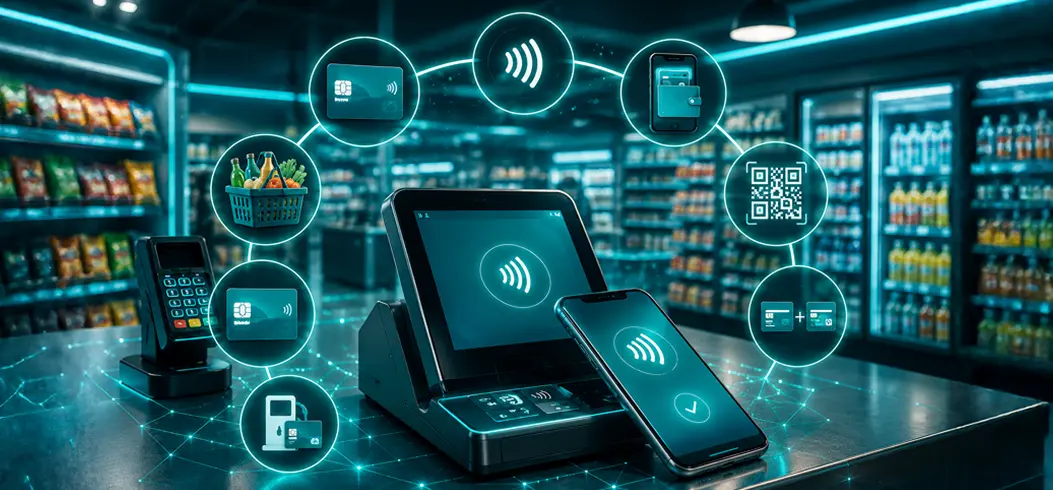
Retail payment processing in a modern c-store environment has expanded well beyond card swipe. Customer payment preferences now span a range that legacy systems weren't designed to handle and operators who can't accommodate the full spectrum lose transactions to competitors who can.
The payment capabilities a modern convenience store point of sale needs to support:
EMV payment: Chip card processing that meets current fraud liability standards
NFC payments and contactless payments: Tap-to-pay transactions that reduce checkout time significantly
Apple Pay and Google Pay: Mobile wallet payments that a growing share of customers now prefers by default
Digital wallets: Broader digital payment ecosystem support beyond the major platforms
QR payments: Particularly relevant for delivery and loyalty program integrations
EBT: Essential for c-stores serving communities that rely on SNAP benefits
Fleet cards: Standard requirement for fuel-selling locations serving commercial vehicle operators
Split payments: The ability to split a transaction across multiple payment methods
On the security side, PCI DSS compliance and tokenization are non-negotiable not just for regulatory reasons but because payment data breaches carry reputational and financial consequences that far exceed the cost of proper security implementation.
The cloud vs on-premises POS, which is better for c-stores questions, has a clearer answer now than it did five years ago but context still matters.
| Area | Cloud POS | On-Premises POS |
|---|---|---|
| Upfront cost | Lower | Higher |
| Maintenance | Vendor-managed | Operator-managed |
| Remote access | Full | None |
| Software updates | Automatic | Manual |
| Offline capability | Requires configuration | Native |
| Multi-location management | Centralized | Complex |
| Scalability | Platform-level | Infrastructure-level |
| Integration flexibility | API-first | Limited |
The total cost of ownership calculation also favors cloud over a three-to-five-year horizon for most mid-market operators, once hardware maintenance, IT support, and the opportunity cost of limited remote visibility are factored in.
AI-powered retail capabilities embedded in modern cloud POS platforms are moving c-store operations from reactive management to predictive intelligence:
Demand forecasting — machine learning models analyzing historical sales data, seasonal patterns, weather signals, and local events to project demand by SKU before inventory gaps develop.
Product recommendations — AI-driven upsell and cross-sell suggestions at the register or self-checkout based on purchase history and basket analysis.
Theft detection — transaction anomaly detection that flags patterns consistent with internal theft, sweet-hearting, or return fraud surfacing exceptions for loss prevention review.
Customer segmentation — AI analysis of loyalty program data to identify customer segments by purchase behavior, enabling targeted promotions that reflect what different customer groups buy.
Smart inventory replenishment — automated reorder triggers based on predictive demand models rather than static minimum thresholds reducing both stockouts and overstock.
Sales forecasting — forward-looking revenue and category projections that support staffing, ordering, and promotional planning.
Evaluating pos systems for c-stores against a structured checklist prevents the most common selection mistakes choosing on price without accounting for integration cost, or choosing on features without verifying offline reliability:
Scalability: Does the platform handle your current location count and your three-year growth plan without a rebuild?
Security: PCI DSS compliance, tokenization, role-based access controls, and audit logging as baseline requirements
Integrations: Native or API-connected support for every system in your stack, verified before contract signature
Industry experience: Has the vendor built specifically for c-store environments, or is this a retail platform being adapted?
Support: What does support look like at 6 AM on a Saturday when a register goes down? Response time for SLAs matter.
Offline capability: Verify specifically how the system behaves during internet outages not just that offline mode exists.
Mobile support: Does the platform support mobile POS on standard hardware or only proprietary devices?
API availability: Is the integration architecture open and documented, or locked to vendor-approved connections?
Modern convenience stores need more than a cash register; they need an intelligent retail platform that unifies retail payment processing, real-time inventory, retail reporting, customer engagement, and multi-store management in one connected system.
Cloud based pos systems deliver that platform in a way that on-premises infrastructure simply can't match at scale. Faster checkout, centralized operations, better inventory accuracy, reduced shrinkage, and the data foundation for AI-driven decision making these aren't features on a spec sheet. They're operational outcomes that show up in margin, customer retention, and the ability to grow without adding operational complexity.
Choosing the right convenience store pos solution whether a well-configured commercial platform or a purpose-built custom system is one of the highest-leverage technology decisions a c-store operator makes.
Disclaimer:
This content has been made available for information purposes only. Views and opinions expressed in this content are those of the individual author only and do not necessarily represent the opinions and views of Chetu. Chetu, and its representatives, make no representation or warranty of any kind, express or implied, regarding the accuracy, adequacy, validity, reliability, availability, or completeness of any information of this content. Under no circumstances shall Chetu, or its representatives, have any liability to you or any loss or damage of any kind incurred as a result of the use of this content or reliance on any information provided in this content. Your use of this website and your reliance on any information on this content is solely at your own risk.
About Chetu:
Founded in 2000, Chetu empowers businesses with AI and digital transformation solutions, supporting startups, SMBs, and Fortune 5000 companies. We deliver end-to-end software solutions backed by global digital intelligence and industry expertise. Our customized software delivery model and one-stop-shop approach span the full technology spectrum. Headquartered in Sunrise, Florida, Chetu operates 13 locations across the U.S., Europe, and Asia.
See more at: Chetu Blogs
Share


Limited Time Offer for a Free E-Book
Privacy Policy | Legal Policy | Careers | Sitemap | Referral | Contact Us
Copyright © 2000- 2026 Chetu Inc. All Rights Reserved.