Thank you!
Your blog has been successfully shared.
Let's Talk !  954 342 5676
  +44 137 243 2466
Roland Burrell - Director of Sales | July 22, 2026
Running HR across a growing business is one of those things that looks manageable until it suddenly isn't. You start with a spreadsheet here, a separate payroll tool there, maybe a basic ATS you picked up a few years ago, and for a while, it works. Then it doesn't. Data lives in five places at once. Someone pulled numbers from last month's exports. Your HR team is buried in tasks that shouldn't take more than a click.
This is the topic that's being discussed in many of these mid-size companies today. The good news is that HCM software was specifically created to help solve this very problem. For example, as reported by IDC, the global HCM software market will have grown to nearly $41 billion by 2024, with a 14.8% year-over-year growth rate. A significant portion of that growth results from the consolidation of HR stacks into one central platform that has multiple modules that communicate with each other.
This guide will discuss the key characteristics of modern HCM software, which types of modules are the most important at various growth phases of a company's employment, and when it would be advisable to develop custom solutions rather than purchase an off-the-shelf product.
HCM systems enable organizations to integrate HR processes that were once performed independently from each other into a single platform. Payroll, recruitment, onboarding, performance management, training and development, and benefit administration are integrated with a HCM platform and use the same shared data. Thus, traditional processes that operate independently can now work together seamlessly on one platform.
That matters more than it might sound. When your payroll module knows that an employee just completed onboarding and enrolled in benefits, you don't have to manually trigger the next step. When your analytics tool can pull from live headcount, performance ratings, and labor costs simultaneously, the picture you're working on from its current, not a snapshot from two weeks ago.
The practical payoff: less time maintaining records, fewer errors from manual handoffs, and better visibility into what's happening across your workforce at any given moment.
Most HCM platforms are built around a set of core modules. Depending on your organization, some will be critical from day one. Others become more important as you scale. Here's how each one works in practice.
All teams go through pressure to fill roles more quickly without sacrificing quality. A robust recruiting module allows you to consolidate the posting of jobs, tracking candidates, screening resumes, scheduling interviews, and managing offers into one location to prevent recruiters from having to switch back and forth between 5 different tools simply to move candidates through their pipeline. For organizations with a large volume of candidates and/or specialized roles, a custom designed ATS will be able to reflect your actual hiring process as opposed to forcing your team through a vendor-defined process.
The data onboarding is worth paying attention to. According to Gallup, only 12% of employees feel their company has a genuinely good onboarding process. Yet organizations that invest in structured onboarding see new hire retention rates up to 82% higher than companies that don't, and new hire productivity that runs about 70% higher. That's not a marginal difference. HCM onboarding modules handle documentation collection, policy sign offs, benefits enrollment, training schedules, and checklist management, getting new hires productive faster while taking that coordination work off HR's plate.
Payroll is the one HR function where errors have immediate, visible consequences. PwC research puts the cost of payroll errors for the average FTSE 100 company at between £10 million and £30 million per year. The employee side of the equation is equally stark, research from PayrollOrg shows that 50% of employees will start looking for a new job after experiencing just two payroll errors. HCM payroll modules handle tax calculations, deductions, overtime, direct deposit, and compliance reporting automatically. For organizations with complex compensation structures or multilocation payrolls, custom solutions offer flexibility that standard packages often can't.
Benefits administration modules centralize enrollment, plan management, leave tracking, and employee communications in one hub. Employees get self-service access to their own information. HR teams get visibility into benefits of performance without running manual reports. The self-service component alone makes a meaningful difference, when employees can check their coverage or update dependents without submitting a ticket to HR, both sides benefit.
Modern performance tools have moved well past the annual review. Today's HCM platforms support continuous feedback loops, goal tracking aligned to company objectives, skills assessments, and development planning, all documented in one system rather than scattered across email threads and shared drives. The practical value is alignment: making sure what individual employees are working toward actually connects to where the business is going.
Retaining talent and maintaining workforce capability both depend on how well an organization supports employee growth. Learning modules handle training delivery, certification tracking, compliance courses, and personalized learning pathways. They also create an auditable record, so when compliance requires documentation of completed training, it's already there.
This is arguably where the real strategic value of HCM software lives. Analytics tools transform raw HR data into dashboards, turnover analysis, workforce forecasting models, labor cost breakdowns, and predictive insights that inform forward-looking decisions rather than just backward-looking reports. Deloitte's 2026 Global Human Capital Trends survey found that 7 in 10 business leaders say their primary competitive strategy over the next three years is to be fast and nimble. That kind of agility isn't possible when your workforce data is sitting in static exports from three different systems.
Self-service portals let employees handle routine requests, updating personal information, viewing pay stubs, requesting leave, selecting benefits, completing training, without routing everything through HR. It saves HR teams significant administrative time and gives employees direct control over their own information, which most people genuinely prefer.
When organizations evaluate HCM platforms, certain capabilities consistently rise to the top of the list. Here's what actually moves the needle.
structures your recruitment pipeline from job posting through hire. The difference between a standard ATS and a custom-built one is whether the technology conforms to your process or whether your recruiters conform to the technology.
reduces manual processing effort and improves accuracy across tax calculations, deductions, and compliance reporting. For organizations with nonstandard compensation structures or multi-location operations, the ability to customize payroll logic is a meaningful practical advantage.
helps organizations anticipate staffing needs before they become urgent, identify skill gaps early, and allocate headcounts more effectively. At the mid-market level, this is often the capability that justifies moving to a more sophisticated HCM platform.
give leaders a current, accurate picture of productivity, labor costs, turnover, and workforce composition, rather than decisions made on data that's weeks old by the time anyone reads it.
reduces administrative volume for HR while improving employee experience. When employees can handle routine requests themselves, HR can focus on work that requires their expertise.
handles training delivery, certification tracking, and compliance documentation in one place, reducing the coordination overhead that comes with managing these functions separately.
Most organizations don't realize their HR tech has become a liability until the symptoms are hard to ignore. A few signs worth taking seriously:
HR teams are spending significant time on manual data entry, payroll processing, or basic employee requests that should be automated
Employee data is scattered across multiple systems, making it difficult to maintain a consistent, reliable record
Workforce planning and reporting still run on spreadsheets, slow, error-prone, and invisible to most of leadership
Current platforms can't scale with the business, limiting the ability to access workforce information and make decisions quickly
If three or more of those apply, you're likely operating with tools that are costing you more than they're saving. The data backs up: research from APA and GPMI shows 51% of organizations still use spreadsheets for payroll, and 85% report active problems with their existing payroll technology. Perhaps more telling, more than 94% of business leaders globally say they want their payroll software fully integrated across all HR systems. Most aren't there yet.
Most organizations evaluating HR technology eventually hit the same question: do we buy a platform and configure it, or do we build something that fits how we actually operate?
According to IDC, the worldwide HCM and payroll applications market is expected to grow from $5.3 billion in 2024 to $9.1 billion by 2029, an 11.3% compound annual growth rate driven by cloud adoption, AI integration, and evolving compliance requirements. That growth reflects both off-the-shelf and custom solutions. The question is which approach fits your situation.
Custom HCM development tends to make more sense when:
Your workflows don't map to standard software: When your processes are genuinely different, by industry, by scale, or by design, you end up bending your operations to fit the software. That's a hidden cost most organizations underestimate.
You need specialized integration: Legacy systems, proprietary applications, and industry specific tools often require integration flexibility that off the shelf platforms can't reliably deliver without significant configuration overhead.
Licensing costs are scaling faster than value: For larger organizations, per seat subscription costs can grow quickly. A custom solution may offer better long-term economics once headcount crosses certain thresholds.
Data ownership and governance are business-critical: Custom systems give you direct control over where your data lives, how it's secured, and how compliance is managed, without depending on a vendor's security posture.
User experience matters to adoption: Platforms built around your employees' specific workflows tend to see better adoption than generic tools that require training just to navigate.
HCM software has a strong operational rationale; however, there are even more strategic advantages than companies think about at the time of selection.
Routine administrative tasks (payroll processing, benefit updates, compliance reports) can be automated, allowing HR staff to concentrate on the strategic labor force rather than data maintenance. Also, the current systems allow employees to gain quick access to required information and carry an observable impact on employee engagement over time.
Regarding compliance, accurate record-keeping, automated reporting, and audit tracking will help organizations meet their labor law obligations without creating manual processes on top of an already difficult workload for HR departments. Finally, real-time workforce analytics enable leaders to make informed hiring, compensation and performance evaluations in real-time, rather than relying on reports that could be weeks old before they’re distributed.
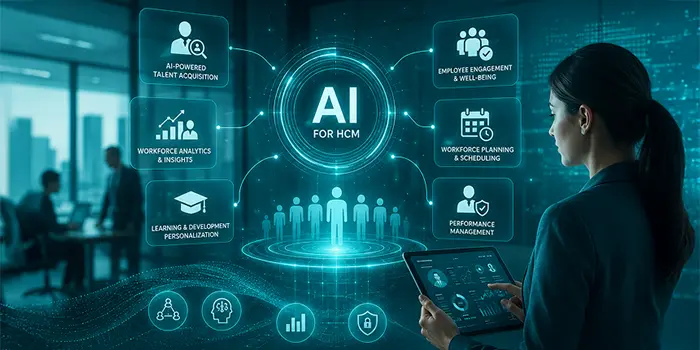
AI isn't coming to HCM software, it's already there, and the gap between organizations that have integrated it and those that haven't is widening. Forecasting, workforce analytics, candidate screening, performance monitoring, and employee experience tools are all being reshaped by AI-driven capabilities.
Gartner put a sharp point on the stakes: by 2027, 50% of enterprises without a people-centric AI strategy will lose their top AI talent. Their December 2025 survey found that only 27% of executives have a comprehensive AI strategy, and just 20% believe their workforce is truly AI-ready. Those numbers suggest a lot of organizations are further behind on this than they realize.
The deployment reality adds another layer. Forrester's State of AI Survey, 2025 found that over 70% of firms already have generative or predictive AI in production, but most lack the strategic alignment, workforce enablement, and governance needed to extract real value from it. Having technology is one thing. Building the organizational capability to use it well is another. For HCM specifically, the most immediate AI applications showing ROI are predictive attrition modeling, skills gap identification, compensation benchmarking, and intelligent workforce scheduling.
Human Capital Management has evolved significantly since its inception as a payroll and records management tool. Instead of simply being a static employee database, HCM now forms the operational foundation for making informed decisions about the workforce for growing businesses.
The future will look different for each company—where some will find a well-designed solution that satisfies most of their needs; others will need to create custom solutions to accommodate their workflows, integration needs, or data management expectations. A critical starting point for evaluating your options is to assess how much your current tools are costing you in terms of time spent, accuracy of data, and visibility into your own workforce.
The right HCM solution will consistently yield returns over a long period of time, no matter if you are looking at HCM for the first time or moving from a solution that has outgrown its usefulness.
Disclaimer:
This content has been made available for information purposes only. Views and opinions expressed in this content are those of the individual author only and do not necessarily represent the opinions and views of Chetu. Chetu, and its representatives, make no representation or warranty of any kind, express or implied, regarding the accuracy, adequacy, validity, reliability, availability, or completeness of any information of this content. Under no circumstances shall Chetu, or its representatives, have any liability to you or any loss or damage of any kind incurred as a result of the use of this content or reliance on any information provided in this content. Your use of this website and your reliance on any information on this content is solely at your own risk.
About Chetu:
Founded in 2000, Chetu empowers businesses with AI and digital transformation solutions, supporting startups, SMBs, and Fortune 5000 companies. We deliver end-to-end software solutions backed by global digital intelligence and industry expertise. Our customized software delivery model and one-stop-shop approach span the full technology spectrum. Headquartered in Sunrise, Florida, Chetu operates 13 locations across the U.S., Europe, and Asia.
See more at: Chetu Blogs
Share


Limited Time Offer for a Free E-Book
Privacy Policy | Legal Policy | Careers | Sitemap | Referral | Contact Us
Copyright © 2000- 2026 Chetu Inc. All Rights Reserved.