Thank you!
Your blog has been successfully shared.
Let's Talk !  954 342 5676
  +44 137 243 2466
Jeff Parcheta - Director of Sales | February 18, 2026
How is agentic AI different from the tools we already use? While traditional AI waits for a prompt, agentic workers are designed to take a goal and determine the best steps to achieve it independently. We are seeing a move away from static automation because dynamic enterprise needs require something more flexible.
What makes agentic AI a true collaborative coworker is its context awareness and ability to learn inside your specific systems. It reduces the cognitive overload on your team by handling the decision latency that usually slows down big projects.
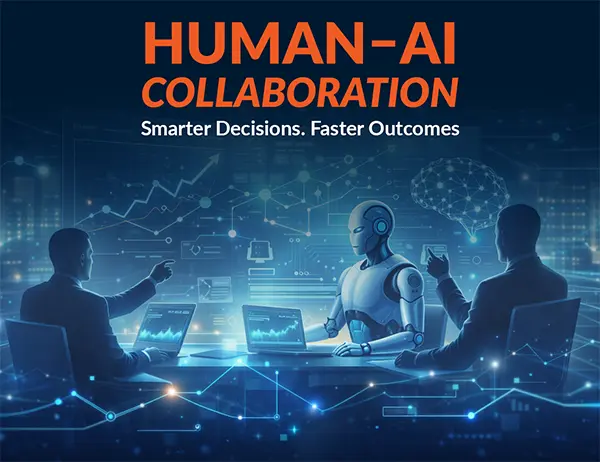
What does daily life look like when you have AI and human collaboration in the workplace? It really comes down to a clear division of labor where humans provide the creativity and accountability while AI agents focus on optimization and scale. This isn't about machines taking over; it is about AI and humans working together to solve problems faster.
To make this work, you need strong models for trust and transparency. Whether you use a "human-in-the-loop" or a "human-on-the-loop" approach, there must be clear escalation paths for when an agent hits a confidence threshold it can't cross alone.
How should a CIO approach integrating AI into human workflows? The most effective strategy is a workflow-first design that maps out your current processes before any agents are actually deployed. You have to align agentic capabilities with your specific business KPIs to ensure the technology is actually driving value.
Agentic AI implementation also requires heavy focus on change management. This means redefining roles and upskilling your teams so they feel comfortable working with their new AI co-workers. It is a cultural shift as much as a technical one.
What does a full agentic AI ecosystem look like from a technical standpoint? It is a complex architecture made of orchestration layers, decision engines, and deep system interoperability. These agents need to be able to talk to your APIs and access your data securely to be effective.
Security and governance are also critical at this scale. You need policy-driven agents that operate within strict auditability and risk controls. Without these guardrails, an autonomous agentic AI workforce can become a liability rather than an asset.
Where can you actually see agentic AI business use cases in action today? In IT and service management, agents can handle autonomous incident resolution and predictive maintenance without human intervention. They act as digital teammates that keep the lights on while your human experts focus on innovation.
In the world of knowledge work and analytics, AI agents support executives by providing real-time decision intelligence. They can scan thousands of documents and provide a summary of the most important facts, allowing leaders to act with more confidence.
How do you measure the human-AI collaboration benefits in a real-world setting? The most obvious gains are in productivity and speed, but the true value is in improved decision accuracy and organizational resilience. Using human AI collaboration frameworks helps you maintain these gains over the long term.
Sustainable collaboration requires following responsible AI principles and continuous performance tuning. By monitoring how your agents and humans interact, you can refine your processes and ensure the partnership remains productive.
Agentic AI is fundamentally changing how we think about work and productivity. It offers a path to a more efficient, creative, and resilient enterprise by allowing humans to focus on what they do best. By building a solid foundation for your agentic AI strategy now, you ensure that your organization is ready for the future of collaborative work.
Ready to build your agentic workforce? Moving from basic automation to autonomous agents requires deep technical expertise. We will help you design and implement the human AI collaboration solutions that your business needs to stay ahead.
Disclaimer:
This content has been made available for information purposes only. Views and opinions expressed in this content are those of the individual author only and do not necessarily represent the opinions and views of Chetu. Chetu, and its representatives, make no representation or warranty of any kind, express or implied, regarding the accuracy, adequacy, validity, reliability, availability, or completeness of any information of this content. Under no circumstances shall Chetu, or its representatives, have any liability to you or any loss or damage of any kind incurred as a result of the use of this content or reliance on any information provided in this content. Your use of this website and your reliance on any information on this content is solely at your own risk.
About Chetu:
Founded in 2000, Chetu empowers businesses with AI and digital transformation solutions, supporting startups, SMBs, and Fortune 5000 companies. We deliver end-to-end software solutions backed by global digital intelligence and industry expertise. Our customized software delivery model and one-stop-shop approach span the full technology spectrum. Headquartered in Sunrise, Florida, Chetu operates 13 locations across the U.S., Europe, and Asia.
See more at: Chetu Blogs
Share


Limited Time Offer for a Free E-Book
Privacy Policy | Legal Policy | Careers | Sitemap | Referral | Contact Us
Copyright © 2000- 2026 Chetu Inc. All Rights Reserved.