Thank you!
Your blog has been successfully shared.
Let's Talk !  954 342 5676
  +44 137 243 2466
Gaurav Sharma – Director of Operations | January 15, 2026
FinOps is a financial operations framework that helps you manage cloud spending by aligning finance, engineering, and operations around shared accountability. If you’re already using cloud at scale, you know cost control is not easy.
In fact, recent Flexera reports show that more than 84% of organizations still consider managing cloud spend their biggest cloud challenge, even before AI enters the picture.
Now add AI to the mix. Model training, retraining, and large-scale inference introduce highly variable, compute-heavy workloads that don’t follow traditional cost patterns. Spend can spike quickly, often without a clear line to immediate business value.
That’s where FinOps for AI comes in, helping you move beyond tracking bills to understanding what your AI workloads cost, why they cost that much, and whether they’re actually delivering value.
AI cost overruns aren’t an exception, they’re becoming the norm. Global spending on generative AI now runs into the hundreds of billions annually, underscoring both the scale of enterprise adoption and the financial risk of unmanaged AI cost growth without strong governance. In practice, this means many AI initiatives don’t fail on capability, they fail when spending accelerates faster than leadership can govern it.
What makes this especially challenging is that AI doesn’t follow traditional cloud economics. High-performance compute, GPU-heavy training, continuous retraining, and data-intensive pipelines push consumption far beyond predictable usage patterns. Training costs for frontier models can run into the hundreds of millions of dollars. For example, some models are estimated to cost around $191 million to train, before factoring in inference, scaling, or long-term optimization
In domains like cloud banking analytics, where AI models power fraud detection, risk scoring, and customer intelligence, uncontrolled cost growth quickly becomes a board-level concern.
And because AI is now central to competitive differentiation, slowing adoption is rarely a viable option. FinOps for AI exists precisely at this inflection point, giving you visibility into where AI spend originates, clarity on why it grows, and the financial control needed to scale innovation without turning it into an open-ended risk.
If you want financial control without slowing momentum, you need clarity on where AI spend accelerates and why it becomes difficult to rein in once scale kicks in.
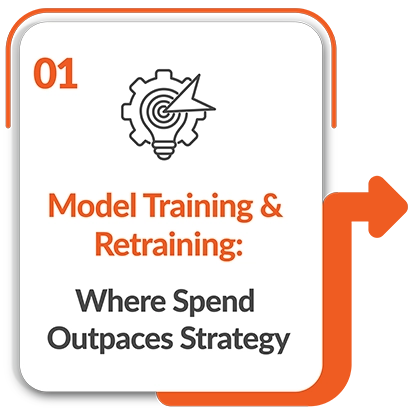
Model Training & Retraining: Where Spend Outpaces Strategy
Every training run is a financial commitment, yet many AI teams iterate aggressively without clear success criteria tied to business outcomes. GPU-intensive experiments, tuning cycles, and frequent retraining can consume significant budgets, even when models never reach production or deliver measurable value.
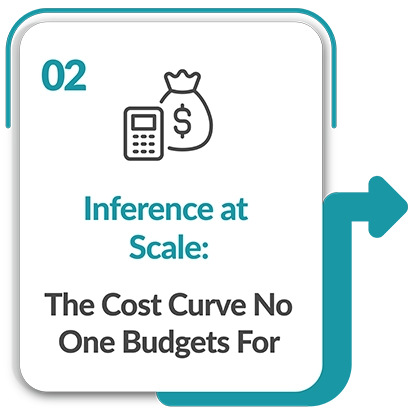
Inference at Scale: The Cost Curve No One Budgets For
Training may get the attention, but inference is where long-term costs take hold. Always-on endpoints, real-time responses, and usage based billing models turn adoption into a compounding expense. The challenge isn’t launching AI, it’s maintaining predictable margins as usage grows.
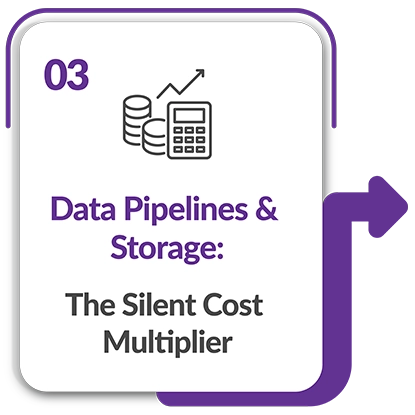
Data Pipelines & Storage: The Silent Cost Multiplier
AI relies on constant data movement, but inefficiencies often go unnoticed. Duplicate datasets, oversized feature stores, and over-retention inflate cloud spend without improving model performance. These costs rarely surface in ROI conversations, yet they steadily erode profitability.
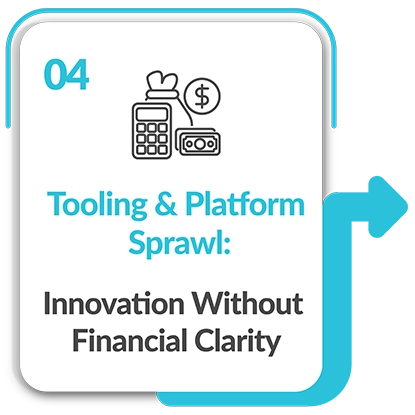
Tooling & Platform Sprawl: Innovation Without Financial Clarity
Multiple clouds, frameworks, and AI tools accelerate innovation, but they also fragment cost accountability. When spend is spread across platforms, answering a basic leadership question becomes difficult: what are we actually spending on AI, and what’s driving it? Without centralized oversight, optimization turns reactive instead of strategic.
These strategies focus on creating financial discipline around AI so you can scale workloads without losing cost predictability.
Align AI Spend with Business Value, Not Just Budgets
Evaluate spend against outcomes that matter, such as cost per prediction, cost per automated decision, or cost per customer interaction. When AI investments are measured by value delivered, prioritization becomes clearer, and waste is easier to justify or eliminate.
Implement Model-Level Cost Allocation
Allocate cloud spend by model, team, and environment to expose which workloads are driving value and which are quietly draining resources. This level of visibility enables informed trade-offs instead of blanket cost cuts.
Optimize Training Architecture Early
Choose the right-sized GPUs, use spot or preemptible instances where risk is acceptable, and avoid complex distributed setups unless scale truly demands it. Early architectural discipline prevents runaway costs later.
Control Inference Costs with Smarter Deployment
Techniques such as autoscaling, batch inference, and model tiering help you match compute usage to real demand. The goal is simple: deliver performance where it matters, without paying for idle capacity around the clock.
Reduce Data Processing Waste
Audit data pipelines regularly to remove redundant processing, reuse features across models, and archive cold data. Reducing unnecessary data movement can cut costs without affecting model quality.
Monitor Anomalies in Real Time
Set up alerts to detect unusual spending patterns, such as runaway training jobs or sudden inference spikes. Early detection prevents minor issues from turning into major cost overruns.
Build AI-Specific FinOps Dashboards
Create AI-focused views that track model performance, usage, and costs together, enabling teams to balance accuracy, latency, and spend.
Forecast AI Spend with Usage-Based Models
Use historical usage data and scenario planning to forecast future AI costs under usage based billing structures. This approach supports better planning as AI initiatives scale from experimentation to enterprise-wide adoption.
As AI adoption accelerates, organizations are increasingly turning to FinOps to bring financial discipline into AI-driven decision-making, and the results are already visible.
According to the FinOps Foundation, the share of organizations actively managing cloud spend grew from 31% to 63% between 2023 and 2024. As AI workloads expand across teams and platforms, clear visibility into AI spending is becoming essential for effective governance.
One study found cloud spending up ~30% due to AI, and 72% say it’s becoming unmanageable, which supports the need for FinOps.
As AI becomes central to enterprise operations, increasing numbers of organizations are integrating cost governance into AI programs, elevating FinOps from a cloud practice to a broader financial discipline.
By tying AI costs to real usage patterns and outcomes, FinOps enables more accurate forecasting as AI initiatives move from experimentation to enterprise-wide deployment.
AI cost optimization isn’t a one-time initiative; it’s an operating capability that must evolve as AI does. As models change, usage expands, and new Artificial Intelligence technologies enter the stack, AI financial governance needs to adapt in step. Organizations that institutionalize FinOps within their AI programs gain more than cost control; they gain the ability to scale AI responsibly, sustain performance over time, and protect profitability as adoption accelerates.
Disclaimer:
This content has been made available for information purposes only. Views and opinions expressed in this content are those of the individual author only and do not necessarily represent the opinions and views of Chetu. Chetu, and its representatives, make no representation or warranty of any kind, express or implied, regarding the accuracy, adequacy, validity, reliability, availability, or completeness of any information of this content. Under no circumstances shall Chetu, or its representatives, have any liability to you or any loss or damage of any kind incurred as a result of the use of this content or reliance on any information provided in this content. Your use of this website and your reliance on any information on this content is solely at your own risk.
About Chetu:
Founded in 2000, Chetu empowers businesses with AI and digital transformation solutions, supporting startups, SMBs, and Fortune 5000 companies. We deliver end-to-end software solutions backed by global digital intelligence and industry expertise. Our customized software delivery model and one-stop-shop approach span the full technology spectrum. Headquartered in Sunrise, Florida, Chetu operates 13 locations across the U.S., Europe, and Asia.
See more at: Chetu Blogs
Share


Limited Time Offer for a Free E-Book
Privacy Policy | Legal Policy | Careers | Sitemap | Referral | Contact Us
Copyright © 2000- 2026 Chetu Inc. All Rights Reserved.