Let's Talk !  (954) 862 3937
Let's Talk ! (954) 862 3937
Businesses are realizing that advances in cloud technology are shaking up the way tasks are completed and how services are provided—for the better. An example of this lies with Oracle and its recent moves, which indicate that it is making more efforts toward cloud-based offerings. More specifically, Oracle has expanded its multi-cloud capabilities to AWS, Google Cloud, and Microsoft Azure – a decision aimed "to help customers accelerate their application migrations and modernizations," according to a recent press release.
That said, businesses big and small that are already leveraging one of Oracle's other offerings, PeopleSoft, do they need to make a change? As the first quarter of 2025 comes to a close, it is time to know this now. We'll explore the process and challenges associated with migration, the advantages, and what you should consider when deciding to move.
To answer this key inquiry, we have to quickly understand the difference between PeopleSoft and how it would be function within the Oracle Cloud Infrastructure, or OCI. PeopleSoft is, normally, an on-premise solution, which requires more attention and a more dedicated hardware approach to its advantages. On the other hand (and expectedly), OCI is a cloud-based solution that boasts flexibility and a series of other benefits. Below, we’ll go over a few key differences.
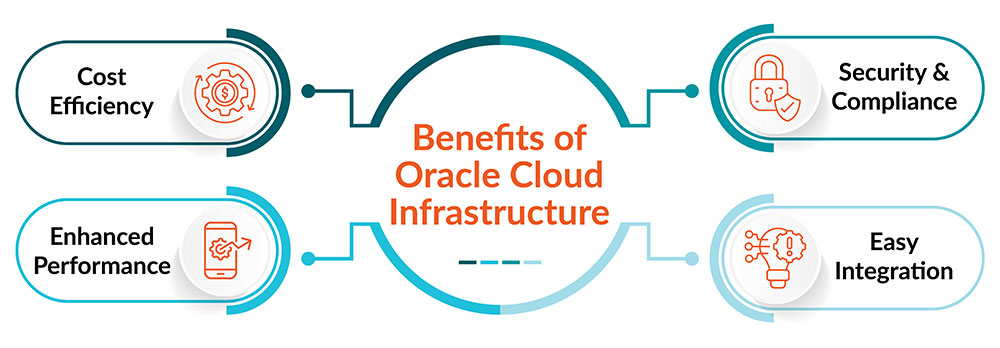
When it comes to on-premise solutions, like Oracle PeopleSoft, the costs associated with maintaining and upgrading them can be significantly higher than the alternative. Comparatively, OCI has a consistently predictable pricing model, which lowers the overall cost of "owning" a solution.
OCI takes the edge regarding performance and scalability as performance and scalability are not restricted to the traditional upgrade method. Therefore, businesses will be able to adjust quickly to the demands of their business.
Keeping up-to-date with ever-changing regulations can be a nuisance. Traditional systems require more attention and care to apply the proper security patches and ensure compliance. Contemporary technologies like OCI are designed to automatically patch and feature the latest encryption solutions to ensure your company data remains secure.
Interestingly, this point leads to OCI regardless of applicable differences. Organizations are able to integrate cutting-edge tools such as Machine Learning, AI-driven analytics, and other tools into OCI for a more robust workflow experience. This “inevitability” results from Oracle’s own push towards modernization.
While our brief examination of the software differences between the two led us to conclude that migrating PeopleSoft to Oracle Cloud Infrastructure is well worth it, we must not forget the hurdles.
For instance, transferring data from one kind of environment to another can be rather complex. Large volumes of sensitive data should be treated with attention and thorough planning to avoid inconsistencies or loss.
In addition to the actual process of migration, businesses that leveraged PeopleSoft for an extended period have already made the solution their own. These tailored functions, or customizations, may need to be reconstructed on OCI if not able to be moved over – leading to unintended downtime.
Speaking of downtime, the changes in workflows and processes that come after migrating could lead to users requiring training and time to adapt to the new UX.
Dealing with or completely mitigating the challenges mentioned above is a very possible thing to achieve. Following the best practices, such as conducting comprehensive assessments, determining and developing the appropriate migration strategy, and consulting an expert for support, will lead to a smooth migration.
Honing in on the last practice, getting in contact with a service provider like Chetu can make the data transfer and integration process seamless. However, we go beyond the foundational migration. We're an Oracle Partner with several years of experience. As a result, we can ensure that performance on OCI is the best it could be, alongside properly configuring it to your specific sector and needs. In addition, we provide ongoing support by way of post-migration optimization and advisement for training.
This brings us back to the main question. Whether or not a business should take PeopleSoft to OCI depends on the initial assessments they make regarding their current processes and costs. What is less "in the air" is the benefits and timing for the change.
2025 represents the ideal time to make that leap towards more contemporary tools due to the latest technologies and innovations being openly integrated into OCI. Plus, with the company's intention of moving towards a hybrid cloud ecosystem more clear, riding the wave of change is a great choice.
Leveraging prolific developers, such as Chetu, and taking advantage of their migration services can help make this change far less stressful and complicated and will ensure that you get the most out of Oracle Cloud Infrastructure.
Produced & Edited by: Juan Requena
Disclaimer:
This content has been made available for information purposes only. Views and opinions expressed in this content are those of the individual author only and do not necessarily represent the opinions and views of Chetu. Chetu, and its representatives, make no representation or warranty of any kind, express or implied, regarding the accuracy, adequacy, validity, reliability, availability, or completeness of any information of this content. Under no circumstances shall Chetu, or its representatives, have any liability to you or any loss or damage of any kind incurred as a result of the use of this content or reliance on any information provided in this content. Your use of this website and your reliance on any information on this content is solely at your own risk.
About Chetu:
Founded in 2000, Chetu empowers businesses with AI and digital transformation solutions, supporting startups, SMBs, and Fortune 5000 companies. We deliver end-to-end software solutions backed by global digital intelligence and industry expertise. Our customized software delivery model and one-stop-shop approach span the full technology spectrum. Headquartered in Sunrise, Florida, Chetu operates 13 locations across the U.S., Europe, and Asia.
See more at: Chetu Blogs


Limited Time Offer for a Free E-Book
Privacy Policy | Legal Policy | Careers | Sitemap | Referral | Contact Us
Copyright © 2000- 2026 Chetu Inc. All Rights Reserved.


 By: Alexander Ewing-Shaw