Thank you!
Your blog has been successfully shared.


Let's Talk !  954 342 5676
  +44 137 243 2466
Rick Heikensen – Director of Operations | January 05, 2026
Despite companies spending heavily in analytics, artificial intelligence, and cloud data migration., the challenge of slow dashboards, growing cloud expenses, and fragmented data silos is actual. Non-negotiable now are the change toward AI-driven decision-making and the requirement of a single, scalable, high-performance data platform.
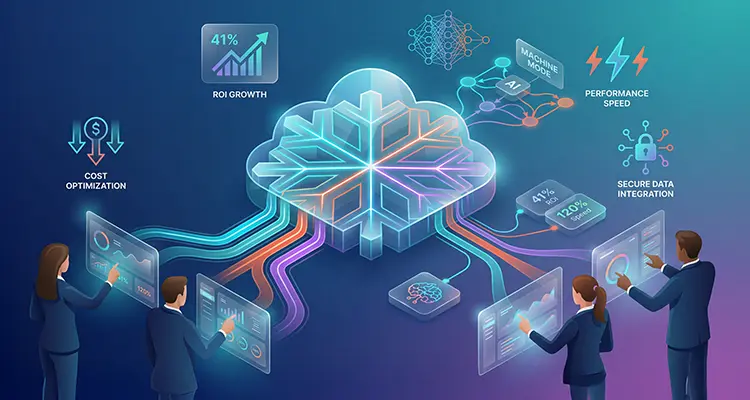
Snowflake presents an artificial intelligence cloud data platform in a unique way. Built with data-driven companies in mind, Snowflake offers native support for Artificial Intelligence and Machine Learning as well as elastic computing and safe data integration. Beyond technical advantages, Snowflake also offers quantifiable business effect; for every dollar spent, companies report an average return of $1.41, equating to a 41% ROI via cost reductions and higher revenue.
Thousands of international clients and fast company acceptance have made Snowflake the foundation for current analytics and data platform renewal. Still, most businesses just utilize a little of Snowflake's features. To maximize return on investment and performance, data leaders, software developers, and data specialists should know seven Snowflake tips.
Running on AWS, Azure, and GCP, Snowflake is a cloud-native data platform. In one scalable environment, it blends the finest of a data lakehouse, data warehouse, and AI Data Cloud. Its unique architecture separates compute and storage, enabling:
This modern architecture offers agility, speed, and reliable multi-cloud operations.
Ensure consistent performance even when multiple users or processes run queries simultaneously with Snowflake’s multi-cluster warehouses. They auto-scale up during peak demand and scale down to minimize billable usage.
Why it matters:
No slowdowns during heavy BI or AI workloads
Ideal for enterprise concurrency
Strong Snowflake cost optimization through auto-scaling
Dashboard refresh times can be improved up to 40% simply by enabling multi-cluster warehouses and setting intelligent min–max cluster policies.
You can query, clone, and restore historical data with Snowflake Time Travel—even after accidental deletion or modification.
Best uses:
Undo table drops or updates
Compliance audits
Debugging AI/ML data pipelines
Validating transformations
Customizable retention periods strengthen governance without requiring additional tooling.
Enterprises can eliminate the need for duplicated datasets with Snowflake’s Data Sharing feature. Teams and external partners can access the same real-time data with zero copying.
Benefits:
Eliminates data silos
Enables faster collaboration
Supports AI/ML model sharing
Reduces ETL overhead
Use shared databases for internal teams and reader accounts for external consumers who don’t use Snowflake.
Snowflake offers powerful ways to cut compute spend without hurting performance.
Key strategies:
Right-size your virtual warehouses
Enable auto-suspend and auto-resume
Scale warehouse sizes based on workload patterns
Use separate warehouses for ETL, AI/ML, and BI
Organizations that adopt these Snowflake best practices often see 20–30% reductions in monthly spending—directly contributing to Snowflake’s strong ROI outcomes.
Snowflake has a set of in-house security features that are aimed at securing the sensitive information while not impeding the data analytics process. With the help of Dynamic Data Masking, PII or any kind of confidential information can be masked based on user roles. Analysts, developers, and data scientists will see only those parts that are necessary.
Role-based access control:
Makes regulatory requirements (GDPR, HIPAA) easier to comply with
Stops the overexposure of data
Helps in the standardization of enterprise data governance
This reduces the risk without having the workflows slowed down.
Snowflake Tasks (scheduled executions) and Streams (change tracking) automate modern ELT pipelines without external orchestrators.
Use cases:
Incremental data loading
Real-time data processing
Daily sales rollups
Automated transformation workflows
Snowflake-native automation brings about fewer errors, better reliability, and essentially enables real-time analytics as compared to traditional cron jobs.
To achieve maximum performance, Snowflake offers various advanced tuning methods.
Key optimization tools:
Clustering keys to improve pruning and reduce scan time
Materialized views for faster repeated queries
Caching strategies for instant results
Data science and BI teams often see 40–60% performance gains after applying proper tuning.
Even experienced Snowflake users fall into a few traps:
Using oversized warehouses “just to be safe”
Not enforcing proper governance standards
Keeping unused tables, raising storage costs
Running mixed workloads on a single warehouse
Ignoring query optimization fundamentals
Avoiding these pitfalls ensures better performance, governance, and cost control.
Snowflake goes beyond a cloud data warehouse; it operates as a unified AI Data Cloud that enables enterprises to transform their data architectures, remove silos, and speed up analytics, AI, and ML workloads. Data leaders have the potential to significantly enhance the performance of their systems, improve security, and make their Snowflake investments yield tangible returns by implementing these seven Snowflake secrets. Whether your main concern is modernization, cloud migration, or AI-driven intelligence, these best practices definitely assist your organization to progress faster and be more assured.
To maximize impact, consider partnering with experienced Snowflake consulting services—experts who can help you automate, optimize, and scale Snowflake for long-term success.
Disclaimer:
This content has been made available for information purposes only. Views and opinions expressed in this content are those of the individual author only and do not necessarily represent the opinions and views of Chetu. Chetu, and its representatives, make no representation or warranty of any kind, express or implied, regarding the accuracy, adequacy, validity, reliability, availability, or completeness of any information of this content. Under no circumstances shall Chetu, or its representatives, have any liability to you or any loss or damage of any kind incurred as a result of the use of this content or reliance on any information provided in this content. Your use of this website and your reliance on any information on this content is solely at your own risk.
About Chetu:
Founded in 2000, Chetu empowers businesses with AI and digital transformation solutions, supporting startups, SMBs, and Fortune 5000 companies. We deliver end-to-end software solutions backed by global digital intelligence and industry expertise. Our customized software delivery model and one-stop-shop approach span the full technology spectrum. Headquartered in Sunrise, Florida, Chetu operates 13 locations across the U.S., Europe, and Asia.
See more at: Chetu Blogs
Share


Limited Time Offer for a Free E-Book
Privacy Policy | Legal Policy | Careers | Sitemap | Referral | Contact Us
Copyright © 2000- 2026 Chetu Inc. All Rights Reserved.