Thank you!
Your blog has been successfully shared.
Let's Talk !  954 342 5676
  +44 137 243 2466
Anshu Raj – Director of Operations | January 12, 2026
Artificial Intelligence (AI) and Machine Learning (ML) solutions have moved beyond experimental technology to become core drivers of business process automation, digital transformation, and operational efficiency. As per Fullview’s 2025 AI Statistics & Trends Report, nearly 78% of enterprises now use AI in at least one business function, highlighting how rapidly AI adoption has become mainstream. Organizations today face mounting pressure to increase productivity, reduce costs, and deliver seamless customer experiences—all while managing vast volumes of structured and unstructured data. According to Infosys’ Enterprise AI Readiness Report, businesses implementing AI-driven automation report productivity improvements of up to 30–40%, demonstrating AI’s tangible operational impact.
AI and ML enable businesses to automate workflows, analyze information at scale, and continuously improve decision-making through learning algorithms. From invoice processing and customer service automation to predictive analytics and intelligent document management systems, these technologies are transforming how enterprises operate across industries.
This blog explores how AI & ML solutions are revolutionizing business processes, the technologies behind intelligent automation, real-world applications, implementation best practices, and the trends shaping the future of AI-powered enterprises.
AI solutions refer to software systems that simulate human intelligence to perform tasks such as reasoning, pattern recognition, speech recognition, and decision-making. Machine learning, a subset of artificial intelligence, focuses on algorithms that learn from data and improve performance over time without explicit programming.
In business environments, AI and ML solutions work together to:
Automate repetitive and complex processes
Extract insights from large datasets
Optimize workflows and resource allocation
Enhance customer experience through personalization
By embedding intelligence into business software, organizations shift from reactive operations to predictive, adaptive, and autonomous processes.
As per enterprise AI infrastructure research published in 2025, organizations with mature AI strategies are nearly 2× more likely to achieve measurable ROI compared to those in early experimentation stages.
While AI defines the overall goal of mimicking human intelligence, ML provides the learning engine that powers intelligent automation.
Together, they function as follows:
AI frameworks establish decision rules and objectives
ML models train on historical and real-time data
Algorithms refine outcomes through supervised learning, unsupervised learning, and reinforcement learning
AI systems orchestrate predictions into automated workflows
This synergy allows business process management systems to adapt dynamically, reducing manual intervention and improving operational efficiency.
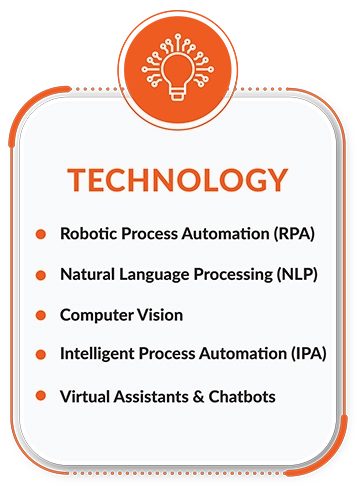
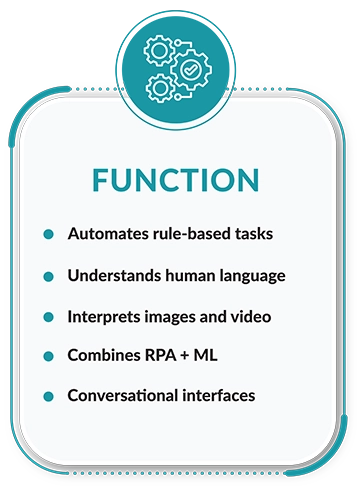
AI-driven automation combines robotic process automation (RPA) with machine learning to handle structured and unstructured data. Unlike traditional automation, intelligent automation improves continuously and manages exceptions intelligently.
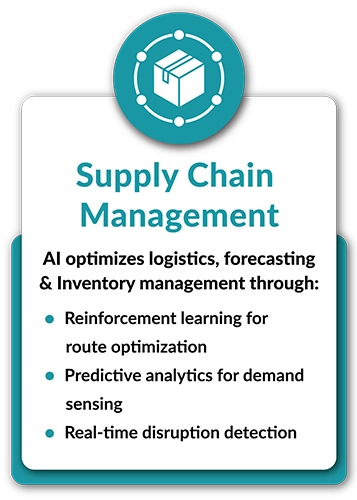
Machine learning models analyze historical data to generate predictions for demand forecasting, inventory planning, risk assessment, and financial performance.
AI tailors interactions, content, and workflows based on customer behavior, improving engagement, satisfaction, and retention.
These capabilities form the foundation of enterprise-wide digital transformation initiatives.
Business process automation (BPA) is the use of technology to execute recurring tasks or workflows where manual effort can be replaced. AI-powered BPA goes beyond static rules by learning from data, optimizing workflows, and supporting complex decision-making.
AI-driven BPA enables:
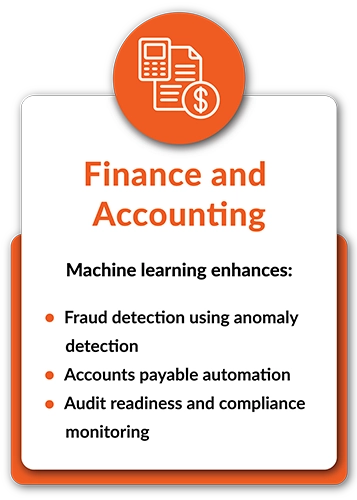
Faster invoice processing and accounts payable automation
Automated purchase order and procurement workflows
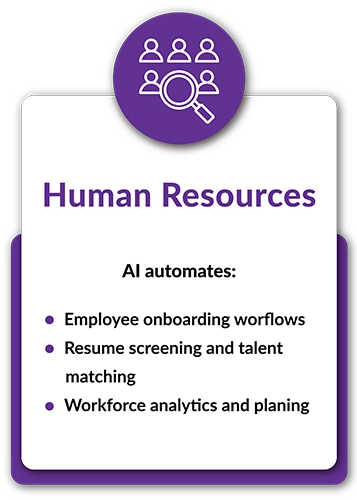
Streamlined onboarding and HR management
End-to-end workflow automation across departments
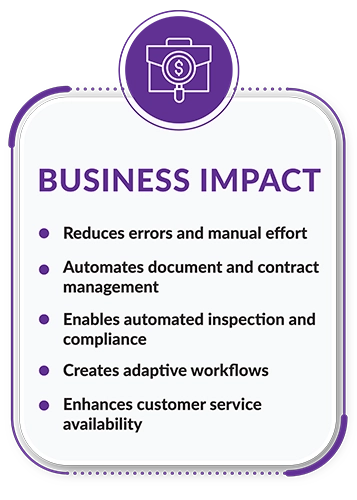
AI & ML solutions help organizations reduce costs and increase productivity by:
Eliminating repetitive data entry
Minimizing human error through intelligent validation
Optimizing resource allocation in real time
Accelerating decision cycles
According to Fullview’s 2025 AI industry analysis,businesses adopting AI-driven automation report improvements in operational efficiency of up to 30%, while freeing employees to focus on strategic and creative tasks.
Intelligent Process Automation (IPA) enhances traditional automation with machine learning, analytics, and decision engines.
Key benefits include:
Automated end-to-end workflows with minimal coding
Adaptive responses to changing business rules
Improved accuracy through continuous learning
Scalability across enterprise systems
IPA is especially impactful in finance, accounting, supply chain management, and IT service management.
RPA handles repetitive, rules-based processes, while AI enables interpretation and decision-making. Together, they power advanced automation scenarios such as:
Invoice processing using OCR and ML validation
Contract management with NLP-driven data extraction
Exception handling based on risk prediction
Intelligent routing in workflow automation systems
This integration transforms RPA bots into self-improving digital workers.
Predictive analytics uses machine learning algorithms to identify patterns, forecast outcomes, and support strategic planning.
Demand forecasting: Optimize inventory and supply chain
Churn prediction: Improve customer retention strategies
Risk management: Enhance regulatory compliance and audits
Linear and logistic regression
Decision trees and random forest
Neural networks and deep learning models
By converting data into actionable insights, predictive analytics improves return on investment and decision accuracy.
AI and ML solutions are redefining customer experience across industries by enabling personalization, automation, and real-time engagement.
AI analyzes customer data, behavior, and preferences to deliver:
Targeted recommendations
Personalized marketing automation campaigns
Dynamic pricing and offers
Chatbots powered by NLP provide:
24/7 customer support
Instant responses and faster resolution
Seamless handoff to human agents when needed
These capabilities improve customer satisfaction while reducing support costs.
Assessment: Identify automation-ready business processes
Data Preparation: Clean, centralize, and structure data
Proof of Concept: Validate models on small use cases
Integration: Embed AI into existing software and APIs
Monitoring: Track model performance and retrain regularly
Governance: Ensure compliance, transparency, and ethics
Responsible AI deployment requires:
Bias mitigation: Auditing models for fairness
Explainable AI: Transparent and interpretable decisions
Data privacy: Secure data management and access control
Ethical AI frameworks build trust, ensure regulatory compliance, and protect organizational reputation.
Organizations should evaluate ROI using:
Process metrics (cycle time, error reduction)
Financial outcomes (cost savings, revenue growth)
Adoption indicators (user engagement, accuracy improvements)
Clear KPIs align AI investments with business goals.
As per a global Bounteous enterprise AI study, over 70% of enterprises report positive ROI from AI initiatives within the first 12–18 months of implementation.
Explainable AI improves transparency, trust, and regulatory compliance, accelerating enterprise adoption.
Agentic AI systems autonomously plan, reason, and execute tasks—ushering in self-managing business processes.
As quantum computing matures, quantum ML may revolutionize optimization, forecasting, and simulation across industries.
AI & ML solutions are no longer optional—they are essential for organizations seeking efficiency, innovation, and competitive advantage. With global AI investment continuing to grow and adoption accelerating, enterprises that embrace intelligent automation today are better positioned for long-term scalability and resilience.
By automating b usiness processes, enabling predictive insights, and enhancing customer experience, AI transforms operations from reactive to intelligent. Enterprises that adopt a structured implementation strategy, prioritize ethical AI, and measure clear ROI will be best positioned to unlock long-term value. As explainable and agentic AI evolve, the future of business lies in intelligent, adaptive, and data-driven processes.
Disclaimer:
This content has been made available for information purposes only. Views and opinions expressed in this content are those of the individual author only and do not necessarily represent the opinions and views of Chetu. Chetu, and its representatives, make no representation or warranty of any kind, express or implied, regarding the accuracy, adequacy, validity, reliability, availability, or completeness of any information of this content. Under no circumstances shall Chetu, or its representatives, have any liability to you or any loss or damage of any kind incurred as a result of the use of this content or reliance on any information provided in this content. Your use of this website and your reliance on any information on this content is solely at your own risk.
About Chetu:
Founded in 2000, Chetu empowers businesses with AI and digital transformation solutions, supporting startups, SMBs, and Fortune 5000 companies. We deliver end-to-end software solutions backed by global digital intelligence and industry expertise. Our customized software delivery model and one-stop-shop approach span the full technology spectrum. Headquartered in Sunrise, Florida, Chetu operates 13 locations across the U.S., Europe, and Asia.
See more at: Chetu Blogs
Share


Limited Time Offer for a Free E-Book
Privacy Policy | Legal Policy | Careers | Sitemap | Referral | Contact Us
Copyright © 2000- 2026 Chetu Inc. All Rights Reserved.