Thank you!
Your blog has been successfully shared.
Let's Talk !  954 342 5676
  +44 137 243 2466
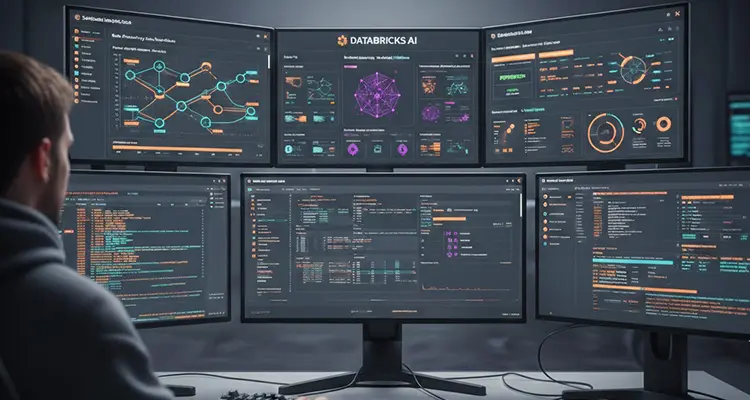
Most organizations find themselves with siloed data, lack of control, and sluggish model implementation as organizations speed up their AI programs. The study by McKinsey showed that approximately 78 percent of businesses worldwide utilize AI in one of their business functions, and the number of businesses acknowledging AI is increasing rapidly across the industries. Databricks AI and Machine Learning pipelines overcome these difficulties by combining data engineering, analytics, and machine learning on one Lakehouse operating on a unified platform. Databricks also allows businesses to build their participants to AI-based production more quickly and safely by integrating the open-source flexibility with scalable infrastructure.
Nevertheless, AI scaling is an issue. According to the state of AI report released by Databricks, companies that implement unified data and ML platforms can deploy models into production three times as much as traditional architectures. DataBricks AI enables companies to process scalable, secure, high-performance machine learning pipelines via means of integrating both Lakehouse architecture and governance and automation. Unity Catalog gives businesses greater access control, traceability, and real-time visibility of data and ML resources. Databricks Machine Learning also enhances the innovation acceleration process through both automatization of model development, and the use of scalable AI workloads. Combined with our own data engineering and artificial intelligence solutions, companies can minimize the costs, enhance the efficiency, and create a clear base of long-term digital transformation.
This blog includes three effective measures that have been demonstrated to improve Databricks AI and ML pipelines as they assist organizations to advance data quality, enhance governance, and reduce time-to-value of machine learning investments.
Strong AI pipeline is initiated with high quality and reliable data that is available. The legacy data architectures are pointed to using disconnected data lakes and warehouses, which forms silos and slows down the analytics and machine learning processes. The Databricks Lakehouse Architecture removes these barriers through consolidating structured, semi-structured and unstructured data under one platform.
According to Gartner, more than 70% of new analytics and data platforms are now cloud-native, reflecting the growing demand for integrated data processing, analytics, and machine learning environments—capabilities delivered by the Lakehouse model.
The Lakehouse enables data engineers, analysts, and data scientists to perform their tasks on the same data without duplication and latency problems because of enabling unified data management. This common core will enhance the consistency of data, minimize the complexity of the ETL process and train machine learning models on relevant and current data.
Organizations using data engineering services rely on the Lakehouse to simplify data ingestion, transformation, and validation while supporting open data formats.This strategy can speed up AI workloads but also reduces the cost of infrastructure and enhances scalability of enterprise workloads.
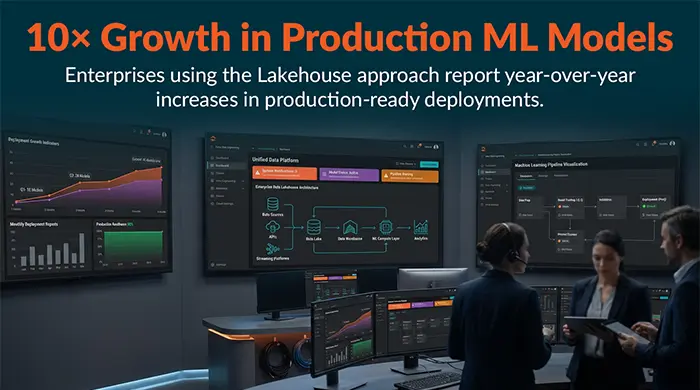
Additionally, as per Databricks customer insights, organizations adopting the Lakehouse approach have seen a significant increase in production-ready ML models, with some enterprises reporting over 10x growth in models deployed year over year. This demonstrates how a unified data foundation accelerates AI maturity while reducing complexity and cost.
As AI adoption grows, governance becomes a critical success factor. Without proper controls, organizations risk data misuse, regulatory violations, and limited visibility into model behavior. Unity Catalog governance provides a centralized solution for managing data access, lineage, and permissions across Databricks environments.
When using Unity Catalog, the enterprises will be able to provide AI security compliance by role-based access control, audit logging, and fine-grained permissions, as sensitive data and models are secured at all pipeline stages. Lineage tracking is part of the built-in ML pipeline transparency by enabling the team to trace the data flow through the model output to the source.
Beyond security, strong governance improves operational efficiency by reducing manual oversight and simplifying compliance reporting. As regulations evolve, Unity Catalog enables organizations to adapt quickly while maintaining trust and accountability in AI-driven decision-making.
As per industry compliance studies, organizations with automated governance frameworks reduce compliance-related risks and reporting effort by 30–40%, while improving trust and transparency across AI pipelines.
Once data and governance are in place, the next step in an effective data science practice centers on model development and deployment acceleration. This can be achieved with Databricks Machine Learning, an end-to-end platform that enables model building and training.
Tools like Databricks MLflow make it easier to track experiments, version models, and manage their lifecycles, allowing for even greater collaboration between data science and data engineering teams. Integrated or in-built AI automation tools like AutoML can automate model generation based on business needs, thus saving effort.
Built on top of Apache Spark, Databricks supports large-scale ML workloads and thus enables businesses to effectively analyze large amounts of data and facilitate optimal machine learning practices.
According to Databricks, teams using MLflow and AutoML can reduce experimentation and model iteration time by up to 50%, enabling faster collaboration between data science and engineering teams.
As an official Databricks development partner, we assist companies with the design, implementation, and optimization of AI and ML pipelines based on their business objectives.
Our professionals focus on the entire machine learning implementation process, including data engineering, model development, as well as governance and deployment.
We craft custom AI solutions that support enterprise strategy, ensure compliance, and work smoothly across today’s technology platforms. Through our expertise in Databricks and profound understanding of domain knowledge, we support organizations to increase the fastness of AI adoption, lessen the complexity of operations, and increase returns on investments.
We give you the strategic advice and technical know-how to succeed, whether you are modernizing the legacy analytics or developing new advanced AI applications.
Disclaimer:
This content has been made available for information purposes only. Views and opinions expressed in this content are those of the individual author only and do not necessarily represent the opinions and views of Chetu. Chetu, and its representatives, make no representation or warranty of any kind, express or implied, regarding the accuracy, adequacy, validity, reliability, availability, or completeness of any information of this content. Under no circumstances shall Chetu, or its representatives, have any liability to you or any loss or damage of any kind incurred as a result of the use of this content or reliance on any information provided in this content. Your use of this website and your reliance on any information on this content is solely at your own risk.
About Chetu:
Founded in 2000, Chetu empowers businesses with AI and digital transformation solutions, supporting startups, SMBs, and Fortune 5000 companies. We deliver end-to-end software solutions backed by global digital intelligence and industry expertise. Our customized software delivery model and one-stop-shop approach span the full technology spectrum. Headquartered in Sunrise, Florida, Chetu operates 13 locations across the U.S., Europe, and Asia.
See more at: Chetu Blogs
Share


Limited Time Offer for a Free E-Book
Privacy Policy | Legal Policy | Careers | Sitemap | Referral | Contact Us
Copyright © 2000- 2026 Chetu Inc. All Rights Reserved.