Let's Talk !  954 342 5676
  +44 137 243 2466
Let's Talk ! 954 342 5676 +44 137 243 2466
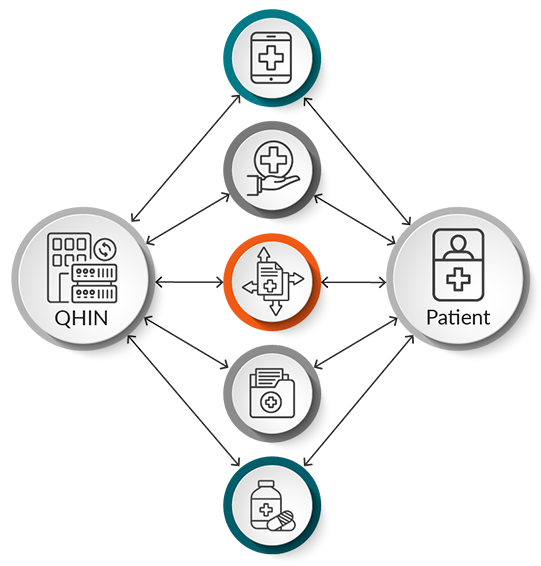
Within healthcare, a prevalent issue faced by United States citizens and workers is fragmented care and systems. Technologies such as Electronic Health Records (EHRs) attempt to unify the data provided by patients to allow professionals to have a seamless experience when studying it and determining care. However, Qualified Health Information Networks, or QHINs, are taking that endeavor a step further.
QHINs certified under the Trusted Exchange Framework and Common Agreement (TEFCA), a set of regulatory necessities that must be followed to ensure the safety and privacy of patients, are redefining what we once considered acceptable data exchange. Consequently, QHINs aim to confront the challenges associated with interoperability head-on by providing a unified ecosystem that drives efficiency and ensures compliance with EHR interoperability solutions.
Now, what is a Qualified Health Information Network (QHIN)? At its core, a QHIN is an organization that's TEFCA-compliant to facilitate secure data exchange between diverse systems. These institutions embrace standards like Fast Healthcare Interoperability Resources, or FHIR, to eradicate the barriers to conventional data sharing. As a result, an interconnected system can be created to make real-time patient data exchange the norm, care coordination is propelled to new heights, and operational efficiency is maximized.
The transformative benefits of QHINs are built to tackle key hurdles within the healthcare sector. Fragmented data systems, issues, and concerns with scalability, security, compliance, and complex interoperability requirements all encapsulate the industry's foundational, structural, and semantic problems. However, QHINs aim to solve these issues in the following ways:
The cornerstone of approaches is tailored. Specific software solutions can align with the QHIN Technical Framework and deliver the standard interoperability healthcare companies expect—eliminated fragmentation.
By utilizing FHIR, developers can simplify data exchange and enable compatibility across various systems, regardless of vendor or platform.
Contemporary, cloud-based infrastructures have the needed flexibility to successfully engage with increasing data demands without compromising performance.
Adhering to TEFCA guidelines can establish security measures and safeguards to protect personal, sensitive patient data and ensure its robustness and completeness.
The foundation of QHINs is their capacity to revolutionize how healthcare providers deliver care through excellent real-time patient data exchange. Organizations can leverage eHealth Exchange QHIN to have real-time access to patient data and seamlessly share it to lead to better-informed decisions. In addition, since the information is timely, providers are able to improve their preventative care plans.
Scalability is another crucial point within healthcare; however, QHIN-based applications provide impressive solutions to address it. As patients and their individualized data grow, it can be difficult to keep everything organized. Therefore, capabilities like telehealth integration, data analytics, and reporting expand access to patient data and improve operational decision-making and patient outcomes.
Taking full advantage of QHIN-based apps that leverage healthcare technology, maintain regulatory compliance, and provide a secure system architecture requires a certain level of expertise. Luckily, partnering with a seasoned software development company ensures that your solutions are designed specifically to address your needs while meeting the QHIN Technical Framework. In addition, some companies even offer end-to-end and post-launch support, meaning you won't have to stress about any production phase.
The healthcare sector is always in a state of flux as it pertains to technological innovation and implementations. QHINs are a cornerstone of this, aiming to achieve true interoperability. As a result of solutions rooted in FHIR interoperability, distinct challenges such as data fragmentation can be tackled and eliminated with TEFCA standardization. In addition, as a future-ready, scalable, and secure solution, providers don't have to fear its relevancy fading or becoming obsolete – leading them to the drawing board again.
Ready to transform your patient’s health outcomes and reduce operational speedbumps? Hire a qualified QHINs developer today!
Disclaimer:
This content has been made available for information purposes only. Views and opinions expressed in this content are those of the individual author only and do not necessarily represent the opinions and views of Chetu. Chetu, and its representatives, make no representation or warranty of any kind, express or implied, regarding the accuracy, adequacy, validity, reliability, availability, or completeness of any information of this content. Under no circumstances shall Chetu, or its representatives, have any liability to you or any loss or damage of any kind incurred as a result of the use of this content or reliance on any information provided in this content. Your use of this website and your reliance on any information on this content is solely at your own risk.
About Chetu:
Founded in 2000, Chetu empowers businesses with AI and digital transformation solutions, supporting startups, SMBs, and Fortune 5000 companies. We deliver end-to-end software solutions backed by global digital intelligence and industry expertise. Our customized software delivery model and one-stop-shop approach span the full technology spectrum. Headquartered in Sunrise, Florida, Chetu operates 13 locations across the U.S., Europe, and Asia.
See more at: Chetu Blogs


Limited Time Offer for a Free E-Book
Privacy Policy | Legal Policy | Careers | Sitemap | Referral | Contact Us
Copyright © 2000- 2026 Chetu Inc. All Rights Reserved.


 By: John Bailey