Let's Talk !  954 342 5676
  +44 137 243 2466
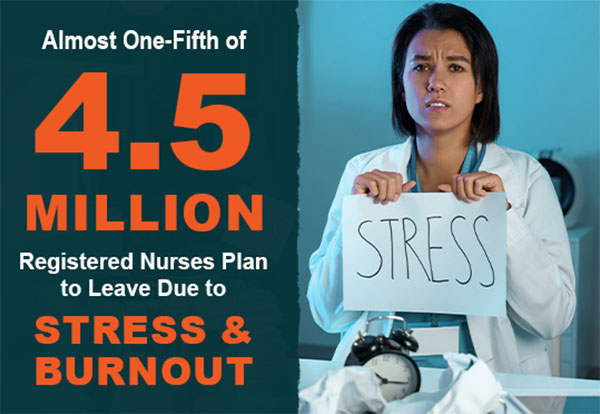
While it’s been a few years since the initial outbreak of COVID-19, we are still reeling from its effects. Our oversaturated patient base is drowning our current health professionals, especially nurses, arguably the backbone of healthcare. The National Council of State Boards of Nursing conducted a study and found that 100,000 nurses left the workforce during the pandemic, and by 2027, almost one-fifth of 4.5 million registered nurses intend to leave the workforce due to stress and burnout. Studies have shown a direct correlation between nurse burnout and increased medication errors, patient falls, and hospital-acquired infections.
Nurses feel burnt out, and in an era with a lack of health professionals, something must be done to remedy the physical and mental toll on our health professionals. Telehealth vendors have stepped up with a promising solution: Virtual nursing. In fact, 74% of hospital leaders believe virtual nursing will become integral to care delivery models in acute inpatient care. Virtual nursing integration is changing healthcare by connecting nurses with patients remotely through telehealth platforms, enhancing accessibility, improving patient care, and streamlining workflow for telehealth and EHR vendors.
Integrating virtual nursing platforms with existing EHR systems can be complex, requiring careful data mapping and API connections. It can also be difficult to integrate with legacy platforms. However, a specialized developer can successfully incorporate AI-enhanced virtual nursing tools into legacy EHR systems for optimized performance.
Aside from integration, data privacy and security are crucial, especially in databases containing sensitive patient information. Protecting patient data requires investing in fortified security measures, including encryption, access controls, and regular audits.
Finally, resource constraints can limit the ability to focus on innovation while successfully managing core products, making it essential to leverage virtual nursing to reduce clinical burdens.
While virtual nursing addresses many of the pitfalls of traditional nursing, there are potential burdens to be aware of to prevent failures. Studies show that up to 50% of healthcare IT projects fail due to poor execution, inadequate expertise, or integration challenges. Additionally, virtual care solutions with insufficient planning often overrun budgets by 20%-30%, causing financial strain on organizations. To ensure that the development of your virtual nursing solution is successful and within budget, partner with a software solutions provider with the appropriate experience to address all your tech needs.
The developers must be able to develop APIs that connect new virtual care features like remote patient monitoring and automated health alerts with existing platforms. There should be interoperable integration with EMRs, EHRs, and third-party applications.
Your software service provider should incorporate tools like:
Customized remote patient monitoring dashboards
Ambient intelligence for symptom tracking
AI chatbots for routine inquiries
Your software service developers should have the expertise to design platforms that adapt to fluctuating patient loads while ensuring compliance with healthcare regulations. They should also ensure scalable virtual nursing solutions that are HIPAA-compliant.
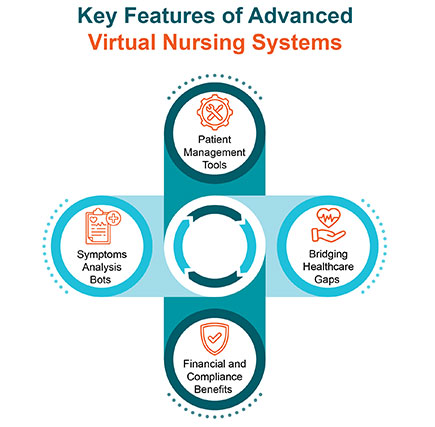
Symptom assessment chatbots are virtual assistants that Artificial Intelligence powers. They aid health professionals and patients in diagnosing their medical conditions by answering questions and offering recommendations based on a patient’s feedback. Chatbots can connect the patient with a healthcare professional if more complex assistance is needed. This helps reduce burnout for healthcare providers as much of the preliminary work is conducted before they meet with a patient. It could even prevent a visit to the doctor’s if the chatbot can offer sufficient information and suggestions.
Since chatbots can handle the differing queries of multiple patients, they offload the mental toll on health professionals and reduce the costs associated with hiring and training human resources. Researchers predict that within the next five years, between 75% and 90% of queries will be handled by chatbots, resulting in cost savings of up to $0.70 per interaction. Healthcare companies can enjoy cost savings, and patients can enjoy shorter waiting times.
Another feature of virtual nursing systems is the patient management tools. These AI-driven resource allocation tools effectively manage nursing staff, reduce administrative burdens, and improve patient outcomes by ensuring that healthcare professionals are assigned to the most needed cases.
One of the most significant advantages of AI-powered patient management tools is automated scheduling. These systems analyze hospital workflows and staffing availability to create efficient work schedules for nurses and other medical professionals.
Often, the reason a person doesn’t go to the doctor isn’t because of costs or fears but rather an inability to access the office. Virtual nursing can help overcome geographical barriers by providing healthcare services to patients in remote areas. Virtual nursing units can provide specialist care to patients who typically do not have access. Wearable devices and IoT-enabled sensors continuously collect patient data, which AI systems analyze to detect anomalies. If something is abnormal, the system can alert the healthcare providers, enabling timely intervention without requiring an in-person visit.
Virtual nurse workflows have significant benefits for healthcare professionals. Not only do they prevent burnout, which helps address the shortage of nurses, but they also reduce costs and maintain compliance, avoiding costly fines.
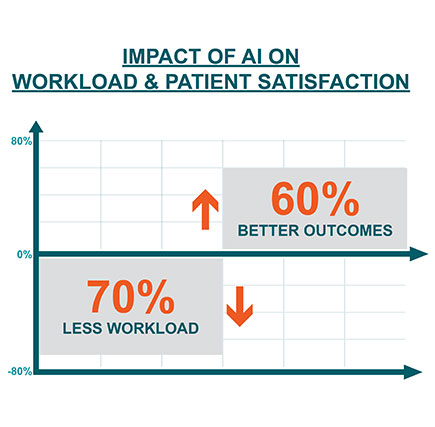
Virtual nurses streamline discharge processes, reducing LOS and associated costs, improving bed turnover rates, and enhancing patient satisfaction. It reduces workload burden by 70% and enhances patient satisfaction and outcomes by 60%.
Virtual nursing will evolve into a standard practice for patient monitoring and chronic care management. Investment in connected health and telenursing programs will continue to grow. Virtual care providers must collaborate with specialized software partners to overcome challenges and accelerate innovation.
Virtual nursing has the potential to advance healthcare into the future. By addressing expertise gaps through strategic partnerships, providers can deliver scalable, compliant, innovative solutions to meet growing demands.
Disclaimer:
This content has been made available for information purposes only. Views and opinions expressed in this content are those of the individual author only and do not necessarily represent the opinions and views of Chetu. Chetu, and its representatives, make no representation or warranty of any kind, express or implied, regarding the accuracy, adequacy, validity, reliability, availability, or completeness of any information of this content. Under no circumstances shall Chetu, or its representatives, have any liability to you or any loss or damage of any kind incurred as a result of the use of this content or reliance on any information provided in this content. Your use of this website and your reliance on any information on this content is solely at your own risk.
About Chetu:
Founded in 2000, Chetu empowers businesses with AI and digital transformation solutions, supporting startups, SMBs, and Fortune 5000 companies. We deliver end-to-end software solutions backed by global digital intelligence and industry expertise. Our customized software delivery model and one-stop-shop approach span the full technology spectrum. Headquartered in Sunrise, Florida, Chetu operates 13 locations across the U.S., Europe, and Asia.
See more at: Chetu Blogs


Limited Time Offer for a Free E-Book
Privacy Policy | Legal Policy | Careers | Sitemap | Referral | Contact Us
Copyright © 2000- 2026 Chetu Inc. All Rights Reserved.


 By: John Bailey