 By: John Bailey
We build from the ground up around your workflows.
Fast deployment with minimal setup.
Hybrid rollout with a rapid MVP delivery


Let's Talk !  954 342 5676
  +44 137 243 2466
The day-to-day operations of various industries can be improved with a myriad of technologically complex solutions. The healthcare industry in particular could use tech-based upgrades to manage daily operations. Enter Practice Management Software (PMS), a solution designed to do exactly that. Still, as nursing faculty has an approximately 49% burnout rate in the last year—according to a study conducted by the Journal of the American Medical Association — it could use further improvement. With a crisis of labor shortages and overworking found within the industry, how could we come to an immediate solution that can also be sustainable for the long haul?
Artificial intelligence as a transformative technology can be harnessed by a skilled software developer to do many simple and complex tasks. This is to say that an AI-powered PMS can be the right solution to aid in administrative tasks like scheduling, billing, document managing, handling patient information, and more.
With an intention to free up our fundamental workers like nurses and doctors to better care for their patients in a time-efficient and comprehensive way, only one question remains. How does it all work?
AI-powered practice management software aims to improve the areas within healthcare administration that are causing the most difficulty for patients to receive the proper care. Areas like appointment scheduling, patient data management and accessibility, and other administrative hurdles alongside patient engagement and accurate decision-making can all be optimized with this implementation. Here's how:
Appointment Scheduling
An area of significant challenge, appointment scheduling takes an average of 26 days for new patients, according to a Washington State Hospital Association survey. It's safe to say that it takes a long time for people to receive care. With AI-powered PMS, appointment scheduling can be optimized by analyzing various historical data points like patient preferences, appointment duration, and the healthcare provider's availability. The use of this technology would cut down on wait time and reduce patient scheduling conflicts.
Patient Data Management and Accessibility
With such a large amount of information that needs to be handled by healthcare organizations, using an AI-powered PMS alongside Natural Language Processing (NLP) techniques can provide an easier method to store and retrieve said info. This utility can allow providers to dedicate more time to crucial tasks quicker and make more informed decisions.
Administrative Tasks
Documentation, billing, and insurance claims are all part of the administrative tasks handled by healthcare practitioners. These tasks also represent a considerable amount of time that's being taken away from patient care. With AI-powered PMS, though, administrative burden can be reduced by automating and streamlining certain processes. Some of these processes include billing and coding, electronic health record (EHR) creation, and auto-populating forms.
Decision-Making Assistance
There is an abundance of ever-changing data within the healthcare industry. So much so that it's become difficult for healthcare providers to stay up to date. With AI-powered PMS, the relevant research, medical history, and corresponding data could be leveraged by providing evidence-based recommendations and suggestions in real-time, leading to better treatment for their patients.
Patient Engagement
Considering the difficulties with scheduling and the now presented issue of patient understanding, people have problems with following up on their care. In turn, this lowers patient outcomes and could lead to worsening states of living. However, with an AI-powered PMS, reminders can be automated, and educational resources can be provided to aid in their understanding. Ultimately, this software solution can facilitate and improve the continuity of care.
The implementation of this complex software solution yields a positive impact. Whether we look at the patient or the provider, the efficiency of routine tasks will improve, coordination and ethics can be enhanced and maintained, care can be further personalized and precise, and more. While the solution is certainly involved due to its moving pieces, including machine learning (ML), artificial intelligence (AI), cloud computing, and big data analytics, a well-versed developer can collaborate with a healthcare provider to make the creation as straightforward as possible. The following is a breakdown of these technologies and their role.
Artificial Intelligence (AI)
The backbone of this kind of software, and, more specifically, the subset of Machine Learning, enables the software to automate its intelligent processes. Processes like data analysis, decision support, and pattern recognition using existing data from medical imaging and medical records.
Natural Language Processing (NLP)
The foundation of the previous technology, Natural Language Processing, is what allows an AI to comprehend and process human language. With this, the software can draw applicable information from its sources to better understand the context and importance of the information needed.
Big Data Analytics
With such an abundance of data, Big Data Analytics leverages the volume of information as it stores and processes various points of a patient's record. Clinical data, medical images, and other healthcare information are used to develop accurate insights, identify patterns, and even aid in decision-making.
As involved as an AI-powered PMS can be, a cloud computing infrastructure allows scalability, security, and the proper level of power to handle the processes a health organization would need. Additionally, since cloud computing is an internet-based infrastructure, it's a cheaper alternative than the on-site alternative.
Application Programming Interfaces (APIs)
Established systems such as electronic health records (EHRs) and laboratory information systems (LISs) are not to be discarded in the incorporation of an AI-powered PMS. Instead, these systems serve as the platforms where the already existing data is stored and can be used for an effortless exchange of data. The interoperability that can be achieved through the use of an API makes for a more comprehensive and organized look at patient data.
The healthcare industry is a rightfully cautious adopter of technologies. They require rigorous testing and irrefutable evidence for widespread adoption, but considering the potential benefits, the healthcare industry is quickly realizing the inherent advantages of using AI in healthcare.
This is great news considering that, right now, more than ever, the healthcare industry is in dire need of solutions to their previously mentioned issues. Luckily, with skilled software developers and an open approach to development, many healthcare institutions will be able to provide better patient care and improve their working conditions along the way. The incorporation of an artificial intelligence-powered practice management system, alongside all of its defining technologies, seems to be a solution that's arrived at just the right time.
Understaffing in healthcare has made daily administrative tasks a burden. With an AI-Powered PMS though, developers can help lighten the load.
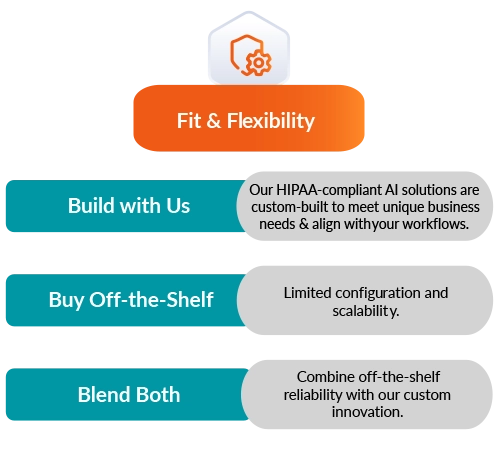
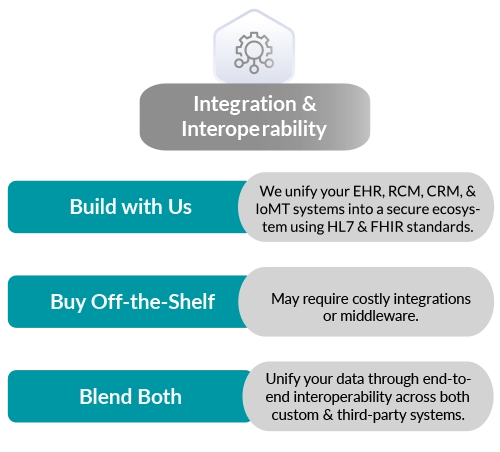
Speed, control, and scalability aren’t one-size-fits-all. Whether you're launching a new healthcare solution or upgrading legacy systems, this quick-hit comparison helps you weigh the trade-offs—custom builds, off-the-shelf ease, or a hybrid that delivers fast and flexibly.
Build with Us
Buy Off-the-Shelf
Blend Both
Speed to Value
We build from the ground up around your workflows.
Fast deployment with minimal setup.
Hybrid rollout with a rapid MVP delivery
Fit & Flexibility
Our HIPAA-compliant Al solutions are custom-built to meet unique business needs & align with your workflows.
Limited configuration and scalability.
Combine off-the-shelf reliability with our custom innovation.
Integration & Interoperability
We unify your EHR, RCM, CRM, & JoMT systems into a secure ecosys-tem using HL7 & FHIR standards.
May require costly integra-tions or middleware.
Unify your data through end-to-end interoperability across both custom & third party systems.
Ownership & Scalability
You own the code, the IP, and the roadmap - built for long-term growth.
Vendor-controlled roadmap and licensing.
Shared scalability with flexible expansion options.


Disclaimer:
This content has been made available for information purposes only. Views and opinions expressed in this content are those of the individual author only and do not necessarily represent the opinions and views of Chetu. Chetu, and its representatives, make no representation or warranty of any kind, express or implied, regarding the accuracy, adequacy, validity, reliability, availability, or completeness of any information of this content. Under no circumstances shall Chetu, or its representatives, have any liability to you or any loss or damage of any kind incurred as a result of the use of this content or reliance on any information provided in this content. Your use of this website and your reliance on any information on this content is solely at your own risk.
About Chetu:
Founded in 2000, Chetu empowers businesses with AI and digital transformation solutions, supporting startups, SMBs, and Fortune 5000 companies. We deliver end-to-end software solutions backed by global digital intelligence and industry expertise. Our customized software delivery model and one-stop-shop approach span the full technology spectrum. Headquartered in Sunrise, Florida, Chetu operates 13 locations across the U.S., Europe, and Asia.
See more at: Chetu Blogs


Limited Time Offer for a Free E-Book
Privacy Policy | Legal Policy | Careers | Sitemap | Referral | Contact Us
Copyright © 2000- 2026 Chetu Inc. All Rights Reserved.