Thank you!
Your blog has been successfully shared.
Let's Talk ! 954 342 5676
  +44 137 243 2466
Randall Iha. Director of Sales | November 12, 2025
For years, Agile pods were the poster child of fast, iterative software delivery. Small, cross-functional groups running sprints, pushing code, pivoting quickly — it worked. Until it didn’t.
Today, the same model that once symbolized innovation is starting to show cracks. Projects stall during handoffs. Context gets lost between rotations. Burnout skyrockets. And even with all that “agility,” scaling still feels out of reach.
So what’s next?
According to McKinsey, only 16% of companies say they’ve succeeded in scaling Agile across the enterprise — a sobering sign that it’s time to evolve.
Enter the Dedicated Development Team: a next-generation model that keeps Agile’s best principles (collaboration, iteration, transparency) while solving its biggest flaws — continuity, accountability, and scalability.
Unlike Agile pods that assemble only developers, dedicated teams are complete, end-to-end capability units. They bring not just engineers, but also project managers, QA, DevOps, architects, trainers, and strategists — everyone needed to carry a product from concept to launch and beyond.
And because they’re modular, businesses can start with a team of two and scale up to twelve or more experts as projects grow.
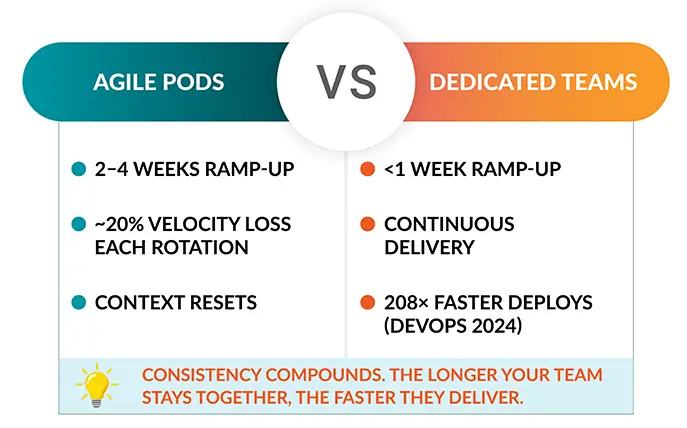
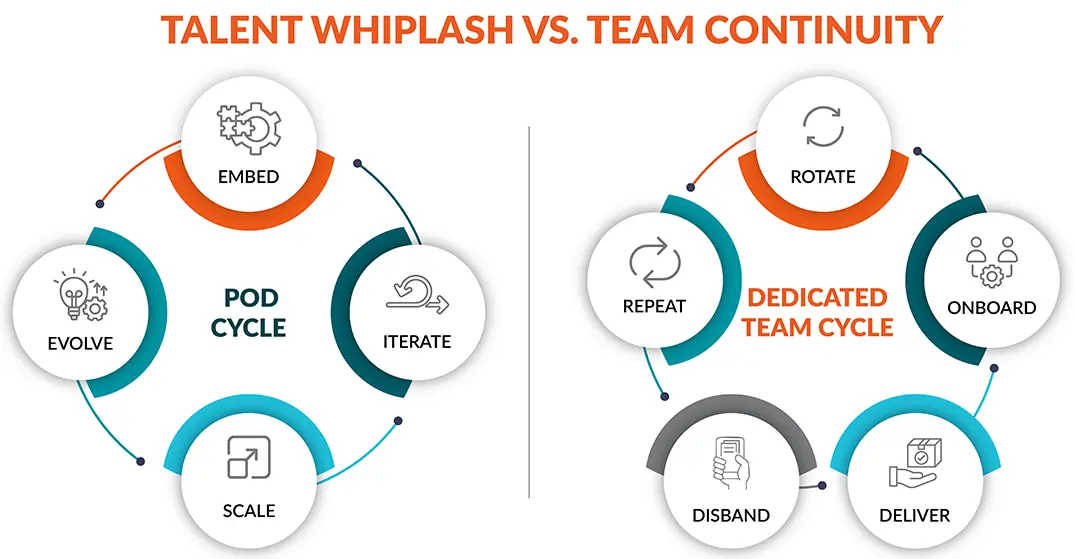
Agile pods often disband and reform constantly. Every handoff requires onboarding, environment setup, and workflow syncing — each step adding friction.
Dedicated development teams eliminate that churn. The same experts stay embedded in your environment from kickoff through completion, gaining deep product context that compounds in value.
According to the 2024 Accelerate State of DevOps Report, elite software teams deploy 208× more frequently and achieve 106× faster lead times than low performers. The common denominator? Stable, long-lived teams that own their work.
Agile pods often suffer from the “who owns this?” dilemma. Each rotation introduces new people, new processes, and new interpretations of success. Accountability gets diffused.
Dedicated development teams flip that script. They function as extensions of your internal culture, aligned to your KPIs, governance model, and delivery cadence. You get transparency, not turnover.
According to Harvard Business Review, lack of clear ownership is the number-one cause of Agile failure in large enterprises.
Dedicated teams maintain a continuous line of responsibility — ensuring bugs, backlogs, and breakthroughs all have a name attached.
That consistency means better product memory, stronger collaboration, and a genuine sense of pride in the outcome.
Agile pods are flexible — until they’re too flexible. As projects shift, so does staffing. That constant rebalancing leads to what engineering managers call “talent whiplash.”
Dedicated development teams bring stability and depth.
Your architect doesn’t disappear mid-project. Your QA lead knows the platform history. Your strategist and PM track every dependency.
And as demand grows, scaling doesn’t mean starting over — it means adding to a foundation that already works.
Korn Ferry projects an 85.2 million-person developer shortage by 2030. Companies relying on temporary pods will keep fighting the same hiring wars.
Dedicated teams sidestep that by delivering sustained, full-stack expertise — from front-end to back-office strategy.
Dedicated development teams plug directly into your workflow, helping you accelerate delivery while keeping full visibility and control.
Most “cost-saving” models end up costing more.
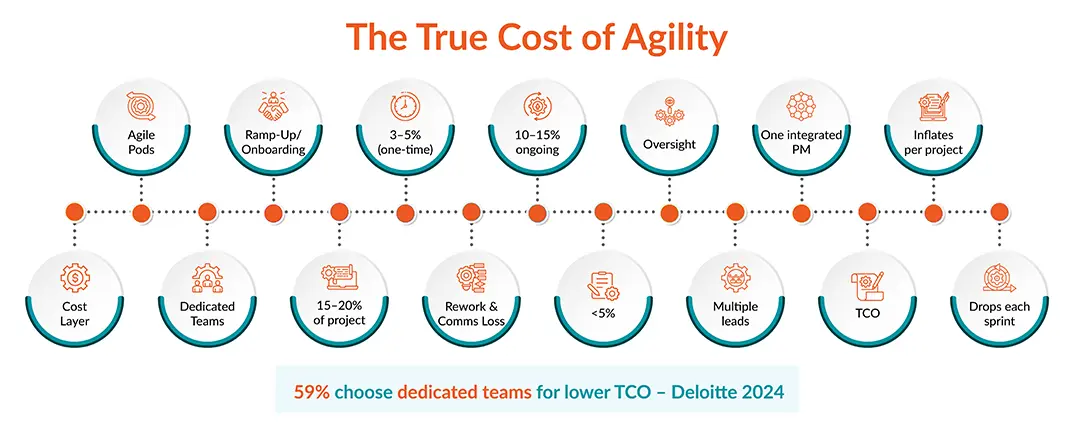
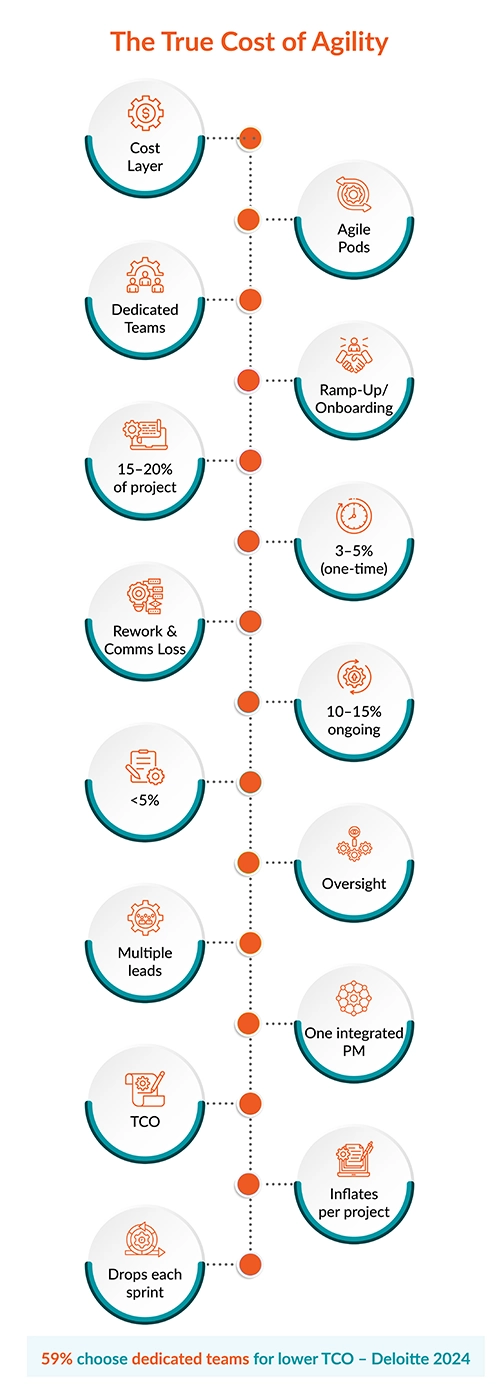
Agile pods often create hidden expenses — repeated onboarding, duplicated management, and rework after each transition.
Dedicated development teams reverse that.
You pay for outcomes, not overhead. You get predictable monthly costs, faster velocity, and fewer rework cycles — because everyone you need to deliver success is already onboard.
Deloitte reports that 59% of enterprises now prefer dedicated or managed teams precisely because they reduce total cost of ownership (TCO) over time.
According to Gartner, 80% of enterprise applications will have embedded AI by 2026. That demands development models capable of continuous innovation — not short-term sprint fragments.
Dedicated development teams are designed for exactly that.
They integrate AI, machine learning, and automation seamlessly into workflows — not as side projects, but as core capabilities.
As organizations move toward more data-driven operations, the ability to embed intelligence into every iteration becomes a key differentiator. Dedicated teams make that possible by aligning AI engineers, developers, and strategists under one agile-but-stable umbrella.
Let’s recap the five data-backed reasons top enterprises are making the switch:
40% faster ramp-up and continuous momentum
End-to-end accountability with shared KPIs
Scalable expertise across every project role — from developers to strategists
Lower TCO through reduced rework and unified delivery
AI-ready architecture built for tomorrow’s enterprise
Agile pods had their moment. But innovation demands evolution.
Dedicated development teams go beyond developers — they bring the whole crew you need to launch, scale, and sustain success.
From two specialists to a full team of twelve or more, you get on-demand power built around your vision.
They don’t replace your internal teams. They amplify them.
They don’t just build software. They build capability, culture, and confidence.
Stop managing projects. Start managing outcomes.
Chetu’s dedicated development teams plug directly into your environment, adapting to your culture, goals, and governance.
No ramp-up. No downtime. Just results.
Disclaimer:
This content has been made available for information purposes only. Views and opinions expressed in this content are those of the individual author only and do not necessarily represent the opinions and views of Chetu. Chetu, and its representatives, make no representation or warranty of any kind, express or implied, regarding the accuracy, adequacy, validity, reliability, availability, or completeness of any information of this content. Under no circumstances shall Chetu, or its representatives, have any liability to you or any loss or damage of any kind incurred as a result of the use of this content or reliance on any information provided in this content. Your use of this website and your reliance on any information on this content is solely at your own risk.
About Chetu:
Founded in 2000, Chetu empowers businesses with AI and digital transformation solutions, supporting startups, SMBs, and Fortune 5000 companies. We deliver end-to-end software solutions backed by global digital intelligence and industry expertise. Our customized software delivery model and one-stop-shop approach span the full technology spectrum. Headquartered in Sunrise, Florida, Chetu operates 13 locations across the U.S., Europe, and Asia.
See more at: Chetu Blogs
Share


Limited Time Offer for a Free E-Book
Privacy Policy | Legal Policy | Careers | Sitemap | Referral | Contact Us
Copyright © 2000- 2026 Chetu Inc. All Rights Reserved.