Thank you!
Your blog has been successfully shared.


Let's Talk !  954 342 5676
  +44 137 243 2466
Atit Shah – Director of Operations | January 13, 2026
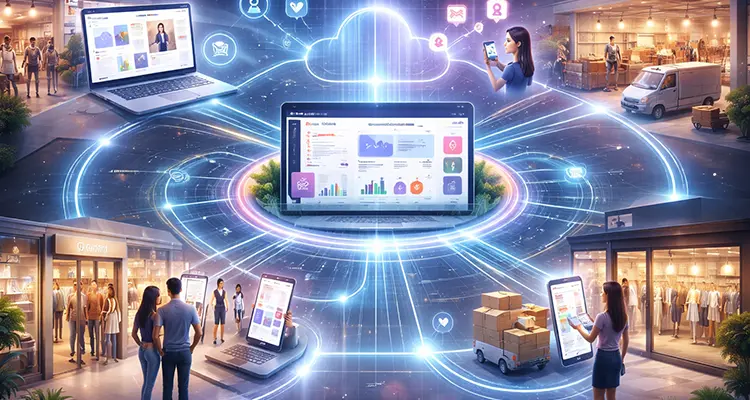
The adoption of smartphones, cloud platforms and continuous connectivity has permanently changed the way consumers shop. Today the consumer anticipates frictionless experiences that combine price reductions, online vouchers, customized bids and one-click shopping experience, anywhere and any time. Recent industry research by McKinsey, Gartner, and Salesforce shows that today, customers interact with the brand through an average of six or more touchpoints before making a purchase, and omni-channel capabilities became the need of the moment instead of a luxury.
Other retailers not uniting these experiences risk disintegrating journeys, inconsistent prices, and loyalty. Omni-channel retail software systems help solve this issue by harmonizing systems, data and customer relationships into one, smart ecosystem.
A multi-channel approach enables retailers to sell in many different channels: physical shops, websites, marketplaces, and mobile applications, but frequently focuses on different channels as isolated entities. This isolated method results in fragmented inventory and inconsistency in promotions and inadequate customer information.
An omni-channel strategy, on the contrary, will combine all the touchpoints into a single experience. When a customer is researching online, making a purchase in a store or returning online through their mobile, the customer experience is the same and customized. According to the latest studies by Harvard Business Review, omni-channel consumers utilize a greater amount of money during their buying experience and have a greater lifetime value than multi-channel shoppers.
To software providers, this development is complicated and at the same time an opportunity. Retailers need a flexible platform that combines POS, eCommerce, loyalty and fulfillment systems and adjusts to the changing consumer behavior. The ability to successfully integrate these components have become a key competitive differentiator.
A centralized data aggregation layer is at the center of any omni-channel platform. This module brings together online, offline, internal and 3rd party data in one source of truth. Retailers will be able to see the full picture of customer behavior, sales performance, and operational efficiency with the help of advanced analytics and AI-driven insights.
Newer services are using cloud data warehousing and live dashboards to facilitate predictive forecasting and demand planning as well as custom-tailored suggestions. According to industry reports by Gartner, the most successful digital transformation brought about by retail transformation is data unification.
An integrated content management system (CMS) will make sure that there is uniform messaging, branding, and promotions in all channels. Retailers are able to implement changes centrally and instantly instead of updating content individually per site, app, kiosk, and the in-store displays.
This is particularly vital when conducting promotions that are time bound, seasonal campaigns, and updates on the rules and regulations. Content management is unified to enhance speed-to-market and minimize operation overhead.
Effective omni-channel retail is characterized by the presence of real-time visibility of inventory. Inventory, order management and POS are now combined on modern platforms to enable buy-online-pickup-in-store (BOPIS), ship-from-store and endless aisle.
More sophisticated solutions will involve RFID, QR codes and scanning barcodes to scan stocks and minimize shrinkage. Retailers with real time inventory systems have fewer stockouts and increased accuracy in fulfilling their orders according to recent research by IBM and the National Retail Federation.
The omni-channel strategy is implemented by customer-facing features. Integrated CRM, loyalty, couponing, and promotion engines help retailers to provide personalized offers depending on the browsing history, buying behavior, and the location.
Mobile push notifications and geo-fencing enable brick-and-mortar stores to interact with local shoppers by promoting them with pertinent and relevant incentives at the right time. Salesforce studies continuously demonstrate that consumers tend to purchase brands that provide personalized experiences through channels more often.
Walmart, Target, Macy and Amazon are the retail giants that continue to demonstrate the standard of omni-channel excellence. The way they invest in integrated business platforms and artificial intelligence to personalize customer experiences and dynamic models of fulfillment testify to the fact that technology can boost customer experience and operational resilience.
These leaders are also increasing consumer expectations, forcing more mid-market and emerging retailers to use the omni-channel platforms to stay competitive. Enterprise-grade omni-channel is now affordable to businesses of all volumes with the availability of scalable, modular software solutions.
Omni-channel retail software has turned into a competitive advantage and has changed into a business imperative. Retailers will be able to provide smooth engagements that will result in customer loyalty, efficiency, and growth by incorporating data, content, inventory, and customer interactions into one platform.
Chetu assists retailers in designing and implementing specialized omni-channel software that is specific to their business model. Having extensive experience in the sphere of retail technologies, cloud services, and system integrations, Chetu helps companies to satisfy the requirements of the modern customer and get ready to withstand the challenges of the future and optimize their retail business.
Disclaimer:
This content has been made available for information purposes only. Views and opinions expressed in this content are those of the individual author only and do not necessarily represent the opinions and views of Chetu. Chetu, and its representatives, make no representation or warranty of any kind, express or implied, regarding the accuracy, adequacy, validity, reliability, availability, or completeness of any information of this content. Under no circumstances shall Chetu, or its representatives, have any liability to you or any loss or damage of any kind incurred as a result of the use of this content or reliance on any information provided in this content. Your use of this website and your reliance on any information on this content is solely at your own risk.
About Chetu:
Founded in 2000, Chetu empowers businesses with AI and digital transformation solutions, supporting startups, SMBs, and Fortune 5000 companies. We deliver end-to-end software solutions backed by global digital intelligence and industry expertise. Our customized software delivery model and one-stop-shop approach span the full technology spectrum. Headquartered in Sunrise, Florida, Chetu operates 13 locations across the U.S., Europe, and Asia.
See more at: Chetu Blogs
Share


Limited Time Offer for a Free E-Book
Privacy Policy | Legal Policy | Careers | Sitemap | Referral | Contact Us
Copyright © 2000- 2026 Chetu Inc. All Rights Reserved.