Thank you!
Your blog has been successfully shared.


Let's Talk !  954 342 5676
  +44 137 243 2466
Chandra Sunke – Director of Operations | March 17, 2026
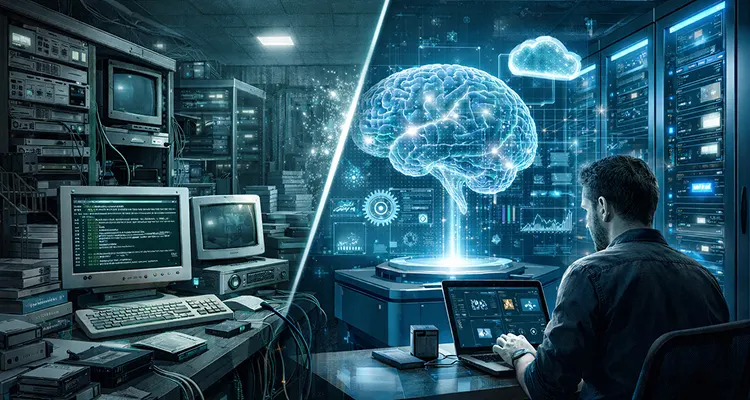
What does AI-first infrastructure really mean for a modern business? It is more than just adding a chatbot to your website; it is a total shift where your entire technical foundation is built to support and learn from data. Many companies rush into AI-driven digital transformation thinking it is a simple upgrade. However, if your foundation is built on aging code and messy data silos, your AI initiatives will likely stall.
Moving toward an enterprise AI transformation requires looking at your technology through an AI maturity model. This helps you understand if you are truly ready to be "AI-first" or if you are still in the experimental phase.
Why do legacy systems slow down AI adoption so much? The biggest issues are usually technical debt and data silos that prevent information from flowing into your AI models. Legacy system limitations often mean your data is trapped in formats that modern machine learning tools cannot read or process.
To move forward, you must focus on technical debt reduction. This doesn't mean you have to throw everything away at once. Instead, it involves legacy application refactoring and building better data pipelines for AI. Without this work, your AI-ready architecture will be built on shaky ground.
How do you start preparing legacy systems for AI without breaking your current operations? A successful legacy system migration begins with a deep AI readiness assessment to see which parts of your tech stack can actually support modern workloads. You need to evaluate the compatibility of your existing databases and how they connect to cloud-native AI architecture.
Modernizing enterprise applications often requires a hybrid cloud AI infrastructure. This setup allows your old systems to live alongside new, scalable AI platforms while you slowly move your data into more flexible environments.
Is it possible to have a "seamless" migration? In our experience, the fastest way to succeed is to stop looking for shortcuts and start an incremental AI migration. Trying to move everything at once is one of the most common mistakes in AI modernization. It creates too much risk for the business and often leads to system crashes.
By following a phased legacy modernization plan, you can tackle the most important parts of your infrastructure first. This approach allows you to build a solid MLOps foundation while your team learns how to manage the new systems.
How do you keep your AI transition secure? You must prioritize AI governance and compliance from day one, especially when you are integrating legacy systems with modern APIs. Protecting sensitive data during a migration is just as important as the technology itself.
However, the biggest hurdle isn't always technical. Successful change management for AI adoption is about helping your team move away from old habits. If your people don't trust the new systems, even the best machine learning infrastructure will fail to deliver value.
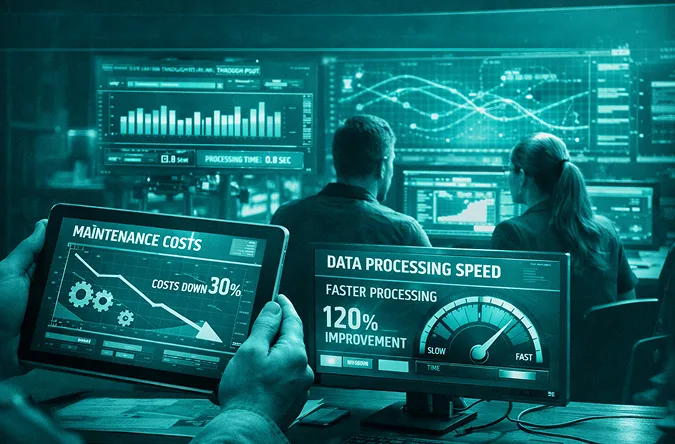
How do you know if your enterprise IT modernization is actually working? You should focus on operational KPIs like reduced maintenance costs and faster data processing times rather than just looking at the accuracy of your AI models. An AI-first strategy planning session should define these metrics early on.
Future-proofing enterprise IT is a continuous process. As your infrastructure becomes more flexible, you will find it easier to plug in new AI tools and automate legacy system integration.
Moving legacy software to an AI-first infrastructure requires discipline and a clear AI transformation roadmap. It is about respecting the realities of your current systems while building the scalable AI platforms of the future. By taking a deliberate, step-by-step approach, you ensure that your AI adoption strategy is sustainable for the long haul.
Ready to modernize your infrastructure? Generic migration plans often ignore the complexity of legacy code. We specialize in the heavy lifting of enterprise AI transformation and legacy system modernization.
Disclaimer:
This content has been made available for information purposes only. Views and opinions expressed in this content are those of the individual author only and do not necessarily represent the opinions and views of Chetu. Chetu, and its representatives, make no representation or warranty of any kind, express or implied, regarding the accuracy, adequacy, validity, reliability, availability, or completeness of any information of this content. Under no circumstances shall Chetu, or its representatives, have any liability to you or any loss or damage of any kind incurred as a result of the use of this content or reliance on any information provided in this content. Your use of this website and your reliance on any information on this content is solely at your own risk.
About Chetu:
Founded in 2000, Chetu empowers businesses with AI and digital transformation solutions, supporting startups, SMBs, and Fortune 5000 companies. We deliver end-to-end software solutions backed by global digital intelligence and industry expertise. Our customized software delivery model and one-stop-shop approach span the full technology spectrum. Headquartered in Sunrise, Florida, Chetu operates 13 locations across the U.S., Europe, and Asia.
See more at: Chetu Blogs
Share


Limited Time Offer for a Free E-Book
Privacy Policy | Legal Policy | Careers | Sitemap | Referral | Contact Us
Copyright © 2000- 2026 Chetu Inc. All Rights Reserved.