Let's Talk !  954 342 5676
  +44 137 243 2466
Let's Talk ! 954 342 5676 +44 137 243 2466
All organizations should strive to have the latest technology that will help optimize operational efficiency. Financial institutions have lengthy processes that prolong applicant status, but with advanced automation, that may no longer be the case. Hyperautomation has changed this reality with its advanced functionality.
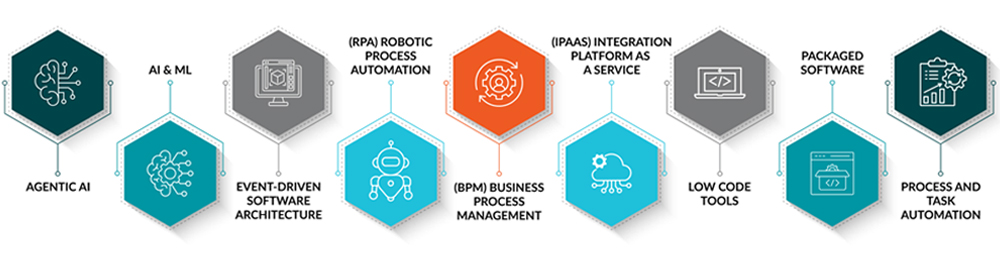
At its inception, hyperautomation employed robotic process automation (RPA), which automated repetitive tasks. However, with the growth of Artificial Intelligence and Machine Learning, hyperautomation can achieve more complex processes.
Hyperautomation differs from traditional automation because it learns, evolves, and transforms processes with the use of AI, Machine learning, and optical character recognition rather than relying on rule-based tasks.
In mortgage lending, hyperautomation accelerates the rate at which banks can process payments, initiate loans, manage risks, and execute credit scoring.
Streamlined business processes and cost reduction
Improved customer experience
Enhanced decision-making
While similar, there are a few key differences between intelligent automation and hyperautomation. They both leverage similar technology like RPA, AI, and Machine Learning, but their end goals are on different complexity level needs. Companies should choose intelligent automation for targeted improvements, whereas hyperautomation is ideal for enterprise-wide transformation.
For example, intelligent automation can pull correct information from unstructured data to process invoices from different vendors with different formats, while hyperautomation automates the whole customer onboarding process.
When approaching a hyperautomation framework, companies should:
Identify and analyze workflows that would be suitable for automation
Select the right combination of automation tools
Establish policies and controls to ensure compliance
Evaluate current workflows for areas of automation. Look for areas with high manual effort, frequent errors, or significant delays.
Define goals. Is it to reduce operational costs? Increase productivity? Enhance customer satisfaction or improve decision-making? Establishing metrics will keep you on track.
Select the right combination of automation tools. Prioritize tools that are easy to use, scalable, and offer interoperability with existing systems.
Choose a software service partner that can guide hyperautomation integration into your work processes.
Traditional mortgage processes are rampant with challenges that stagnate operational efficiency and customer satisfaction. With hyperautomation, the mortgage process is optimized for optimal performance.
Challenges in Mortgage Processes (And How to Address Them)
Manual Errors slow down the workflow, further delaying the process.
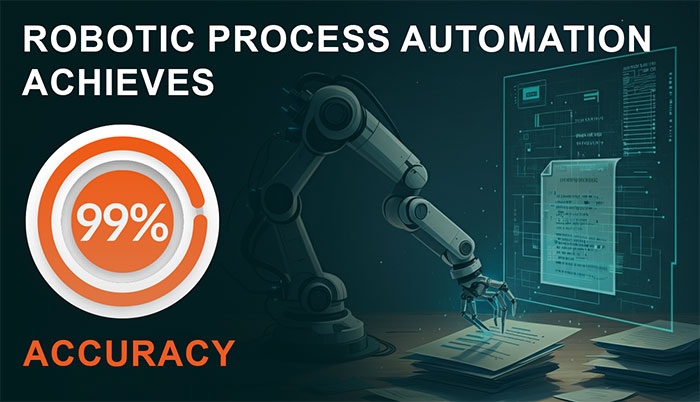
Solution: Hyperautomation enables RPA to automate document gathering and data extraction. The error rate for manual data entry can be as high as 30%, and automated data entry leveraging RPA bot is 99% accurate.
Mortgage operations often rely on disjointed legacy systems that do not communicate effectively, resulting in duplicate data entry and inconsistent records.
Solution: Hyperautomation combines systems to ensure frictionless data transfer and consistent records.
An industry with constant regulation changes makes it difficult to maintain strict compliance measures.
Solution: Automated reporting with rule-based validations will guarantee compliance through hyperautomation.
Lengthy processing times delay application approval, but hyperautomation reduces these durations significantly.
Solution: Hyperautomation enables faster, error-free processing with OCR for document recognition and creates intelligent workflows that reduce human intervention and processing time. A study by Sutherland with a leading mortgage firm found that RPA helps them speed up 20% of processing through automation.
Lack of visibility can make tracking insights difficult.
Solution: Hyperautomation leverages AI to analyze creditworthiness and assess risk, providing mortgage lenders with real-time updates.
Automated Loan Processing and Underwriting: Streamlines application handling, verifies documentation, and evaluates borrower profiles using AI models.
Customer Onboarding: Due to Know Your Customer regulations, customer onboarding can be extensive. Hyperautomation uses pre-trained bots to extract information from documents and utilizes Machine Learning to develop risk profiles. Hyperautomation can automate the whole process from identity verification to account activation.
Compliance and Regulatory Reporting: Hyperautomation automates regulatory reporting processes by collecting, validating, and transforming data from various sources, generating reports, performing real-time monitoring, and ensuring compliance with changing regulations.
AI-Personalized Customer Service: Organizations using hyperautomation solutions gain insights from employee data to understand preferences and create personalized experiences. For example, hyperautomation can route a customer service ticket to an aligned agent for seamless communication.
Hyperautomation has combined the best of automation into one comprehensive system that can optimize your mortgage operations. However, implementing it can be a struggle, especially when it has so many technical components. Finding the right software service provider with the expertise to implement this system into your mortgage operations is pivotal to success.
Disclaimer:
This content has been made available for information purposes only. Views and opinions expressed in this content are those of the individual author only and do not necessarily represent the opinions and views of Chetu. Chetu, and its representatives, make no representation or warranty of any kind, express or implied, regarding the accuracy, adequacy, validity, reliability, availability, or completeness of any information of this content. Under no circumstances shall Chetu, or its representatives, have any liability to you or any loss or damage of any kind incurred as a result of the use of this content or reliance on any information provided in this content. Your use of this website and your reliance on any information on this content is solely at your own risk.
About Chetu:
Founded in 2000, Chetu empowers businesses with AI and digital transformation solutions, supporting startups, SMBs, and Fortune 5000 companies. We deliver end-to-end software solutions backed by global digital intelligence and industry expertise. Our customized software delivery model and one-stop-shop approach span the full technology spectrum. Headquartered in Sunrise, Florida, Chetu operates 13 locations across the U.S., Europe, and Asia.
See more at: Chetu Blogs


Limited Time Offer for a Free E-Book
Privacy Policy | Legal Policy | Careers | Sitemap | Referral | Contact Us
Copyright © 2000- 2026 Chetu Inc. All Rights Reserved.

 By: Jeff Parcheta