Thank you!
Your blog has been successfully shared.


Let's Talk !  954 342 5676
  +44 137 243 2466
Akash Sinha - Director of Operations | February 20, 2026
Historically, road danger solutions have tended to be reactive. An incident occurs. We react. But how about the idea of cars warning each other in advance of a problem occurring?
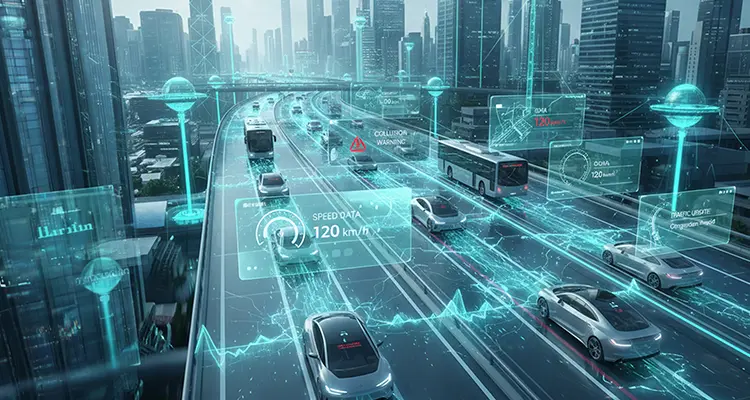
That’s the promise behind Vehicle-to-Vehicle (V2V) technology. And honestly, it’s no longer theoretical. It’s already shaping how future automobiles interact with roads, cities, and people as part of advancing Intelligent Transportation Systems (ITS). Quietly. But consistently.
If you work in transportation, mobility technology, or urban planning, you have seen/you may have been feeling the earth move recently: more data than ever, more systems to interconnect, and dramatically less tolerance for avoidable accidents. In short, V2V is key to making the conversation about safety move from reaction to prevention.
At its core, Vehicle-to-Vehicle communication allows vehicles to talk to each other. Not metaphorically. Literally. Using short-range, wireless signals, V2V technology enables vehicles to broadcast critical operational data such as:
This data is being shared many times per second as well. And at what rate that data is being shared does mean something. Instead of waiting for a threat to act, cars are now becoming situationally aware and proactive. A car braking hard up ahead. A vehicle approaching an intersection too fast. A blind-spot conflict you cannot see yet.
That shift from reaction to anticipation is why V2V has become foundational to modern vehicle communication systems and connected transit planning. It also plays a critical role in advancing Intelligent Transportation Systems (ITS) as transportation networks grow denser, faster and more complex.
A few years ago, V2V was often discussed alongside future autonomous vehicles. Important, but distant. That framing has changed.
Today’s transportation environments include human-driven cars, connected vehicles, micromobility devices, smart traffic signals, and pedestrians carrying smartphones and wearables. Not everyone is autonomous. Not everyone is predictable. So the system has to be smarter.
V2V helps fill that gap by enabling vehicles to share intent and awareness in real time. It reduces reliance on line-of-sight sensors alone. And it provides an additional safety layer when cameras or radar fall short.
This might sound obvious, but it’s worth saying out loud. Accidents happen fast. Often faster than human reaction time. V2V doesn’t replace drivers or infrastructure. It supports them with earlier, better information. And that changes outcomes.
V2V communication also enables crash avoidance technology by alerting drivers—or automated systems—before risks turn into collisions. Not everyone agrees on how quickly adoption will scale. And that’s okay. What’s clear is that the technology already works. And it’s improving how vehicles make split-second decisions in complex environments.
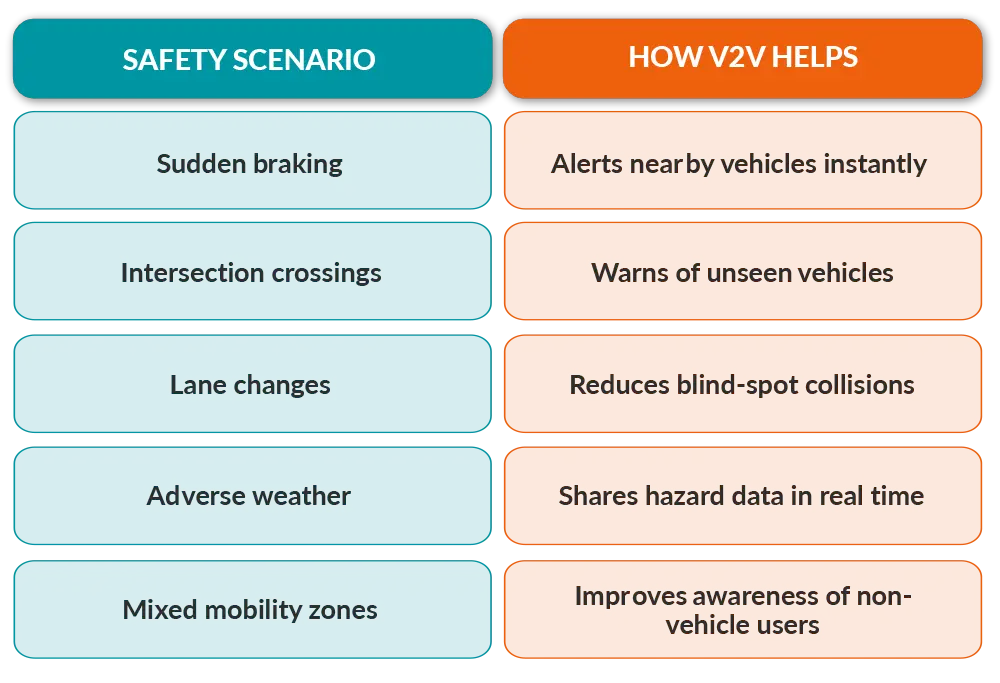
This is where V2V stops being abstract and becomes practical. V2V improves safety by reducing reaction time. And reaction time saves lives. Below is a clear snapshot of how vehicle communication technology supports safer transportation environments.
As cities plan for future automobiles, V2V plays a central role in building safer, more responsive transit environments powered by ITS technologies. Especially where traffic density and mobility diversity continue to rise.
V2V does not operate in isolation. And that’s the point. It integrates into broader ITS platforms that include:
Together, these components form connected transportation ecosystems that adapt in real time. But here’s the challenge. Integration is where many initiatives struggle. Different protocols. Different vendors. Different data formats. Architecture—not hardware—often determines success.
Building effective V2V-enabled systems is less about hardware and more about software coordination.
Successful ITS integration software requires:
Secure communication protocols
Scalable backend systems
Real-time data processing
Cross-platform interoperability
Long-term maintainability
Further in the case of V2V implementations, companies working on V2V initiatives may require custom transit software development which merges this data by aligning vehicles, infrastructure, and enterprise platforms into a single operational frame. This is where experienced teams help bridge the gap between transportation hardware and production-grade software systems, without forcing rigid, one-size-fits-all solutions.
We used to think V2V was still years away from practical impact. We were wrong. Between regulatory interest, urban congestion, and connected mobility growth, adoption is accelerating. Quietly. But steadily.
And if you’re modernizing transportation systems today, delaying V2V planning often leads to expensive retrofits later. Early architectural decisions create flexibility. And confidence.
Vehicle-to-Vehicle communication is no longer experimental. It’s becoming a foundational element of modern transit safety.
With the ongoing wave of technology such as advancing Intelligent Transportation Systems (ITS), V2V enables proactive risk reduction, smarter infrastructure, and more resilient transportation networks.
The organizations planning for interoperability now will be better positioned as connected mobility becomes the norm.
Disclaimer:
This content has been made available for information purposes only. Views and opinions expressed in this content are those of the individual author only and do not necessarily represent the opinions and views of Chetu. Chetu, and its representatives, make no representation or warranty of any kind, express or implied, regarding the accuracy, adequacy, validity, reliability, availability, or completeness of any information of this content. Under no circumstances shall Chetu, or its representatives, have any liability to you or any loss or damage of any kind incurred as a result of the use of this content or reliance on any information provided in this content. Your use of this website and your reliance on any information on this content is solely at your own risk.
About Chetu:
Founded in 2000, Chetu empowers businesses with AI and digital transformation solutions, supporting startups, SMBs, and Fortune 5000 companies. We deliver end-to-end software solutions backed by global digital intelligence and industry expertise. Our customized software delivery model and one-stop-shop approach span the full technology spectrum. Headquartered in Sunrise, Florida, Chetu operates 13 locations across the U.S., Europe, and Asia.
See more at: Chetu Blogs
Share


Limited Time Offer for a Free E-Book
Privacy Policy | Legal Policy | Careers | Sitemap | Referral | Contact Us
Copyright © 2000- 2026 Chetu Inc. All Rights Reserved.